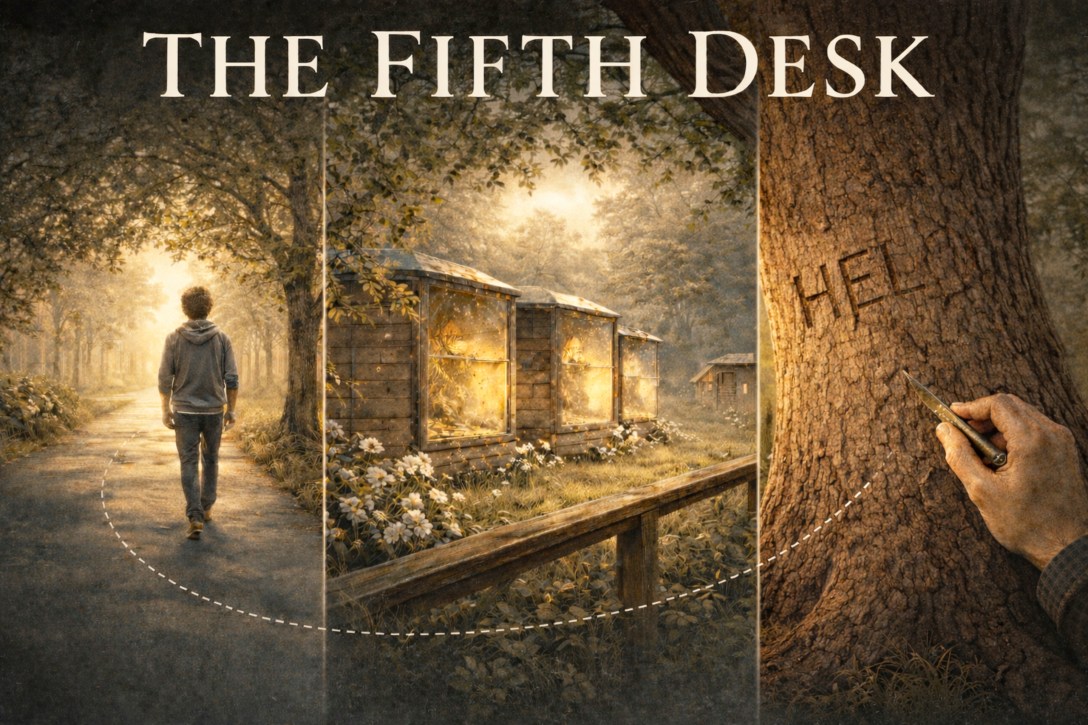
There are moments when a person discovers that emotion alone cannot carry the weight of what has happened. Feeling becomes too unstable, too porous, too easily disrupted by memory or accident. At such moments another kind of structure begins to emerge. It does not announce itself as philosophy or therapy. It appears first in the body—in habits, repetitions, small arrangements of time and space that gradually assume the role once occupied by narrative or meaning.
In the account recorded in New Grass, the organizing structure is walking.
The narrator walks not as recreation but as discipline. The body wakes and moves before the mind has assembled its reasons. The steps accumulate in a rhythm that soon becomes more reliable than thought. Breath aligns with pace. Muscles adapt to pain. Counting begins without deliberate intention and continues without requiring attention. The body performs the work of regulation automatically.
Walking therefore becomes a machine for distributing emotional pressure.
The narrator never states what event necessitated this system. Instead the text describes a series of small adjustments that keep the day moving forward: breathing through the nose, inventorying the objects in one’s pockets, crossing streets according to signals that may or may not have been noticed consciously. The logic is simple. Stopping allows memory to speak more loudly. Movement lowers the volume.
Modern life produces many such disciplines. When older social rituals—mourning customs, religious frameworks, communal obligations—lose their authority, individuals are forced to construct private systems capable of stabilizing experience. Walking is one of the most common. The city becomes an instrument for pacing the mind. Streets hold their shape, the narrator observes, because they have been told to do so. The walker borrows that stability.
Yet walking alone cannot fully contain the pressures the narrator carries. As the day unfolds, a second system appears.
In the park the narrator encounters a small bee garden positioned slightly away from the main path. The hives stand behind glass walls like windows that do not require looking through. Bees move in quiet arcs, departing and returning without collision. Their sound forms a continuous field—low, even, self-correcting.
What the narrator sees in the bees is not beauty but coherence.
Human life rarely achieves the kind of order visible in a functioning hive. Each insect participates in a collective pattern that requires no reflection. The colony adjusts itself through instinctive coordination. When one bee brushes another, both correct their course immediately. The system continues uninterrupted.
For a moment the narrator’s internal discipline of counting fades into the background. The bees offer another model of organization, one that does not depend on effort or willpower. They embody a natural order in which activity and purpose remain inseparable. Work continues because the structure of the colony makes it possible.
The narrator watches until the sound loses its edges.
This encounter reveals something crucial about the earlier practice of walking. Counting steps, adjusting breath, pacing the day—these actions are attempts to simulate the stability that biological systems possess automatically. The body imitates the hive. It repeats motions until the turbulence inside it begins to settle into something like pattern.
But imitation cannot entirely replace participation.
Human grief differs from the problems that confront a colony of bees. Bees respond to disruption through coordinated adjustment. The system corrects itself. Human memory resists such correction. It persists beyond the moment that produced it, demanding recognition long after the surrounding world has resumed its ordinary operations.
This resistance becomes visible in the final movement of the story, when the narrator leaves the park and walks toward a chestnut tree standing beyond the part of the city that pretends to be finished.
Unlike the hive, the tree does not organize activity in the present. It organizes time.
Its bark is covered with initials and dates carved by unknown hands. Some marks are careful. Others appear hurried or angry. Many have softened with age until they are nearly illegible. The tree functions as an archive—an accidental record of private events that once required a permanent trace.
The narrator approaches the trunk and circles it slowly. The knife in his pocket has been present since the beginning of the walk, though its purpose remained unspoken until this moment. When he presses the blade into the bark, the resistance gives gradually. Each letter demands pressure and correction. The act cannot be performed mechanically. It requires attention.
The system of walking pauses.
This difference matters. Counting steps allowed the narrator to move through the day without naming what had been lost. Watching the bees offered a vision of order that did not depend on memory at all. Carving the tree introduces a third possibility.
Memory becomes physical.
The letters remain incomplete but accurate, the narrator observes after finishing. Sap gathers at their edges, already beginning its slow work of sealing the wound. The tree absorbs the mark without erasing it. Over time the scar will soften and darken, joining the other inscriptions scattered across the trunk.
In that moment the narrator has moved through three distinct systems of survival.
Walking provided mechanical order.
The bees revealed natural order.
The tree offered historical order.
Each system organizes experience differently. Walking manages the present through repetition. The hive maintains equilibrium through collective instinct. The tree records the past through inscription. Together they form a sequence through which the narrator passes over the course of a single day.
What appears at first as an ordinary routine of errands and park visits gradually reveals itself as a carefully balanced architecture for carrying grief.
The narrator cannot simply stop walking; stopping would amplify the unresolved sentence that occasionally passes through his mind like weather. He cannot remain indefinitely among the bees; their harmony belongs to another species. Only the tree offers a place where memory can enter the world without dissolving the fragile equilibrium the body has constructed.
After carving the name, the narrator returns home and sleeps.
The next morning begins again in the same pale room with the same quiet air. The body stands. The street retains its shape. Walking resumes. Yet something has shifted. The loss that once circulated invisibly through the body now exists outside it as well, inscribed in the bark of a tree among many other names.
Modern life often leaves individuals to invent such systems on their own. Cities contain countless versions of the structures described here—paths worn smooth by repeated walking, gardens where biological order briefly interrupts human noise, trees that accumulate the private marks of those who passed beneath their branches. These environments provide the scaffolding through which ordinary people carry experiences that no public institution has agreed to recognize.
The narrator’s routine therefore reveals something about the cultural weather of the present moment. In a society where shared rituals of mourning have largely disappeared, grief must travel through alternative infrastructures. The body walks. The mind observes other systems of life. Eventually a mark appears somewhere in the landscape.
Grass grows afterward, as it always does, covering the disturbance without removing it. The ground retains the memory beneath the surface. And the day, like the street, continues to hold its shape.
 The New Poetics