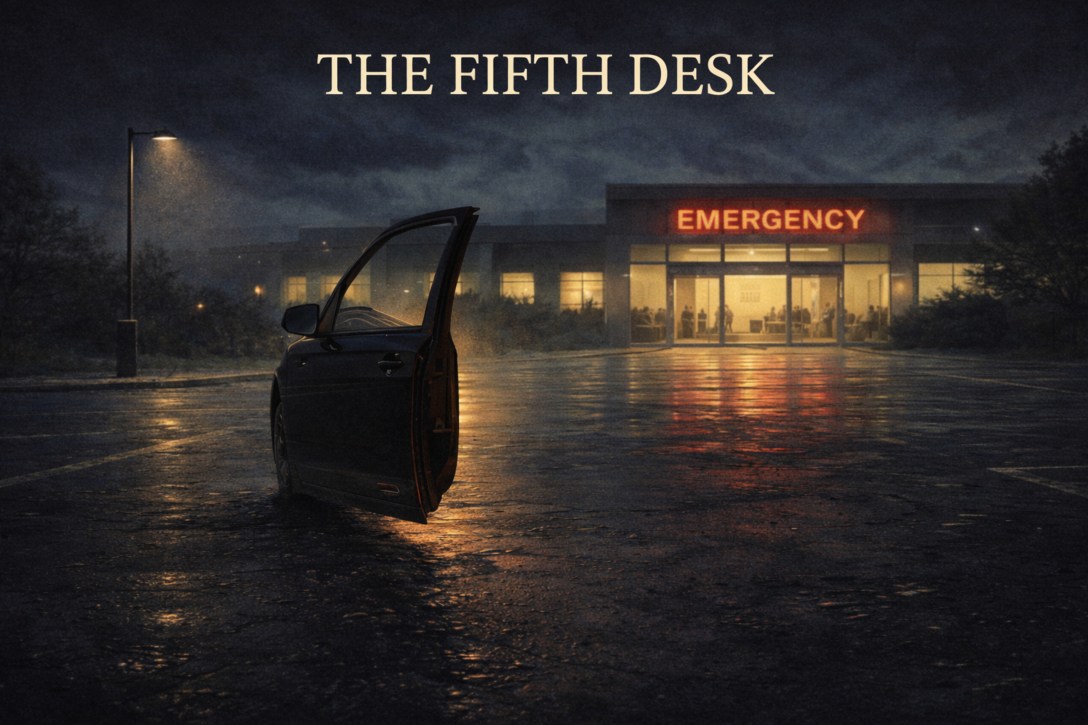
The first sentence the reader encounters in Still Two-Thirty-One does not belong to the story at all. It belongs to Wittgenstein. “What we cannot speak about we must pass over in silence.” The line appears before the narrative begins, a philosophical fragment placed above an account of a night in which a woman goes into distress and a man drives her to the hospital. At first the quotation reads like a gesture toward seriousness. Many contemporary stories borrow philosophy in this way, attaching a sentence from an older text like a ceremonial epigraph. But the sentence quietly performs a different function here. It describes the structure of the narrative that follows.
The narrator never falls silent. He speaks continuously. He describes the room, the heat, the sound of the air conditioner grinding through the night. He records the angle of the rear-view mirror, the glow of the hospital lights, the pen scratching across a clipboard. The language is careful, almost procedural. Yet the story organizes itself around something the narrator cannot quite say. The narrative behaves like a system designed to stabilize a single pause without naming what that pause might mean.
When the story first appeared I read it the way the narrator appears to intend: as a compressed tragedy unfolding across a few urgent hours. A woman wakes in pain. A man gathers his child, starts the car, and drives through the empty streets toward the hospital. Fluorescent corridors and medical forms replace the dark anonymity of the night. But once the emotional surface of the story settles, its architecture begins to reveal itself. The real subject of the narrative is not the emergency. It is the small pause that occurs before the car door opens.
“My hand stayed on the handle.”
That sentence is the structural center of the story. Everything before it gathers momentum toward movement: the tightening breath, the hurried descent of the stairs, the empty streets sliding past the windshield. Everything after it becomes an attempt to explain what happened inside that pause.
The story’s deeper mechanism becomes visible only when we recognize that several kinds of time are operating at once. There is the time of the body—pain, breath, pulse, the irregular rhythm of lungs struggling to keep pace with fear. There is the time of institutions, measured in timestamps and recorded through forms, wristbands, and official charts. And there is the time in which moral decisions occur. That time does not move in minutes at all. It unfolds inside brief intervals when a person decides whether to act.
The pause at the car door belongs to this third system.
Three larger pressure systems in the surrounding cultural atmosphere help explain why a story like this appears now and why it takes precisely this form.
The first is the quiet exhaustion of event-driven narrative in a culture saturated with stories. The contemporary archive of narrative has become enormous. Streaming platforms release entire seasons at once. Podcast series extend for years. Algorithmic recommendation engines circulate novels and films through endless cycles of rediscovery. Under these conditions the mechanics of plot have become transparent. Readers and viewers recognize narrative trajectories long before they reach their conclusion.
Writers working inside this environment increasingly redirect attention away from the event itself and toward the experience of time surrounding the event. What matters is no longer simply what happened but how a moment unfolds, stretches, repeats, or stalls while it is happening. Still Two-Thirty-One belongs to this emerging territory. Its drama does not depend on the escalation of action but on the distortion of temporal perception. The night does not progress smoothly from bedroom to hospital room. Instead it fractures into moments that seem to expand or repeat: the narrator adjusting the mirror twice though it is already correct, the man crossing the hospital drive twice with the same cup, the nurse repeating the same sentence to different patients.
The story gradually teaches the reader that chronological time is not the dominant force governing the night. Something else has entered the system.
The second pressure shaping the narrative emerges from the contemporary instability of narrative authority. Twentieth-century fiction often assumed that a narrator’s account, even when limited or biased, represented a reliable reconstruction of events. In recent decades that assumption has eroded. Readers have grown accustomed to narrators who speak truthfully while failing to recognize the implications of their own words. The burden of interpretation shifts outward. The reader must reconstruct the structure the narrator cannot see.
The narrator of Still Two-Thirty-One occupies precisely this unstable position. Near the end of the story he insists that he tells the account “straight.” In a narrow sense he does. The details are precise. Dialogue appears intact. The sequence of movements seems carefully remembered. Yet the narrative contains an absence that quietly organizes everything else. The story never tells us how long he stood beside the car.
Instead it produces a field of temporal disturbances that make the measurement impossible. The hospital clock reads 2:31 a.m. The narrator looks away and looks back. The time has not moved. People continue passing through the hallway while the clock remains fixed. The narrator cannot align the sequence of events into a stable timeline. Chronological measurement dissolves precisely where the pause begins.
The reader slowly recognizes what the narrator cannot say directly. The decisive event of the night may not be the medical diagnosis delivered inside the hospital. It may be the moment outside the car when time seemed to soften and stretch.
The third pressure shaping the story arises from the expanding authority of institutions that translate lived experience into recorded data. Modern societies increasingly rely on systems that convert events into measurable entries: timestamps, medical charts, surveillance footage, digital logs. These systems stabilize reality by assigning each moment a position within chronological order.
The hospital performs exactly this function. As soon as the narrator arrives, the institution begins translating the night into official language. A clipboard appears. A name is written down. A question about the duration of pain is asked. The narrator answers with an approximation—“around two-thirty.” The nurse records it. The event now possesses an official timestamp.
But the narrator’s experience of the night refuses to fit inside that frame. His memory circles the pause at the car door, the moment when time seemed to stretch and blur. The hospital chart cannot record that interval. It can only document the moment when the institution itself entered the story.
What emerges from the collision between these temporal systems is the story’s central revelation. Institutions measure what people do. Moral life often unfolds in the seconds before action becomes visible.
The narrator’s language reflects this discovery with remarkable discipline. Again and again he returns to the grammar of possibility. “Almost keeps showing up.” “I almost called.” “I thought about calling.” Each of these sentences records an action that nearly occurred but did not. The story accumulates these almost-events until the reader begins to sense that the narrative is organized around the negative space of decisions that remained unrealized.
At this point the Wittgenstein epigraph begins to reveal its deeper role. The philosopher’s claim about silence is often read as a prohibition against speaking about certain subjects. In this story the sentence functions differently. The narrator does not remain silent. He speaks constantly. But the structure of his language ensures that the central fact of the story remains unsaid.
He obeys Wittgenstein by circling the unspeakable.
The formal ambition of the story lies in this maneuver. The narrative never accuses the narrator of wrongdoing. It does not provide evidence that the pause caused the tragedy. Instead it constructs a world in which hesitation itself becomes the decisive event. Time behaves strangely precisely where responsibility might begin.
What gives the story its historical force is the way it reveals a paradox embedded within contemporary life. Our institutions possess extraordinary mechanisms for measuring behavior. They record purchases, movements, messages, and transactions with astonishing precision. Yet these systems remain largely blind to the domain in which many moral decisions actually occur: the brief interval before an action takes place.
The narrator’s final sentence reveals the structure that has governed the narrative all along.
“The world didn’t stop me.”
The line appears to offer an explanation. In fact it exposes the condition that made the pause possible. Nothing prevented him from acting sooner. The road was open. The hospital doors slid apart automatically. The institutional machinery functioned exactly as designed.
The world did not intervene.
The storm formed inside the pause.
By the time the reader reaches the end of the story the sky of the narrative has changed. What first appeared to be a tragedy unfolding through unfortunate circumstance now reveals itself as something more unsettling: the discovery that a few unmeasured seconds can become the gravitational center of an entire life.
The hospital chart will record a time of arrival. The institutional record will remain stable. Chronological history will continue moving forward.
But the narrator will remain suspended inside a different system of time altogether—the moral interval in which he stood beside a car, his hand resting on the handle, discovering that the smallest pause can become irreversible.
 The New Poetics