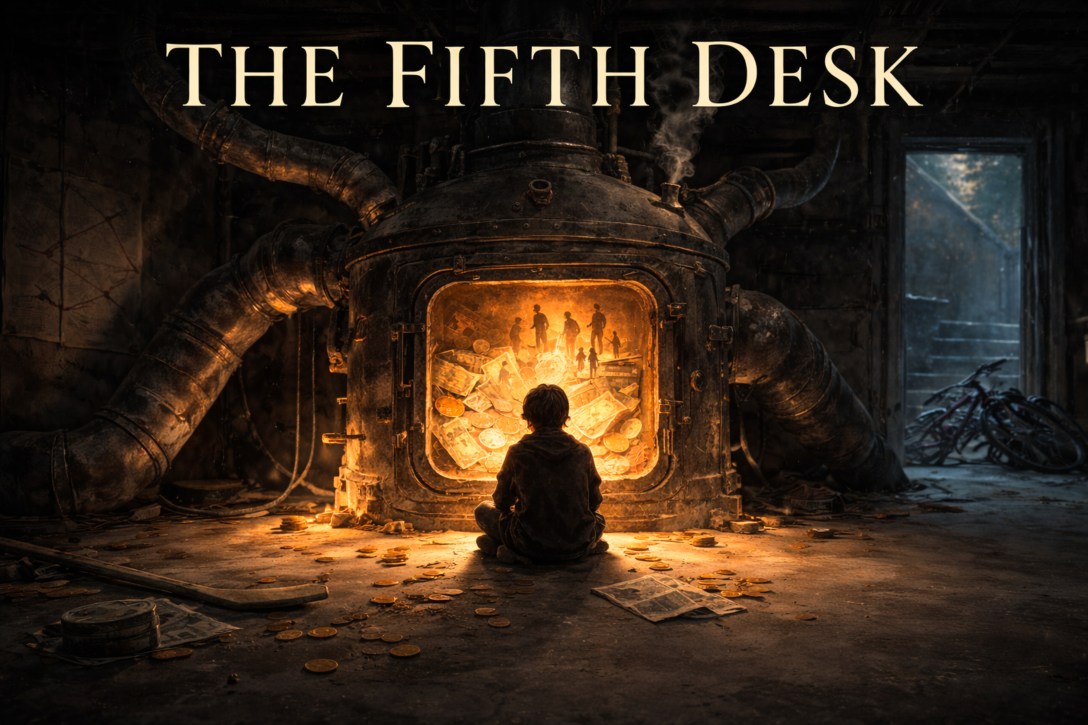
There are objects in childhood that seem accidental while we are living among them. They belong to the background of the house, part of the machinery of daily life, and we assume they exist only to serve whatever practical purpose adults once assigned to them. Only later does it become clear that such objects were quietly organizing the social world around them. They were the unseen centers of gravity around which friendships, hierarchies, and ambitions slowly arranged themselves.
In the red-brick Rose house on the Riverdale cul-de-sac, that object was the furnace.
It was an old McClary “Crystal” furnace, already archaic by the standards of the time, a squat iron machine from another generation of domestic engineering. Its ducts branched outward through the basement ceiling like the limbs of an octopus. The children who gathered in the house did not think of it as a heating system. They thought of it as a structure—an environment with chambers, hollows, and hidden cavities that invited occupation. Inside its dented surfaces the neighborhood gang began storing the coins they accumulated over the course of the summer.
The furnace became their treasury.
The transformation occurred without ceremony. A handful of coins appeared one afternoon and needed a place to be kept safe from parents and younger siblings. The furnace provided the perfect architecture. Its iron shell contained dozens of natural hiding places. Terry Rose, who had already begun assuming the role of leader within the group, distributed the money among several compartments for “security,” as he called it. Abelard counted the funds. Randolph ran errands. Others contributed occasional ideas or labor.
By the time the children realized what they had built, the furnace had become something larger than a hiding place.
It had become a system.
Money rarely remains neutral once it begins to accumulate. Even small amounts demand organization. Coins must be counted, guarded, and allocated toward a future purpose. The moment those operations begin, hierarchy emerges. Someone must manage the treasury. Someone must decide how the money will be spent. Someone must enforce the rules governing its protection.
Within weeks the gang had assembled a miniature economy.
Their goal was modest: enough money for seven full meals at the neighborhood burger joint called King’s Park. Yet the smallness of the ambition disguised the seriousness of the structure forming around it. The children saved coins with a discipline that would have been recognizable in any corporate office. They calculated prices, assigned responsibilities, and monitored progress toward the final sum.
At the center of this improvised economy stood the furnace.
Its presence anchored the system physically and symbolically. Every coin passed through the basement before disappearing into one of its hidden chambers. The machine gave the gang something like an institutional headquarters. The basement became a treasury room. The furnace became the vault.
The word “Crystal” in the furnace’s name carried a significance the children themselves could not have articulated. Crystals form through a process of slow cooling, when heat recedes and matter settles into a stable geometric structure. The gang believed their system possessed that same stability. The coins hidden in the furnace seemed to guarantee permanence. The burger feast would eventually arrive. The gang would remain intact. Their small republic had hardened into a form that felt solid and enduring.
But the furnace contained another meaning as well.
A furnace is also a forge.
It is a machine designed to apply heat and pressure until raw materials transform into something stronger. The children thought they were using the furnace as a vault. In reality the furnace was using them.
Inside its chambers the loose elements of childhood were undergoing a quiet transformation. The gang was not merely storing coins. It was generating a political order. Terry’s authority solidified through repeated decisions about how the money would be hidden and protected. Abelard’s accounting reinforced the legitimacy of the treasury. Randolph’s reliability as a runner established the group’s operational discipline.
Without announcing it, the furnace had become the engine of a small society.
This society formed in a house that was itself beginning to collapse. The Rose household offered the neighborhood children a rare freedom precisely because the authority that once governed it had weakened. Andy Rose kept nocturnal hours that removed him from the children’s daily life. Olivia Rose drifted through the house between long retreats behind the bedroom door. Domestic order had begun to dissolve.
The children experienced this absence as liberation. The Rose house became a playground where games could expand without interruption. Furniture could be rearranged, floors could be scarred, basements could be transformed into arenas for hockey or secret councils.
But freedom rarely appears alone. It usually emerges as the byproduct of structural decay.
The same neglect that allowed the children to occupy the house also produced the slow deterioration visible in its walls and roof. Rainwater seeped through damaged shingles. Mold crept along the drywall seams. The hardwood floors had been carved and dented by years of unsupervised play. The house was drifting toward ruin even as it hosted the flourishing republic of the furnace.
The children did not notice the contradiction. They understood the house only as a space where rules loosened and imagination expanded. But the furnace at the center of their world belonged to an earlier technological order already passing out of use. The machine that once heated the house now functioned primarily as a symbolic structure around which the children organized their economy.
In that sense the furnace mirrored the larger geography of Riverdale itself. The neighborhood stood on the working-class side of a railway line separating it from the larger houses of Riverdale Heights. The children of the cul-de-sac inhabited a social landscape already marked by the early stages of decline. Yet within that landscape they were constructing their own institutions, adapting the materials available to them.
Terry Rose understood this instinctively. Leadership among children rarely emerges through formal election. It appears through a combination of imagination, daring, and the willingness to assume responsibility for collective structures. Terry possessed those qualities in abundance. The furnace treasury allowed him to exercise them.
His authority depended not on wealth or parental status but on his ability to see the system the others were building before they saw it themselves. When he redistributed the coins across the furnace’s cavities, he was performing a kind of statecraft. Security required dispersion. No single compartment could contain the entire treasury. The republic would survive only if its wealth remained distributed.
The other children accepted this logic because Terry’s confidence made it persuasive.
The scene in which Terry steals a five-dollar bill from his father reveals how far this transformation has already progressed. When Andy Rose chases him down the street and finds him perched on the roof of a neighbor’s house, the confrontation unfolds like a strange recognition between two versions of the same figure. The father sees something of himself in the boy’s defiance. Terry sees only the exhilaration of standing above the world that tries to contain him.
Andy eventually abandons the argument with a warning that sounds less like discipline than resignation.
“It all catches up to you eventually,” he says.
The sentence acknowledges the furnace’s true function. Andy understands what Terry cannot yet see: the boy’s leadership within the basement republic is forging habits that will follow him beyond childhood. The furnace has become a training ground for the larger economies of risk and authority that define adult life.
Terry remains on the roof long after his father walks away, watching the moon rise above the neighborhood. When he finally howls into the night, the gesture resembles a declaration of sovereignty. The republic of the furnace has produced its ruler.
Yet crystals formed inside furnaces rarely remain intact.
The gang’s system begins to dissolve at the very moment it appears complete. The coins are exchanged for paper bills and placed inside an old hockey card box. The treasury has reached its mature form. But the furnace—the machine that held the republic together—has been abandoned.
Aeneas, searching for Terry and Caleb the following day, glimpses the empty box through the basement window and senses something has shifted. When he later finds two bicycles abandoned outside the burger joint, the image carries the quiet authority of an aftermath signal. One wheel is still spinning. Motion remains, but the system that produced it has already disappeared.
The republic has ended.
Childhood institutions rarely collapse with ceremony. They dissolve when the structures sustaining them quietly disappear. The furnace remains in the basement, but its treasury is gone. The gang disperses into separate trajectories. Aeneas turns away from the restaurant and begins walking home, thinking suddenly of leftover meatloaf in the refrigerator.
The moment feels anticlimactic until one recognizes what the furnace has accomplished.
The children believed they were storing money inside its chambers.
But the furnace was performing a different operation.
It was heating their loyalties, testing their hierarchies, and slowly forging the identities they would carry into the world beyond the cul-de-sac. Inside that iron machine Terry Rose learned the grammar of leadership, risk, and authority. The treasury he guarded so carefully was never the true object under construction.
The crystal of childhood had briefly formed around those games.
Then the furnace melted it.
What remained was the boy it had forged.
 The New Poetics