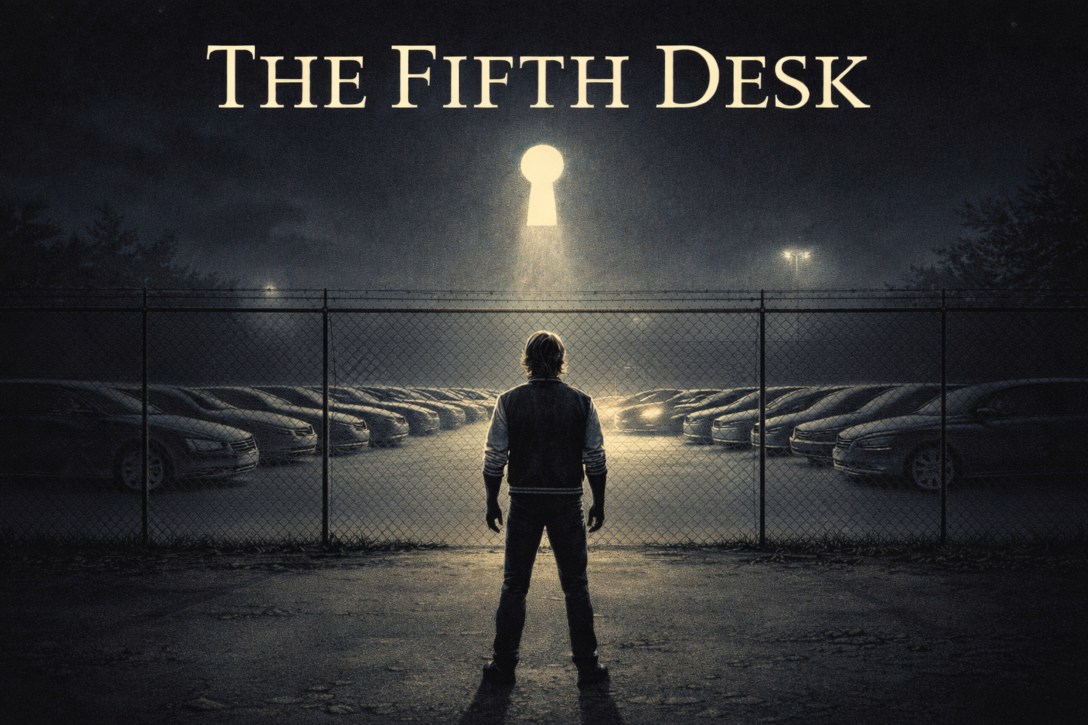
I first encountered the figure of the young car thief at a time when institutions had begun to believe they had finally mastered disorder. The modern city had surrounded its valuable objects with an apparatus designed to eliminate unpredictability. Cameras watched the entrances to warehouses and storage lots. Patrol routes repeated through the night with mechanical regularity. Ledgers reconciled each object with a number and a location. The promise of such arrangements was simple: nothing of consequence could occur without passing through a system of verification.
Within that environment the romantic outlaw appeared increasingly improbable. The older mythology of American freedom had been organized around movement—highways stretching into darkness, engines accelerating beyond the reach of authority. But as infrastructure expanded across the landscape, movement itself was gradually absorbed into systems designed to regulate it.
The story of the young man who turns twenty-one over a slice of diner pie and decides, almost ceremonially, to begin stealing cars like his father might at first seem like a lingering echo of that earlier mythology. The narrator inherits not only the memory of his father’s profession but also a sense that his own life has been waiting for this moment of continuation. Crime appears less like a choice than a kind of vocation, transmitted across generations like a trade.
Yet the world in which this inheritance unfolds is no longer the open territory imagined by earlier outlaw stories. The object of the narrator’s desire sits inside a fenced storage lot for luxury automobiles. Barbed wire crowns the fence. Cameras monitor the parking grid. A guard performs a nightly patrol, confirming the presence of each vehicle against the boxes recorded in a ledger.
The environment represents a fully articulated institutional system. Every car occupies a numbered position. Every movement corresponds to a procedure. The guard’s patrol advances through the lot with the rhythm of a metronome, verifying that the system remains stable. From the perspective of the institution that owns the cars, nothing here is mysterious. The machines are inventory. The patrol is security. The ledger records reality in its proper form.
But the narrator who enters this space experiences it through an entirely different structure of meaning.
The automobiles do not appear to him as inventory awaiting sale. They become living presences, “wailing to get out like children in an orphanage.” The fence is not merely a barrier but the wall of a prison. His task becomes an act of liberation rather than theft.
At first glance this transformation might seem like a rhetorical gesture—a criminal reframing his actions in heroic language. Yet the story reveals something more profound. The narrator does not simply describe the environment symbolically. He perceives it symbolically. His language reorganizes the entire landscape into a network of correspondences and living metaphors.
Rain becomes a set of tiny fingers probing his collar. Breath hovers in the air like a phantom he must scatter with his hands. Moonlight falls across the parking lot in shapes that resemble bones and tiles. Even the guard becomes a figure within a symbolic spectrum, imagined as a particular color within the narrator’s private cosmology.
What the narrator inhabits is not a rejection of structure but a different kind of structure altogether.
The institutional system surrounding the cars operates through measurement and verification. Its logic is numerical. Objects acquire meaning through their position in a ledger or their presence within a camera’s frame. Reality becomes what can be counted.
The narrator moves through another architecture entirely—one built from symbols, language, and imaginative correspondences. In this visionary system objects do not derive meaning from their place in an inventory. They derive meaning from the relationships the imagination perceives among them.
Cars become captives. The fence becomes a prison wall. Keys become artifacts of liberation.
Once these transformations occur, the logic of the night changes.
This difference in perception explains the peculiar way the narrator experiences time. At several moments he feels as though events are unfolding before they occur, as if his actions had “always occurred—just not in the same order.” The sensation resembles prophecy. From the standpoint of the institutional system that surrounds him, such perception should be impossible. The system understands time only through procedure: patrol routes repeat, inventory remains stable, events occur in measurable sequence.
But the narrator experiences time through patterns rather than procedures. At one moment he imagines seeing the entire parking lot from above, like a hawk surveying the terrain. From that height, he claims, all the angles become visible.
The image reveals the difference between surveillance and vision. Surveillance attempts to dominate the world through instruments that translate reality into information. Vision operates through imagination, revealing patterns that cannot be reduced to numbers.
The guard embodies the first mode of perception. His world consists of routines. He walks his route, checks his boxes, and confirms the stability of the inventory. The cars are assets under his protection. The ledger defines their meaning.
The narrator inhabits the second. The same environment that appears to the guard as a logistical grid becomes a symbolic landscape in which every object participates in a mythic drama.
Because the guard operates entirely within the institutional system, he cannot perceive the symbolic one unfolding around him. The cameras record the surfaces of the lot, but they cannot recognize the imaginative transformation that has already redefined the scene. The ledger contains the inventory, but it cannot register the meanings that the narrator’s vision assigns to the machines.
The two men therefore move through the same physical space while inhabiting different systems of reality.
The guard protects the institutional order.
The narrator navigates the visionary one.
The story hints that this way of seeing may itself be an inheritance. The narrator repeatedly invokes the memory of his father, a car thief who died during a failed escape. At first the father appears simply as the source of the techniques the son now employs. Yet one memory interrupts that romantic lineage. The narrator recalls seeing his father sitting quietly on the edge of a bed, staring at his hands as though they had betrayed him.
The image suggests a moment of doubt—perhaps the recognition that the older mythology of the outlaw driver no longer corresponded perfectly to the world that had replaced it. By the time the son comes of age, the highways of freedom have been reorganized into infrastructures of regulation. Cars exist inside logistical networks. Valuable machines are stored in guarded enclosures where movement is carefully monitored.
The outlaw appears obsolete.
And yet the narrator succeeds.
He moves across the lot unseen, enters the security office, and takes the key to the car he desires. The guard completes his patrol believing the system has functioned flawlessly. The cameras continue recording their silent images. The ledger still contains its boxes.
What the system never registers is the structure of meaning that allowed the event to occur.
The institutions surrounding the automobiles believe they control the world by translating it into numbers, cameras, and procedures. But these instruments can only recognize the order they were designed to measure.
Human beings never inhabit that order alone.
They also move through symbolic architectures built from language, memory, and imagination. These structures reorganize reality in ways that institutions cannot perceive. They transform machines into companions, barriers into prisons, and routine events into moments of destiny.
On that particular night the guard patrolled the institutional system.
The young thief moved through another system entirely.
One was built from ledgers and patrol routes.
The other from symbols, language, and vision.
The guard protected the first.
The thief inhabited the second.
And only one of those systems possessed the power to transform the night.
 The New Poetics