Also when they shall be afraid of that which is high, and fears shall be in the way, and the almond tree shall flourish, and the grasshopper shall be a burden, and desire shall fail: because man goeth to his long home, and the mourners go about the streets.”
Ecclesiastes 12:5, The King James Bible
I
The water in the kitchen tap had been bad for a week. Terry had filled the jugs the night before from the spigot off the rain barrel at the side of the garage where the line ran clean because the line was his own. He had carried them up the side path in the dark, two at a time, and set them on the floor inside the back door. There were three jugs and they were the kind that took the cap with a thread. He locked the back door, slid the chain.
The house sat at the end of the cul-de-sac where it had sat for almost a hundred years. Red brick, two-story, the brick darker on the north side from a century of weather. The roof had been patched in three places that Terry had got to and in two places he had not. The porch boards were soft on the third step from the top and Terry had not replaced them because the whole porch wanted replacing.
The street was a working cul-de-sac. Same as when Terry was a boy. Two of the bungalows had been bought up and rebuilt in the last ten years. One had a coded box on the door now. The Roses’ house sat among the three or four that had not been touched. The man across the street, Petros, was older than Andy would have been and still came out in the morning to look at his roses.
In the morning Terry made coffee on the stovetop pot he had taken apart in the spring and put back together with a section of bicycle tube where the gasket had gone soft. He filled the pot from the jug. The flame turned blue then gathered. The radio was on low in the kitchen window. The signal on the AM band had been weaker for a year. He used the FM. There was a station out of the lake that played records by people who were dead now.
He stood at the kitchen window with the cup in his hand. The window looked out on the back yard, which was small and which had a sumac at the back fence that had spread without his consent and he let it. The grass was gray with frost. Beyond the fence was the alley and beyond the alley the rear of the houses on the next street and beyond those the rail line which had run there since before the house had been built. A train went by at six and at eleven and at three and at seven in the evening and he no longer registered them unless one was late.
He drank the coffee slowly. The window was cold against the back of his hand when he set the cup on the sill. His shoulder had the stiffness it had when the cold came in and he rolled it once and let it settle.
A car went by slow on the street out front. He did not move from the window. The car continued to the end of the cul-de-sac and turned around in the apron and came back past the house. A sedan, dark, not new. He did not recognize it. The driver did not look at the house in the way a man looking at the house would look. The car continued past and turned the corner and was gone.
Terry stood at the window a while longer. He was not waiting to see if it would come back. He was letting his hands settle.
The kitchen had been Olivia’s. The cupboard doors were the doors she had painted in a year Terry could not now place. The linoleum was the linoleum Terry had laid himself the year after she died because the older one had gone past the point where it could be cleaned. There was a stain on the ceiling in the corner over the sink where the upstairs bathroom had leaked four years ago. He had fixed the leak and not painted the ceiling. He preferred the stain to a fresh patch that would draw the eye to itself.
He went to the cabinet by the back door. There was an envelope behind a stack of utility receipts that he kept because the names on them were Andy’s name and his own name across the years and because the dates on them were dates he could prove had happened. He took the cash out and split the fold. Half in his front pocket. Half in the inside lining of his jacket where there was a slit he had cut and not sewn. There was a small black notebook behind the envelope which he did not take out and did not move.
He went down the basement stairs. The basement had been a basement Terry and Caleb had played hockey in when they were small. There was a different furnace now. The original had failed in the year after Andy died and Terry had replaced it with a unit he had pulled out of a renovation in Leslieville that had been throwing it out. The new furnace was older than the original had been when it failed. He kept it running with parts cannibalized from two other furnaces over the years. It would last another winter or it would not.
He went past the furnace to the workbench at the back. On the bench was a carburetor he was midway through cleaning and a coffee can full of small parts in solvent. He had been working on it the night before until late. He looked at it. He let it sit. He went to the metal cabinet at the end of the bench and unlocked it with a key from his pocket and took out a folded oilcloth and brought it up the stairs.
In the kitchen he set the oilcloth on the table and unfolded it. Inside was a revolver Andy had kept in the same metal cabinet for the last fifteen years of his life and that Terry had moved to a different cabinet after he died and then moved back when he had taken over the house. It was a Smith and Wesson Model 10, four-inch barrel, blued steel gone matte from age, the grips checkered walnut darkened by the oil from his father’s hands and his own. Andy had bought it in the seventies from a man who had brought it across from Buffalo. There were six rounds in the cylinder. There was a box of fifty with thirty-eight rounds in it that Terry had not opened since the spring when he had loaded the cylinder against a different reason than the one he had now. He took the box from the oilcloth and put it in his front pocket. He folded the cloth over the revolver and held the bundle in his hand and stood in the kitchen a moment without moving.
He sat down at the table. The radio played a song he knew. He set the bundle on the table beside his cup and looked at it. He did not unwrap it again. After a while he got up and rinsed the cup at the sink with water from the jug.
He went upstairs to the bathroom and washed his face from the jug he kept on the bathroom shelf, which was a smaller jug. He dried his face on the towel he had used the day before. He looked at himself in the glass over the sink and looked away. The glass had a crack in the lower corner that had been there since he was fourteen years old and that he had never replaced.
When he came back down the knock was at the front door, not the back. He paused on the stairs. The front door was the door no one used. Caleb had not used the front door in eight years. The neighbors had used the back. The man who paid down Andy’s debt had used the back. The knock was not loud. It was not the knock of someone in uniform. He went down through the front room and stopped at the door without touching the handle.
“Who is it.”
“Terry. It’s me.”
He undid the deadbolt and the spring lock and opened the door.
Heloise was on the porch in a coat she had owned for twelve years that he recognized at the collar. The coat was buttoned wrong, the third button through the second hole. She had a bag over her shoulder that was not full and that she was holding to her body with her arm pressed against it. Her hair was down on one side and pinned back on the other. The skin under her eyes was the skin of a person who had not slept in some days. The sky behind her was the gray of late October that does not lift in the day. He had not seen her in two years.
“Is the boy here,” she said.
“No.”
“Are you alone.”
“Yes.”
She came in fast. He shut the door behind her and turned the lock and slid the chain. She was already past the front room and into the kitchen. He followed her. She went to the kitchen window and stood at the side of it and looked out at the back yard and the alley and the rail line, and then she crossed the kitchen and looked out the window over the sink at the front. She stayed at that window a long time. She did not turn around.
“Heloise.”
“I went three different ways. I don’t think I was followed. I don’t know.”
“Sit down.”
She did not sit. She stayed at the window. He went to the kitchen counter and poured a cup and brought it to her at the sill. She took it. She did not drink. She held it with both hands. Her hands were cold and the cup did not warm them quickly. She looked at the bundle on the table.
“Sit down, Heloise.”
She came away from the window. She sat in the chair by the table that was the chair he sat in when he sat at the table, and she did not seem to register which chair. She set the cup on the table and her hand went to the edge of the table and stayed there. She had not taken off the coat. The coat carried the cold of the porch and under that the close warmth of someone who had been in the same clothes too long.
“That’s Andy’s.”
“Yes.”
She looked at the bundle and then at him and then at the cup and did not speak for a moment.
“All right.”
“Tell me about the boy.”
She drew breath. She let it out.
“Three days. He left a note. I’ll show you. He has done this before. He stays out a night sometimes. Two. Not three. The first day I sat with the note and read it again and I did not call anyone because there was no one to call. I did not sleep. The second morning they came.”
“Department.”
“Yes. Two of them. Polite. Asked when I had last spoken to him. Asked about his school. Asked if he had been in touch with anyone outside the city. Asked if I had family in the country. They were already holding the form with the answers. They left after fifteen minutes. They did not say a name for it.”
“Department doesn’t say names.”
“No.”
“Go on.”
“After they left I went into his room. I went through it. I do not know what I was looking for. I did not find anything that I could read. There were notebooks. I opened them. They were not for me to read. I did not have time to go through them properly. I did not have a place to take them. I left them where they were.”
“What kind of notebooks.”
“Spiral. The kind from a stationer. Three of them. Pencil, in his hand. Drawings in the margins. Lists of things I could not read. Names that were not names of people I knew.”
“All right.”
“The third day in the afternoon a car came and parked at the corner of my block. Not the corner, the next corner. Past it. Where they could see the door of the building. They sat in the car. Two men. They did not get out. I watched through the slit in the curtain. They sat there an hour. I do not know if they were the same two men. They had a different car. After an hour I closed the curtain. They were still there. I packed in the dark. I left at four this morning. I told the woman across the hall I was going to my sister in Hamilton. I do not have a sister in Hamilton.”
“You took a cab.”
“I took a cab to Union and bought a ticket for Hamilton and did not get on the bus. I walked from Union for two hours. I took a second cab from a hotel on Bloor that does not check carefully. I had the cab let me off six blocks from here. I came up the back.”
“You did right.”
“I don’t know.”
“You did right, Heloise.”
He went to the window and looked down at the street. There was a car at the corner he had not seen there before and there was a man walking a dog on the far side of the street going slow. Terry watched the man with the dog until the man with the dog reached the end of the block and turned the corner and did not come back. The car at the corner had no one in it that he could see. He came back from the window.
“Drink the coffee.”
She drank the coffee. She held the cup in both hands and drank it slowly. After a while she set it down and reached into the bag and took out a folded piece of paper and put it on the table between them. The paper was lined and torn at the edge from where it had been pulled from a pad. The paper itself was older than three days. It had been folded and refolded and the corners were soft.
“This is the note.”
He took and unfolded it. He read it once and read it again. He looked at her and back at the page. He folded it along its old folds and gave it back to her. She put it into the bag without putting it in an inner pocket and zipped the bag.
“When did he write it.”
“I don’t know. Some time ago. Months.”
“He left it where you would find it.”
“Yes.”
“He knew you would come looking.”
He was quiet for a moment. He looked at the bundle on the table.
“I think it has to do with his father,” she said.
The radio had been playing. He had stopped registering it. Now he heard it. A song he knew from a kitchen he had been in twenty years ago in summer, when the three of them had been alive. He had not chosen to remember the kitchen. The kitchen had remembered itself.
“Aeneas,” she said.
He nodded once. He did not say the name back. He looked at the table between them. Her hand was on the table. His hand was on the table. They did not touch.
“I’ll get my things.”
He stood. He took the bundle from the table. He went up the stairs to the back bedroom that had been his since he was a boy and that he had not changed when the house became his. The duffel was under the bed. He pulled it out and set it on the bed and opened it. There were already things in it. A second pair of boots that were broken in. Two pairs of wool socks. A thermal shirt. A small case with a razor and a comb and a piece of soap wrapped in paper. A flashlight on a battery and a smaller one on a hand crank. He added a sweater from the dresser and a second shirt and a pair of work pants and a wool watch cap. He set the bundle in the duffel against the side and put a shirt over it. He zipped the duffel and set it by the door.
He went to the closet and took down a wool jacket that was older than the coat he had been wearing in the kitchen. He looked at it. He put it back. He took down a different jacket made for cold and rain and put that on the bed. The fixed-blade knife was on the dresser in its sheath. He put it on his belt under the jacket. The folder was in his left front pocket already. It had been there for a year.
He took the cash from his pocket and counted it again now and put it back, half and half. He went down to the kitchen and opened the cabinet and took the small black notebook from behind the envelope and put it in the inside pocket of the rain jacket. Heloise watched him do this. She did not ask.
In the kitchen he put two of the three jugs into a canvas bag from the hook by the back door. The third he left where it was. A tin of coffee from the cupboard. A can of beans. A can of corn. A jar of honey from the small shelf by the stove. A small jar of salt. A loaf of bread he had bought two days ago. A roll of electrical tape from a hook. A coil of wire. A multi-tool from the drawer. A box of waterproof matches from the high shelf above the stove. He went to the basement and opened the metal cabinet at the end of the workbench again and took out a roll of canvas tied with a cord and the smaller knife in its sheath that he had not taken upstairs. The smaller knife in the canvas bag. The canvas roll under his arm.
He set the canvas bag and the roll by the back door. He turned off the radio. The room was different with the radio off. He took down the hat from the peg by the back door and put it on.
“Heloise.”
She stood. She picked up her own bag. She came to the back door and stood beside him. He looked at the buttons of her coat. She looked down and saw and her mouth went tight and she undid the third and fourth buttons and redid them in the right holes without taking the coat off.
“The car’s in the garage.”
“All right.”
He opened the back door and looked out at the empty yard. The kitchen window of the house behind reflected the sky and showed nothing. He carried the duffel and the canvas bag down the back step and across the small yard to the garage. The garage door was the man-door at the side, not the roll-up. He had unlocked it the night before when he had gone for the jugs and he had not relocked it. He had known he might be moving fast. He held the door for her. She went in.
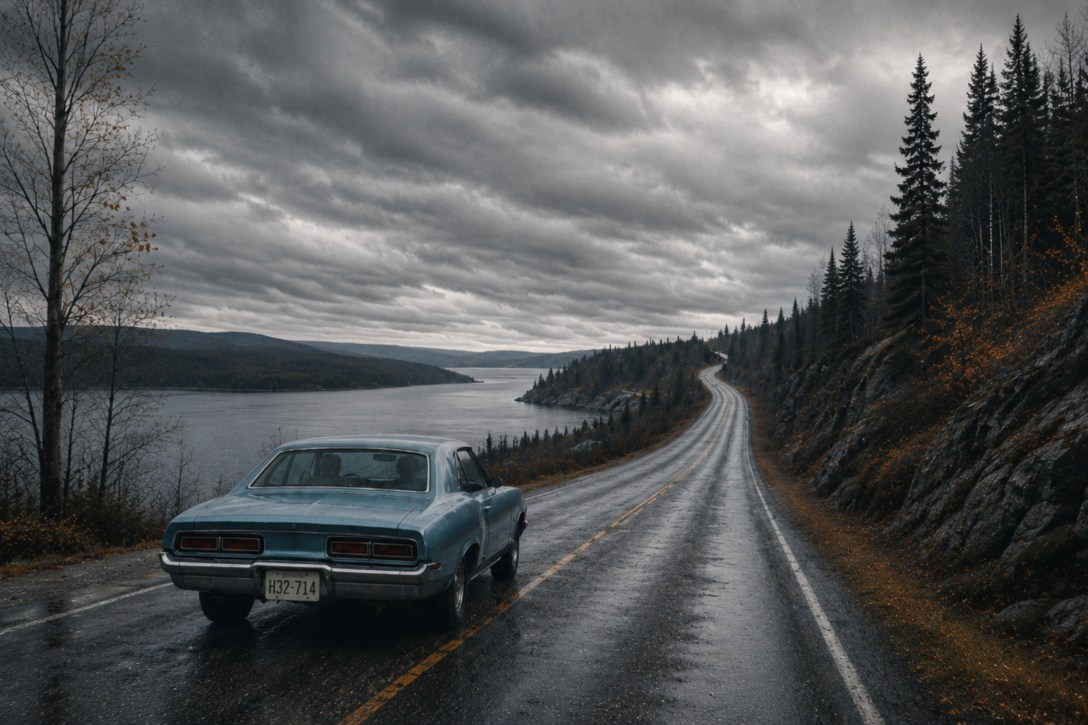
The garage was the garage Andy had used. The roll-up faced the alley. The Charger was under the canvas tarp that Terry pulled off only when he was driving it or working on it. He pulled the tarp off now and folded it onto the bench. The paint was the powder blue his father had painted his Stingray fifty years ago and that Terry had painted the Charger to match the year he had bought it, sixteen years ago, off a man in Hamilton who had been letting it sit in a barn. Terry had pulled the engine and rebuilt it. He had repainted it the color his father had driven and which was the wrong color for the work. He had known this at the time.
He set the duffel on the back seat. He took one of the jugs from the canvas bag and set it on the floor of the passenger side. He set the canvas bag in the trunk. The trunk had a tool roll in it already and a jerry can strapped to the wheel well and a wool blanket folded against the back. He closed the trunk. He went around to the driver’s side and unlocked it from the door. He reached across and unlocked the passenger side. Heloise got in. He got in. He locked both doors before he turned the key.
The engine took twice. The third time it caught and the garage filled with the sound of it. He let it run. He had let it run before he moved every time he had started it for sixteen years. He turned the heat on low. He looked over at her. She was looking at the dashboard. She was not looking at him.
“Nice colour,” she said.
“Yes.”
She did not say more.
He got out of the car. He went to the roll-up door at the front of the garage and pulled the chain and the door went up. The cold air came in. He went back to the car and got in and put the car in reverse and backed out into the alley. He got out again. He pulled the chain and the door came down. He locked it from the outside with the padlock he kept on the loop. He got back in the car and pulled forward to the end of the alley and stopped before turning onto the side street.
He sat at the end of the alley for a moment. The street was clear. He turned right, away from the cul-de-sac and toward the artery on the far side. He did not pass his own house going out. He took the long way around the block.
The radio in the car was off. He did not turn it on. They came onto the artery at a place where the entrance ramp to the highway was the second of two and not the first.
The sky was high and gray and the light was thin. The trees on the side of the road were half bare. Heloise’s hand went to the window and stayed there a while and came back to her lap.
“Terry.”
“Yes.”
“Thank you.”
He nodded. He did not speak. They drove.
The 400 came up. He took the ramp.
The car settled into the lane and he held the lane and the speed and the city began to fall away. The buildings that had been close were further. Then there were buildings that were lower. Then the buildings stopped and the strip malls came and then the strip malls stopped and there were fields, gray with the early frost, with stands of trees at their edges where the wind had taken some of the leaves and not others. Heloise put her head against the window and closed her eyes. She did not sleep. He could see her eyes moving behind the lids.
After an hour he saw the patrol car on the shoulder ahead of them in the median, parked in the gap between the divided lanes, facing the southbound side. He saw it in time. He did not slow and he did not change lanes. He held the speed and the lane.
Heloise opened her eyes.
“Look down at your bag,” he said.
She looked down at her bag. They went past. The patrol car did not move. He watched the rear-view for a long time. The patrol car stayed where it was. Heloise did not look up until he told her she could.
She did not ask. He did not say.
The trunk was a search away. The car was the wrong color for the work. Terry drove.
After two hours the country had changed. The fields gave way to rock and the rock to forest. The road bent and rose and the lakes began to show themselves through the trees in pieces, gray and flat. The light was already going. He had the headlights on by four o’clock. The cars on the road were fewer. The trucks were working trucks and they moved at their own pace and he did not pass them.
A sign came up on the right that he had not seen before. It was newer than the post it stood on. He read it as he passed. Vehicles subject to inspection at any point along this corridor. Drivers should be prepared to present credentials on request. Compliance ensures continuity for all road users. He read it once. He did not read it again.
A second sign stood below the first, smaller and older. The number for the reporting line was painted out in black. The paint was old.
Heloise had read it too.
“How long since you came up this road,” she said.
“Two years.”
“They’ve put them up since.”
“Yes.”
She did not say anything else for a while. After a while she looked over at his hands on the wheel. She looked at them for a moment and looked back out at the road.
“I forgot you drive with both hands.”
“Yes.”
She looked back at the road. He kept both hands on the wheel.
It was full dark by the time he saw the diner sign. The pole was bent at the bottom where something had hit it once. Three trucks in the lot. Two cars. He drove past the diner and went a quarter mile down the road and turned and came back. He parked at the end of the row, against the tree line, nose-out toward the road. He turned off the engine. The engine ticked as it cooled.
He watched the diner through the window for a minute. Two men at the counter. The back of a third in a booth. The woman behind the counter was the same woman he had seen here before, two years ago. He did not know if she would remember him. He did not know if it would matter if she did.
“Stay close.”
“All right.”
He walked her in front of him to the door, which he did not like, but the alternative was walking behind her, which he liked less. The bell on the door rang. The smell of the place came up at them, fryer grease and coffee and the bodies of men who had been on the road that day. The men at the counter looked up. One of them looked at her and held the look. Terry put his hand on the small of her back and moved her past the counter to the booth at the back where he could see the door and the kitchen pass-through both. The man at the counter looked away.
The woman behind the counter looked up at them and looked at him. Her eyes went a fraction narrow and then settled. She did not come over. She turned and put a slip on the wheel for the cook. She wiped the counter. After a while she picked up the pot and two cups and came over.
“Long time.”
“It has been.”
She poured both cups. She did not ask. She set the pot on the table and went away without taking an order. They had not opened the menus.
“She knows you,” Heloise said.
“A little.”
“How.”
He shook his head.
“All right.”
She came back after a while with her pad.
“Eggs,” Terry said. “Toast.”
“Same,” Heloise said.
The woman wrote it down without looking at the pad. She looked at Heloise and the look took in the coat and the hair and the bag, and the look was not unkind and it was not kind. She nodded once and walked away.
The food came after a while. They ate. Heloise ate slowly. Her stomach had been closed for three days and the eggs were going down past something that did not want to give way, and she chewed each forkful longer than she needed to, and she finished most of it. He finished. The man at the front booth got up and paid and left. The bell rang. The two men at the counter stayed. One of them looked over at their booth once and went back to his food. Heloise reached into her bag for a moment and her hand stayed in the bag and she closed her eyes and then she took her hand out without taking anything and she set the bag back on the seat beside her. Terry did not ask. He had seen her hand find what it found. He let her keep it.
When Terry went up to the counter to pay, the woman took the cash and counted it once and gave him back two singles he had not expected.
“There’s a place at the next exit if you need to stop,” she said. “The one after, don’t.”
He nodded. He put the singles in his pocket.
“Thank you.”
She had already turned to the next thing.
In the car Heloise had her coat closed and her hands in her pockets. The car was cold inside. He let it run. The heat came up. He pulled out of the lot and onto the highway and kept north. There was a moon coming up behind the trees on the east side of the road and the trees were black against it.
She slept after a while. She slept with her head against the window. Her breath fogged the glass and cleared and fogged again.
He drove. He kept both hands on the wheel.
II
He drove twenty kilometres past the diner and pulled into a rest stop and turned off the engine. The stretch from the diner to the rest stop had been empty road in the dark. He had passed two cars going south and one going his direction that had pulled off at an exit before the rest stop. The rest stop itself was a gravel turnout with a single street lamp that worked and a picnic table that did not have its top.
He sat in the driver’s seat and listened to the cold ticking around the engine and watched the highway through the rear window for half an hour without seeing another car go by. Heloise did not wake when the engine stopped. He let her sleep. His shoulder against the door had gone numb at the point of contact and he shifted his weight off it and the blood came back as a slow ache.
He took the bundle from the duffel and unwrapped it on his knee. The revolver was matte and cold in the dome light. He checked the cylinder by feel and put it back in the duffel and did not zip the duffel and moved the duffel to the floor of the passenger side at her feet. Her foot was already against it. She did not register.
He started the car after a while and pulled out of the rest stop and went on north. The sky lightened by stages. The light came up gray over the lakes and the lakes were there suddenly when the trees thinned and gone again when the trees closed. He had the headlights on until the morning was real. The cars on the road were trucks and the trucks were working trucks.
He took one swallow from the jug between his feet and made himself stop. The water was cold enough to hurt his teeth. There was less of it than he wanted there to be. He capped the jug and set it back where it had been. His mouth had the metal taste of a mouth that had not been brushed since the day before and the swallow had not cleared it.
Heloise woke at seven without speaking. She straightened in her seat and put her hand to the back of her neck. After a while she reached for the radio. She turned the dial through static and a man preaching and a song in French that broke up and then a station that was clear that was playing something old. She left it.
“How long have you been driving.”
“I stopped half an hour.”
“I should have driven.”
“There wasn’t a place I would have stopped to switch.”
The man on the radio said the title and the year. The year was a year before the boy was born. He said nothing. She said nothing.
After a while she said, “I have to use a bathroom.”
“Twenty minutes.”
The place was a station and a coffee counter on a lot at a junction. He pulled in and parked at the side where the Charger was not visible from the highway. The lot was poured concrete that had cracked and been patched and cracked again. There were four trucks at the pumps and a station wagon at the side. The coffee place had the lights on in the kitchen at the back and the lights off in the dining room because no one was sitting in it. He got out and walked her to the door and held the door for her.
The woman behind the counter was older than the woman at the diner the night before and she did not look up when they came in. There was a man at the counter eating eggs and a man at a corner table with a paper that was a paper from the day before. The man at the counter looked up at Heloise once and went back to his eggs. He did not look again. The man at the corner table did not look up at all. Neither man asked what they were doing on the road this early. The woman behind the counter finished what she was doing and came over.
“Two coffees. To go.”
“Cream.”
“One black. One with.”
She made the coffees. She did not make conversation. The coffee maker was an older one that had been kept running and that made a sound when the water came up that Terry recognized from a coffee maker his mother had had when he was a boy. Heloise came back from the bathroom and stood beside Terry at the counter without speaking. The woman set the coffees on the counter in two paper cups with lids. Terry paid in cash. The woman gave him back the change without counting because it had been the right amount. He nodded. He took the coffees.
In the car he set the coffees in the cup-holders and watched the lot before he started.
“You can sleep more,” he said.
“I know.”
She drank the coffee slowly with both hands.
The road bent and rose and the trees were spruce now more than pine and the rock came up out of the ground in shoulders and ridges. The lakes were larger. The light was higher. There was wind in the trees that had not been in the trees in the morning.
He came up behind a flatbed truck loaded with what had been logged in the country east of the highway. The truck was older than the Charger. The load was chained on three axles and the chains had black marks worn into the bark. The driver was a man in his sixties with a wool cap. He was holding the truck at a speed that was below the speed limit because the load did not want to be pushed. Terry held back forty metres. He did not pass. The road bent around two curves and at the second the driver of the truck put his hand out the window once in a small acknowledgment and Terry did not flash his lights or honk back. He just kept the distance. After a kilometre the truck pulled into a turnout at a logging-road entrance and Terry went past. The driver did not look up as they went past.
He saw the porcupine in time. It was crossing the road in the slow way of an animal that has not learned the road is something to be afraid of. He moved the car to the left without slowing and back into the lane and the porcupine kept going across into the brush. He had not looked at it. He had moved around it. The whole motion took less than a second.
She had been looking out at the road. She looked at him. She looked at him for a long time. He kept his eyes on the road.
“He used to do that.”
“Is that right.”
“I didn’t know you did.”
“No.”
“I never saw you drive much.”
“No.”
“He would have stopped the car for a chipmunk.”
“Sounds like him.”
“Did he tell you why.”
“What for.”
She looked back at the road. After a while he could see her face in the side window and her face was the face of a woman who had remembered something she had not chosen to remember and now had it back.
“I thought I had forgotten the way he did things.”
“You haven’t.”
“I told myself I had.”
The road went on. The radio played a song neither knew and then a song he knew. The station was based out of a town further north that Terry had been through twice. The man had a voice that did not perform and that did not flatten.
“You used to listen to this with him.”
“He found it before I did.”
“I thought I had forgotten that too.”
“You’re not forgetting now.”
She drank what was left of the coffee.
“It’s strange to be in this car.”
“It’s the same color.”
“I noticed in the garage. I didn’t say.”
“I know.”
“Why did you do it.”
“It was what was on the car when I bought it.”
“It wasn’t.”
“No.”
She set the cup in the holder and looked out the window.
By eleven they were past the cottage country and into the harder country. The motels and gas stations were further apart and the towns when they came were small and the buildings were the buildings of a country that had been built once and not rebuilt. They passed a sign hand-painted over the original lettering. The hand-painted version said FIREWOOD and an arrow pointing east.
Two kilometres on they passed the place. It was a yard at the side of the highway with a man and a boy stacking split wood under a tarp. The man was older than Terry and the boy was eight or nine. The man straightened as the Charger went past and looked at the car. The boy did not look up from the wood. The boy had been taught to keep working when a car came past. The man’s hand went up in a small wave that was less wave than acknowledgment.
“You know him.”
“No.”
“He waved.”
“Men out here wave.”
“At a car like this they wave.”
She thought about that. “What does that mean.”
“It means he saw the car. It means he wanted me to see that he saw it. He’s letting me know.”
She looked back at the road. After a while she said, “Aeneas would have stopped to buy wood.”
“He would have. He didn’t always have somewhere to put it.”
“He bought it anyway. I never knew where he was putting it. I think he gave it away.”
“That sounds right.”
“He never told me where it went.”
“No.”
She nodded. She was quiet again.
The road ran past a long lake on the west side that had cabins along the shore at intervals. Most of the cabins had their shutters up for the season. One of them had smoke coming from a stovepipe and a small dock with two chairs on it that had not been brought in. Heloise watched the cabins as they went past. She did not say anything. After the lake the road went into the trees again and the country closed.
The country thickened through the afternoon. The road went past two lakes he knew the names of and a third he did not.
Around three they came into a small town that the highway ran through as a single street. There was a school on the right with the windows boarded. There was a hockey rink at the end of the street with the boards visible through a chain-link fence and the boards were the boards Terry remembered from rinks in his own boyhood, white with the red and blue lines painted on the wood. There were no cars in the rink lot. Past the rink there was a Legion hall with the sign half painted out, the word LEGION still legible under the newer paint that had been rolled across it. The newer paint was the color the country office had used for the past five years.
Past the Legion there was a small grocery with two cars in the lot, both old, and a man standing outside the door of the grocery with a cigarette. He looked at the Charger as it went past. His face did not register anything. At the end of the street there was a war memorial in a small triangle of grass at the place where the highway bent. The memorial was a single granite slab with names cut into it. Terry could not read the names at the speed he was driving. He had been past this memorial before.
Heloise saw it. She turned her head as they went past and kept her head turned until the memorial was gone. She did not say anything.
The light failed by four. By four-thirty the sky was orange in the west and gray-blue in the east and the trees on the east side of the road were already in shadow. Heloise had slept for an hour and woken and not spoken since. She was watching the country.
He had been thinking about gas for an hour. He had passed a station at three-thirty that had a man in the lot who had stood and watched the Charger come in and had kept watching after it went past. He had not pulled in. He had passed a chain station at four-fifteen with a credential terminal at the pump and a clerk inside looking at a screen. He had not pulled in. The needle was past a quarter and going.
The third station was at a junction where a logging road came in from the east. The building had once been white and was now the color of what was under the paint. Two pumps under a roof that had a light on. An old hatchback at one of the pumps with no one at it. A sign in the window that said OPEN and a smaller sign below it that said CASH. He pulled in slow and stopped at the side of the building where the Charger was not in the light from the pump roof. He sat in the car a moment.
“I’ll be quick.”
“I’m coming in.”
“You don’t need to.”
“I need a bathroom.”
He looked at her. He nodded.
“Stay close.”
The air had teeth in it. The lot was gravel and the gravel had ice in it where the day’s wet had frozen. The bell on the door rang.
There were two men in the station. One behind the counter and the other on a stool at the end where the lottery tickets were. They were brothers. He saw it as soon as he saw them. The same jaw. The same set of the shoulders. They were in their forties or close. The one on the stool had a beer beside him on the counter. The one behind the counter had nothing in his hands. They were watching the door before the bell rang because they had heard the Charger pull in.
The one behind the counter looked at Terry once and at Heloise and the look at Heloise stayed.
“Evening.”
“Evening,” Terry said.
“Pump’s not on the system. You pay before. Cash.”
“All right.”
“How much.”
“Fill it.”
“Sixty.”
Terry took the bills from his front pocket and laid them on the counter. The clerk did not pick them up. He looked at the money and at Terry and at Heloise.
“You folks coming from the city.”
“From south.”
“Hell of a car.”
Terry did not answer.
“Where’s the bathroom.”
The clerk looked at her. He took his time.
“Round the back. Outside. Key’s on the hook.”
“Thank you.”
She took the key. The hook was beside the brother on the stool. He watched her hand take the key. She did not look at him. She walked past Terry to the door and the bell rang. The cold came in.
The clerk looked at Terry.
“Real pretty.”
Terry did not answer. He kept his hand on the counter near the bills.
“She your wife.”
“I’d like the pump.”
“Sure. In a minute.”
The brother on the stool laughed once, low.
“Where you headed.”
“North.”
“North where.”
“I’d like the pump.”
The clerk pushed the bills slowly into the till without ringing them through and turned the key in the lock. The pump outside clicked and started.
The bell rang. Heloise came back. She put the key on the hook and stayed at the door rather than coming forward. Her face was paler at the cheek than it had been when she went out and her hand on the door knob did not let go right away. She had worked something through her body in the four minutes she had been gone and she had come back into a room she had been about to come back into. Terry did not look at her. He kept his eyes on the clerk.
“Honey, you don’t have to leave so quick,” the clerk said. He was looking at her past Terry. “Got a chair for you. Cold out.”
She did not answer.
“My brother and me. We don’t see a woman like you up here often. Take a load off.”
The brother on the stool laughed again. He did not move from the stool.
“Be a shame,” the clerk said. “Big handsome car out there. Long way to wherever. Why don’t you stay a while.”
Terry turned his body slightly so that he was facing the counter and the stool both. He moved his weight onto the foot closer to the counter and put his other hand flat on the counter beside the bills. He looked at the clerk.
“You’ll fill the tank. We’ll get back in the car.”
“Friendly conversation.”
“You’ll fill the tank.”
“I heard you.”
“Heloise. Wait at the car.”
She turned and opened the door and went out. The bell rang. The cold came in. The brother on the stool stood up. He did not come around the counter. He stood and watched her go.
The clerk waited a beat to see if Terry would look at the brother.
Terry did not look at the brother.
“Pump’s running,” the clerk said.
“Yes.”
“Hell of a car for around here.”
“Yes.”
“Be a shame for it to get a scratch.”
“It would.”
“Long road.”
The clerk smiled at him without his eyes smiling. The brother on the stool shifted his weight onto his other foot. Terry could see him in the reflection of the window glass behind the clerk. The brother was looking at the door.
Terry waited. He did not speak. He did not reach for anything. He kept his hand on the counter beside the bills. He looked at the clerk and the clerk’s eyes flicked to the brother once and back.
The pump outside cut off.
“Sixty,” the clerk said.
“You took it.”
“So I did.”
Terry stepped back from the counter. He turned and walked to the door without turning his back fully on the men. He opened the door. The bell rang. He went out.
Heloise was at the passenger side. Her hand was on the door. She had not opened it. She was watching the window of the station. Her face in the lot light was the face of a woman who had been about to open the door and get in and had decided against it and was now waiting. She did not turn when he came around the car. She kept her eyes on the window of the station. Only when he was at the driver’s side did she open the door and get in.
He got in. He locked both doors. He let the engine catch and did not let it warm. He pulled out. He did not look at the station. He turned north and watched the rear-view. The lot lights came on as they pulled out and the lot in the rear-view was lit yellow and the door of the station opened and the brother on the stool came out and stood in the lot looking at the highway. He did not move. The Charger went around the curve and the station was gone.
Terry held the speed.
She did not put on her seat belt and after ten minutes he reached over and pulled it across her and she took it from his hand and clicked it in. She did not look at him. She looked out the window. Her breath had not steadied since she had come out of the station and was not steadying. She put her hand on her thigh and held it there and the hand stayed.
The road climbed for several kilometres and at the top of the climb there was a long view back south where the highway lay flat for a stretch before the trees. He watched the rear-view at the top. The road behind was empty.
Twenty kilometres on a set of headlights came up at a distance. He watched them. They held a steady distance for ten kilometres and then they fell back and were gone. He did not know whether they had turned off or pulled over or simply slowed enough to drop from sight.
After an hour she put her hand to her mouth.
“Pull over.”
He pulled to the shoulder. She got out and went into the brush and was sick. She came back. She got in. She closed the door. Her mouth had the taste of what she had brought up and she had not had water to wash it. Terry handed her the jug without speaking and she rinsed and spat through the open door and handed it back. He pulled back onto the highway.
He drove another twenty minutes. He passed two pull-offs and pulled into the third. The third was a logging-road entrance bent ten metres in around a stand of spruce. He drove down it and stopped where the spruce closed around the car. He turned and backed in so the front faced the road. He killed the engine. He killed the lights.
The dark came up around the car like water rising.
He took the bundle from the duffel and set the revolver on the seat between them under the fold of his jacket.
“Is that for them.”
“It’s for whoever.”
“All right.”
“They didn’t take the plate. I watched. I don’t think so.”
“All right.”
“Sleep if you can.”
“I won’t.”
“Try.”
He reclined his seat halfway. She reclined hers. The cold came up through the floor of the car. By eight her breath was visible in the cabin. By nine the inside of the windshield had begun to fog with the cold and the moisture from their breathing and at one point Terry reached forward and ran his hand across the inside of the glass and the moisture wiped clear and a thin film of frost remained on the glass at the edges where the seal was old. The frost grew back at the edges within an hour. He did not wipe it again. He turned the engine on for ten minutes every hour to run the heat. He did this three times. The first two times she was awake. The third time she was awake too. Between the cycles the cabin smelled of the cold and of the cloth of their coats and of two bodies that had been together in a car since morning. The smell was not unpleasant. It was the smell of close company without space. He registered it and did not name it.
After the second time she said, “Terry.”
“Yes.”
She did not say more. After the third heat cycle, when the engine had gone off again, she reached into the bag at her feet. Her hand stayed in the bag a long time. She took out a photo strip in a paper sleeve. He saw it in his peripheral vision and did not turn his head. She held it in her lap. She did not look at it. After a while she put it back in the sleeve and into the bag and zipped the bag.
He did not ask. She did not say.
His stomach tightened once and he remembered he had not eaten since the diner. The bread in the canvas bag was at his elbow. He did not open the bag. The sound would carry more than hunger would.
After a while she slept.
He did not. He sat in the seat with his hand on the bundle under the jacket and watched the road through the gap in the spruce. No car came down it. Once a truck went by on the highway above and the headlights swept the spruce and were gone. He counted to two hundred after the truck had passed. He listened for a vehicle slowing on the highway. He listened for a vehicle pulling onto the shoulder. Nothing came. He let the count go.
Once an animal moved in the brush behind the car and stopped and moved again and was gone. He could not tell what size the animal was from the sound. He waited for it to come around the side of the car where he could see it. It did not come. After a while he heard nothing more.
His hands went stiff in the cold and he opened and closed them on the wheel until they came back. He kept the engine off between heat cycles because the engine running was a sound. The cold was the cost of the silence. He paid it.
His jaw had set with the cold by four and he kept it set rather than let his teeth find each other. His mouth tasted of metal. His stomach had gone tight some hours back and he had stopped registering it.
The sky began to gray at six. He let her sleep until the gray was light enough to drive in. He started the engine and let it run and pulled out of the pull-off slow and got back on the highway.
North Bay came up before the town woke. The lights were on in the houses on the side of the highway and the lights were on in a coffee place at the edge of town and the rest of the town was dark windows. He drove through slow and steady at the speed limit. There was a patrol car parked at the lot of a fast-food place that had not opened. The patrol car had no one in it that Terry could see. He held the speed and the lane and went past it without looking. Heloise had not woken. She was asleep with her head against the window.
Past the town the highway went west for a few kilometres and forked. The Trans-Canada continued west toward the Soo. Highway 11 angled north. He took the 11. The road was emptier than the road south of the town had been. The country opened on the right side as the trees thinned along a long slope down to a lake. The lake was gray and flat in the early light. The east was pink at the edge of the sky.
Heloise woke. She put her hand to her face and looked out.
“Where are we.”
“Past North Bay. We took the 11.”
“How long was I out.”
“Two hours.”
She looked at the country. She looked at the lake.
The road ran along the lake for two kilometres and bent inland and ran through stands of birch that had lost most of their leaves and that stood pale against the spruce behind. The sun came up behind them and the light came in over their shoulders. The road climbed away from the lake. There was no traffic in either direction. The trees on the east side of the road threw their long shadows across the asphalt and the shadows moved slowly across the windshield as they drove.
At the top of the climb a black truck was pulled onto the shoulder. A man was standing beside it looking back south down the highway in the direction they had come. He did not look at the Charger as they went by. The truck was pointed north. The man was looking south. Terry watched the truck in the rear-view until the road bent and the truck was gone.
III
The country opened on the right side of the highway as the trees thinned along a long slope down to a lake. The road bent away from the lake and into spruce and went on north. The sun was up behind them and Heloise had her eyes closed against the brightness in the side mirror and her face was turned away from the window.
He drove a stretch of two-lane through trees that had lost most of their colour and had not yet lost their leaves and that stood brown and rust-coloured against the spruce. There were no cars in either direction. He held the speed. By eight-thirty the highway began to climb into the country he knew was the start of the belt and the rock came up out of the ground in long shoulders that ran beside the road for kilometres at a time. The shoulders were granite and the granite was wet with the morning where the sun had not reached and dry where it had. Where the cuts were old they had been blasted and where the cuts were older still moss had taken the rock and the moss was the colour of nothing in particular.
Heloise opened her eyes after the second long shoulder.
“Where are we now.”
“Past Temagami. We’re getting into the belt.”
“What belt.”
“Mining belt. Old belt. Nineteen-hundreds. Most of the towns up here came up because of it.”
“And now.”
“Some still mine. Some don’t.”
She looked at the rock. She looked at the trees behind the rock. She did not say more.
He passed a sign at a side road that pointed to a town he had been through twice before. The sign was the original sign with a newer sign bolted under it. The newer sign said NO CREDENTIAL TERMINAL and an arrow pointing the way the side road went. He had not seen a sign like that before. He registered it without comment. Heloise had her eyes on the rock and did not see it.
The road bent and the rock fell away on the right side and a lake appeared. The lake ran along the highway for three kilometres and was the colour of slate. There was an island in the middle of the lake with one small building on it that Terry could see from the road. The building had no smoke from the roof. The dock at the building was pulled out for the season and stacked on the rocks beside it.
After the lake the highway climbed into trees and the trees closed and the country went interior again. They were ten kilometres from the lake when the lights came on behind them.
He had been watching the rear-view and the cruiser had come up behind them in a stretch where the highway was straight and the cruiser had been a kilometre back and then half a kilometre back and then it was on them. The lights came on. Terry took his foot off the gas slowly. He did not brake. He moved to the shoulder slow and stopped. He kept both hands on the wheel.
“Don’t move,” he said.
Heloise sat very still. Her hand was on her thigh. She did not look at the side mirror.
The cruiser stopped behind them and the lights stayed on. Terry watched the cruiser in the rear-view. The driver’s-side door of the cruiser did not open. The officer was inside. Terry could see the shape of him at the wheel. The shape was not moving. After a moment the shape lifted a hand and put something to his ear. The lights stayed on.
A minute went by. Two minutes went by. Heloise had not breathed in the way she breathed. Her chest was holding. The blood had gone from her hand on the thigh and the hand was the colour of paper. Terry watched the cruiser.
The lights went off. The cruiser pulled out from the shoulder and into the lane and accelerated past them. The cruiser did not slow as it went past. Terry saw the officer’s face in profile through the side window and the officer was not looking at them. The officer was looking ahead at something Terry could not see. The cruiser went on north and the cruiser was a quarter kilometre ahead and then half a kilometre ahead and then it was around the bend and gone.
Terry kept his hands on the wheel. He waited. He counted to thirty. He pulled back onto the highway and held a speed below the limit for the first kilometre and then brought it up.
Heloise let her breath out.
“He didn’t get out.”
“No.”
“Why did he stop.”
“He didn’t stop. He pulled over. Then he got something on the radio that mattered more.”
“What would matter more.”
“I don’t know. Something.”
She did not say more for a stretch. After a kilometre she said, “I thought he was going to come up to the window.”
“I know you did.”
“My hands won’t work right.”
“Don’t try to make them. They’ll come back.”
She held her hands in her lap and looked at them and looked back at the road. After ten minutes she put her hands on her thighs and the hands were steady on the thighs.
The road went on. The country was the country it had been before the cruiser and the country did not know the cruiser had come through. He watched the rear-view for a long time after the cruiser was gone. Nothing came. The morning went on into mid-morning. The light was high and the shadows were short.
He came up behind a working pickup that was older than the Charger and he held back behind it for two kilometres and then the pickup turned off at a logging road and he went on. He passed a stretch where the highway ran along a river that was the same gray as the rock. The river moved in a slow shallow run beside the road and there were stones in the river that the water broke around. He looked at the river when he could and at the road when he had to. His eyes had begun to dry from watching mirrors. He blinked them slow and let them rest a beat between mirror-checks.
Around eleven they came up on a place that was a coffee counter and a small store on a lot with a single pump out front. The pump was old and the pump did not have a credential terminal. There was one car in the lot, a station wagon. He pulled in. He did not stop at the pump. He parked at the side of the building.
“Coffee.”
“Yes.”
The bell on the door rang. The woman behind the counter was older and had her hair in a long grey braid and was wearing two cardigans, one over the other. She looked up when they came in and looked at them and went back to what she was doing. There was a man at the counter with a coffee. He was in his sixties. He had a wool jacket and a wool cap and the cap was on the counter beside the coffee. His hands were on the cup with his fingers laced through the handle. He did not look up.
The radio behind the counter was on. It was the same station Terry had been listening to in the car. The man on the station was reading the weather. After the weather he said the call letters and the town the station broadcast from and he played a song.
The song began and Terry was at the counter with his hand in his pocket for the cash.
It was a song he had not heard in a long time. It was a song he had not heard since the kitchen in summer when the three of them had been alive. It was a song Aeneas had played in that kitchen on a record that Aeneas had bought when he was nineteen. The record had been scratched in two places and the song had jumped at one of the scratches and Aeneas had known where the jump was and would lift the needle just before and set it down just after. The song had played on this radio many times in the years since but it had not played in any place where Terry had been listening with Heloise in twenty years.
He did not turn his head. He kept his hand in his pocket. He counted out the bills. He set them on the counter. The woman took them and gave him back change without speaking. She wrote down the order and put the slip on the wheel for the kitchen at the back. The song was halfway through.
Heloise was at the counter beside him. She had not spoken. She had been about to ask for something. He could feel her not asking. She stood at the counter and her hand was on the counter and her hand had stopped moving. Her breath had gone shallow at the top of the chest and not lower. The song went on.
The man at the counter with the wool cap took a drink of his coffee and set the cup down and his fingers laced back through the handle. He did not look up. The song was the song the man’s generation had listened to and the song did not surprise the man. The song was the country the man was in and the man was in the country.
The song ended. The man on the radio said the title and the year. The year was a year of theirs.
The next song came on. The next song was a song Terry did not know.
Heloise turned her head a fraction toward him. She did not look at him. She just turned her head a fraction. Then she turned it back. Her hand on the counter began to move again.
“Two coffees. To go.”
The woman made the coffees. She made them slow. She set them on the counter in two paper cups. Terry took them. He nodded to the woman. The woman nodded back. The man at the counter did not look up.
In the car he handed Heloise her cup. She took it. She did not drink. She held it in her lap with both hands. He started the engine and let it run and pulled out of the lot.
They drove a kilometre without speaking. Then she said, “I knew that song.”
“I know you did.”
“I haven’t heard it in. I don’t know how long.”
“It was on the radio.”
“It was.”
She drank some of the coffee. The coffee was hotter than she had thought and she set the cup down too quickly and it spilled on her hand and she did not register the spill. She wiped her hand on her coat. She drank again, slower.
“He used to play that on the record.”
“That’s right.”
She held the cup. She looked out at the road. The road was straight for a long stretch and the trees on either side were the same trees they had been all morning.
“Aeneas would have known where the jump was.”
“He always knew where the jump was.”
“He’d lift the needle.”
“And set it down on the other side.”
“You did that too.”
“On his record. He showed me where.”
“I didn’t know that.”
“He showed me once.”
She looked at him. He kept his eyes on the road.
“What else don’t I know.”
“More than that. Less than you think.”
She looked back at the road. She drank the coffee. She did not say more.
The country opened again past the coffee place and the road went over a low rise and the road from the top of the rise ran straight for two kilometres down a long shallow grade and at the bottom of the grade the road bent right around a stand of birch and then the road ran flat through a stretch of muskeg with the spruce thin and crooked on either side. The colour of the country was the colour of late autumn in the muskeg, which was the colour of nothing very alive and nothing very dead.
He drove. The radio in the car was off. He had not turned it on after the cruiser. He did not turn it on now. The cup of coffee was warm in the holder beside him.
After the muskeg the road climbed again and the country thickened back to spruce and rock and there was a sign at a side road that pointed to Elk Lake. He did not turn off. He went on. Past the turnoff the highway ran along the edge of a long lake and the lake was the largest lake they had passed. The lake had islands in it and the islands had trees on them and most of the trees on the islands were spruce and a few were the rust-coloured trees and the rust-coloured trees were brighter on the islands than on the shore because the islands had nothing behind them but water.
Heloise watched the lake. She did not speak. She watched the lake for the full length of it.
When the lake ended the road went into trees again and the country closed and they drove for an hour in country that did not change. The light was high. The shadows had begun to lengthen by one o’clock. They passed a mining road that came down out of the bush from the east. The road was gravel. There was a pickup at the entrance to the road that was waiting to pull out onto the highway and Terry slowed and let the pickup go ahead of them. The pickup pulled out. The driver of the pickup was a man Terry’s age with a beard and the beard was grey at the edges. The man raised a hand at the wheel as he pulled out. Terry raised a hand back. The pickup went ahead of them and Terry held back forty metres. The pickup held the speed limit. They drove behind the pickup for ten kilometres and then the pickup turned off at a side road that went west and Terry went on north.
They came up on Cobalt in the middle of the afternoon. Cobalt sat on a slope that came down off a ridge to a lake and the buildings of the town were the buildings of a town that had been built when there was money for building and that had not been built since. The brick of the buildings was dark with a hundred and twenty years of mining and weather. The signs on the storefronts were old signs. Some of the storefronts were empty. At the edge of town a headframe stood above the trees, black against the afternoon sky, no longer working and still taller than anything around it. The Cobalt Mining Museum was on the left as the highway came down the hill into town. The museum was open. There were two cars in the lot of the museum. The highway ran through the town as the main street and the main street came down the slope and bent at the bottom around the head of the lake.
He did not stop in Cobalt. He drove through. He had been through it twice before and he knew the streets. He looked at the lake as they bent around the head of it. The lake was small and was the colour of the rock on the shore. There was a small park at the head of the lake with a bench and on the bench was a man sitting with his back to the highway looking out at the water. The man had a thermos beside him on the bench. He did not turn when the Charger went past.
Past Cobalt the highway climbed again and the country opened on the west side into a stretch of country that had been logged and that was now a long shallow valley of stumps and second growth. The light was beginning to go. He had been thinking about the motel for an hour. He knew a place six kilometres past Cobalt at the edge of a small settlement that was not on most maps. The place had been there twenty years ago and he had stayed there once. He did not know if it would be there now.
The cruiser came up behind them in the valley.
It was a different cruiser. He saw it in the rear-view at a distance and he watched it for three kilometres while it gained on them and he knew before the lights came on that this one would not pass.
The lights came on.
He took his foot off the gas. He moved to the shoulder. He stopped. He put both hands on the wheel where the officer would see them when the officer came up.
“Stay still,” he said. “Don’t reach for anything. Don’t speak unless he asks you something. If he asks you a question, answer short.”
“All right.”
The cruiser stopped behind them. The driver’s-side door opened. The officer got out. He was in his thirties or close. He had a wool cap under his uniform cap and the wool cap showed below the brim. He was alone in the cruiser. He came up on the driver’s side slow, with his hand resting on his belt where the radio was, not where the weapon was. He came to the window. Terry rolled it down.
“Afternoon.”
“Afternoon.”
“Licence and registration please.”
Terry took the licence from the inside pocket of his jacket and the registration from the visor. He handed them out. The officer took them. The officer looked at the licence. He looked at Terry. He looked at the licence again.
“This your address.”
“Yes.”
“Long way from home.”
“Yes.”
“Where you headed.”
“North.”
“How far north.”
“Visiting.”
The officer looked at him a beat. He did not press.
“I’ll need to run these. Sit tight.”
“All right.”
The officer went back to the cruiser with the licence and the registration. Terry watched in the side mirror. The officer got in. The officer’s head was down at his screen. Terry kept his hands on the wheel. Heloise did not move. The cold from the open window had come in across Terry’s collar and had settled at the back of his neck and stayed.
A minute went by. Then three.
The officer came back. He had the licence and the registration in his hand and he handed them back through the window.
“All right, Mr. Rose. Couple of things. The corridor up here’s been on advisory for a week. Means we’re stopping vehicles that haven’t been logged on this road in a while. Yours hasn’t, going on two years. You’ll see more checks the further north you go. Some checkpoints. Just so you know.”
“All right.”
“That’s some car.”
“It is.”
The officer looked at the Charger. He looked at Terry. The look was the look of a man who knew what the car was and what the car cost to keep and what kind of man kept it.
“My old man had a sixty-eight. Different paint. He had it till I was fourteen and then he had to sell it. He wasn’t happy about it.”
“They don’t sell themselves easy.”
“No they don’t.”
The officer nodded. He looked once at Heloise across the cabin and looked away. He stepped back from the window.
“Drive safe.”
“Thank you.”
The officer went back to the cruiser. He got in. He sat there a moment with the door closed. Then he pulled out and went past them and went on north. The cruiser went over a rise and was gone.
Terry put the licence and the registration back. He waited a moment. He pulled onto the highway. He held the speed at the limit. He watched the rear-view for a long time.
After a kilometre Heloise said, “He was kind.”
“He was a working man.”
“He decided to let us go.”
“He decided before he came up.”
“How.”
“The car helped.”
“Because he liked it.”
“Because he knew what it cost to keep.”
“That was enough.”
“For him. Today.”
“All right.”
She looked out the window. The stretch of valley they were in was beginning to shadow with the late afternoon and the second growth on the west side was a long gold colour where the light came across it. They drove three kilometres and then the road went into trees and the gold was gone.
The motel was where it had been. It was a row of seven units in a single low building with the office at the near end. The sign on the road said VACANCY in painted letters and below the sign was a smaller sign that said CASH. The lot was gravel. There was one pickup at one of the units and the rest of the lot was empty. The light was beginning to go.
He pulled in and parked at the unit furthest from the office and turned off the engine.
“Wait here.”
He got out. He walked to the office. There was a bell on the door of the office. The bell rang. The man behind the desk was older than Terry by a decade and was reading a newspaper with reading glasses on the end of his nose. He looked up over the glasses. He looked at Terry.
“Need a room?”
“One night. Two beds if you have it.”
“Got one with two.”
“How much.”
“Sixty cash. Or on the system, sixty-five and I take the credential.”
“Cash.”
The man nodded. He took a key from a board behind him. The key was on a wood block with a number burned into the wood. The number was four. He set the key on the counter.
“Sign here.”
The book was a paper book. Terry signed a name that was not his name. The man did not look at the name. He took the cash and put it in a drawer under the counter and closed the drawer.
“Office closes at ten. After that the door is locked. You need anything before, knock.”
“Thanks.”
“Coffee in the morning’s there at six.”
Terry took the key. He walked back to the car. The cold was in the lot now and the breath came out white. He drove the car down the row to the unit and parked nose-out facing the highway.
“Take what you need.”
He carried the duffel and the canvas bag. She carried her bag. He unlocked the door and held it. She went in. He went in after her and closed the door and locked it and slid the chain.
The room had two beds with green covers. A small table with two chairs. A television on a stand that was older than televisions like it had been in production. A bathroom through a door at the back. A heater under the window that was running. The room smelled of the heater and faintly of the smoke from a previous occupant who had smoked in the room some time ago and that the heater had cooked into the walls. There was a cigarette burn on the green cover of the bed nearest the door, dark at the edge and pale in the centre.
Heloise set her bag on the bed nearest the door. She sat on the bed. She did not take off the coat.
“You sleep there,” he said. “I’ll take the one by the window.”
“All right.”
He set his bags on the second bed. He went through the room. He checked the bathroom and the back of the bathroom door and the lock on the bathroom window which was a small frosted window high up that did not open. He checked the closet which was empty of hangers and had a smell of cedar that someone had put down a long time ago. He checked the back of the door of the room itself and tested the chain by pulling on it once. He moved the second chair from the table to the inside of the door and set it under the door knob at an angle so that the back of the chair was wedged against the knob. He went to the window and looked through the curtain at the lot. The lot was empty except for the pickup at the other unit. The highway past the lot was empty in both directions. He let the curtain fall and went to the second window beside the door which was a smaller window with a thinner curtain and looked through that one as well. The lot from the second window was the same as the lot from the first window. He let that curtain fall too.
He went back to the door and tested the chain again. He took the bundle out of the duffel and unwrapped it and set the revolver on the table. He took the box of rounds out of his pocket and set it beside the revolver. He sat at one of the chairs facing the door.
Heloise sat on the bed and looked at the revolver on the table and looked at the window and looked at the door.
“It’s a roof.”
“Yes.”
“It’s not safe.”
“Less unsafe.”
“All right.”
The room had heat but not warmth. She lay down on the bed in the coat. She turned her face to the wall. After a few minutes her breathing changed. She was not asleep. She was lying very still.
Terry sat at the table with the revolver in front of him. He did not turn on the lamp. The light from the lot through the curtain was enough. The room was warm at the ceiling and cold at the floor. His feet did not warm when he thought about taking his boots off, so he did not take them off. He thought of the bread in the bag and did not move for it. He listened. He could hear the heater. He could hear the ice in the wind on the parking lot. He could hear nothing else.
After an hour Heloise said into the wall, “What was the song.”
He told her the title. He told her the year.
She said the title back, quietly, as if she were trying it. She did not say the year.
She did not say more after that. After a while her breathing changed again and this time she was asleep. The room was small enough that her breath when it went under was a thing he heard from the chair. He sat with that. He did not name it. The not-naming took the same shape the naming would have taken if he had let it. He sat at the table.
IV
The coffee in the office at six was thin and warm. Terry took two paper cups of coffee and brought them back to the room. Heloise was awake when he came in. She was sitting up on the bed in the coat with her hands in her lap and her hair pinned back wrong on the side that had been pinned back right when she came to his door three days ago. She took the cup he handed her and held it.
“What time is it.”
“Six fifteen.”
“All right.”
He sat at the table where the revolver had been all night. The revolver was now wrapped in the oilcloth and was in the duffel where he had put it before he opened the door for the coffee. The room was cold at the floor still. The heater had run all night and the room had warmed at the ceiling.
“Did you sleep,” she said.
“Some.”
“You did not.”
“Some.”
She drank the coffee. After a while she put the cup down on the night table and stood. She went to the bathroom. He heard the water run. She came back. The cold water at the sink had brought some colour back to her face but had not brought it all back. She sat on the bed again. She put on her shoes. She picked up her bag.
He carried the duffel and the canvas bag out to the car and put them in the trunk. The lot was lit by the one light at the office and the rest of the lot was dark and the breath came out white. He walked back and tapped on the door and she came out and he locked the door behind her and put the key in the slot at the office. The man at the desk was not there. The slot was the slot.
In the car he let it run. The heat came up. He pulled out of the lot onto the highway and went north.
The light came up gray over the country. The frost was on the grass at the shoulder and on the second-growth in the valley they had come through the day before. The sun did not come up properly for an hour and when it came up it came up behind them as it had the morning before. Heloise had her head turned to the side window and her eyes were open. She was watching the country the way a person watches a thing they have been told is going to be there and that they want to be sure of.
After an hour she said, “Terry.”
“Yes.”
She did not speak for a moment. She was looking at her hands.
“He started asking me about names a year ago.”
He did not look at her. He drove. The road in front of him stayed the road.
“All right.”
“He asked me what was in mine. He asked me what was in his. He asked what they meant. He asked who had given them. I told him what I knew. I told him I had picked his because I had liked it. I told him the constellation he was named after.”
“You didn’t tell him about Aeneas.”
“No.”
“All right.”
“He asked me about his father’s name. He had not asked me for years. He had not asked me since he was eight or nine. He asked me again. I told him it was a name from the old stories. I told him it meant something old. He nodded the way he nods. He didn’t push.”
“That sounds right.”
“He came back to it. Different times. Different ways. He asked who decides what a name is for. He asked who keeps names. He asked what happens to a name when no one says it. I did not understand at the time that he was asking the same question. I understand now.”
“All right.”
“He asked me about people I had grown up with. He asked me whether I knew where they were now. He asked me how the country knew where people were. He asked me whether the country knew where everyone was. He asked me whether the country knew where his father was.”
She stopped. She held her hands in her lap. She had not drunk the coffee in the cup-holder and the coffee had cooled.
“What did you tell him.”
“I told him the country knew what it knew. I told him not everyone was in the country in the same way. I told him there were people the country did not know about in the way it knew about other people. He nodded. He did not ask the next question. I did not give him the next answer.”
“All right.”
“I think he knew the answer already. I think he was asking me to see if I would say it.”
“And you did not.”
“No.”
“Heloise.”
“I did not say it. I did not know I was being asked. I know I was being asked now.”
The road bent and rose and the rock came up in the way it had come up the day before and the spruce was the same spruce. The country did not change quickly in this part of the corridor.
“Heloise.”
“Yes.”
“What is the rest.”
“There is more later. Not now.”
“All right.”
She turned her face back to the window and she was quiet for a long time. He let her be quiet.
The road went on through the morning. They passed the side road to a town Terry knew by name and did not turn off. They passed a small hauler going the other direction with a load of fuel drums roped down with yellow rope and the driver of the hauler raised his hand at the wheel and Terry raised his hand back. The driver was a man Terry did not know. The exchange was the exchange that men out here made when they passed each other and the exchange did not require knowing.
By eleven the road came up on Kirkland Lake. The town was larger than Cobalt and more of it was working. The headframes here were not all the way silent. There was one at the south end of the town with a hum coming off it that Terry could hear through the closed window of the car as they went past. The streets had cars in them. The diner on the main street had a line of trucks at the curb. There was a hardware store with a window that had a sign in it that read CASH ACCEPTED HERE in the same hand as the sign at the gas station of the brothers had been written in. Terry registered the hand without comment.
He did not stop in Kirkland Lake. He drove through. He filled the tank at a station on the north side of the town that he had used twice before and that had a man behind the counter who took cash and asked no questions and gave him a receipt that was a paper receipt without the credential terminal printing involved. He paid. He bought a box of saltines and a tin of sardines and a small bag of apples from a basket on the counter. He took the food back to the car and set the bag at Heloise’s feet beside the duffel.
“Eat one of these.”
“In a while.”
“Eat one now.”
She took an apple. She ate half of it slowly and put the rest in the door pocket beside her. She drank some of the coffee that was now cold.
“Do you want a coffee.”
“Not yet.”
“All right.”
He pulled out of the lot. He drove north out of the town on the highway and the country opened back up into spruce and rock and the hum of the headframe did not follow them past the last buildings.
She was quiet through the noon hour. She watched the country. She slept for twenty minutes and woke. She did not speak. He did not ask. He drove. He thought about the gas at the station and the man behind the counter and the box of saltines on the seat between them and the road ahead. He thought about what she had told him in the morning and he did not push her for the rest. The rest would come.
It came at one-thirty.
She had been looking at her hands for a while. She had taken the photo-booth strip out of the bag and was holding it in her lap. She did not look at it. She held it. After a while she put it back in the bag and zipped the bag.
“There were three notebooks,” she said.
He kept his eyes on the road.
“I told you that.”
“You told me that. I did not tell you what was in them.”
“All right.”
“There were lists. The lists were long. The lists were of names. The names were people. I did not know any of the names. The names ran for pages. The first notebook was nothing but the lists.”
“All right.”
“The second notebook had places. Streets. Numbers on streets. Names of buildings. The hours certain doors were unlocked. The hours certain doors were locked. The second notebook was a notebook of how to get into things.”
“All right.”
“He had it organized. I do not have it organized. I am giving you what comes.”
Her throat had gone dry on the second notebook and she had not stopped to drink. The cup beside her was cold. She did not pick it up.
“All right. Go on.”
“The third notebook had the rest. It had what I could read least. It had pieces that ran together. There was a community he was writing about. He did not say where it was. He said it was a community that lived as one. He said they kept their own books. He said they did not use the system’s instruments. He said they had not used them in two generations. He said the country had been built by people like them and the country had stopped being built by people like them and the country had taken away from them the ways of being people like them. I am giving you the words I remember. They are not the right words. They are close.”
“All right.”
“He said the country was building a record of them. He said the record was being built without their knowing. He said the record was being built so that when the time came the country could take them apart with the leverage of the record. He said the leverage was the threat of one neighbour against another. That is not how he wrote it. He wrote it longer. He said the leverage was the fear of what the country knew about each one. He said the way to take the leverage away from the country was to give the record back to the people in it. He said the only way to give it back was to give it back where everyone could see it at once. He said the wall was where it had to go. I do not know what wall. He did not say in the notebook. He said the wall.”
She stopped. She held her hands. The hand at her thigh had begun to tremble at the back of the wrist where the muscle had been held still for too long. She did not register the tremble. She drew breath and went on.
“He said the cost would be the things that were private between people that were in the record. He said the things were in the record because the country had been watching and had put them there. He said the things did not belong to the country and the country could not be allowed to keep them. He said they belonged to the people in the community. He said they belonged to the community itself. He said if the community could not bear them it would not have been a community. He said it had to bear them.”
“All right.”
“He said the cost of bearing them was the cost. He said the cost was less than the cost of being administered. He said the country was waiting to administer the community. He said they were going to be administered with the leverage. He said giving the record back was giving the leverage away. He said giving the leverage away was the act.”
She drew breath. She let it out. The breath did not go all the way down.
“He used the word act.”
“All right.”
“He had read about a man who had nailed something to a door.”
“Yes.”
“You knew that.”
“No. I do not know what he read. I know the kind of man who nails something to a door.”
“He read about him. He said in the notebook that he had read about him. He said that man had not been wrong but had been small. He said the small had been because the door had been the door of one church. He said the wall had to be the wall of the country. He did not say what wall.”
“All right.”
“I do not know which wall. I do not know which community. I do not know how he found them. I do not know how he found the record. I do not know how he got the record onto the wall. I have been trying to know for three days. I cannot.”
“You don’t have to.”
“I have to.”
“Heloise.”
“I have to.”
“All right.”
She put her face in her hands and she sat like that for a long time. Terry had been holding the wheel at ten and two for the better part of an hour and his hands at the wheel had set with the grip and he did not let go. His jaw had locked at the back of the molars and he kept it locked. He drove. He did not speak. He let her sit. The road went on. The country was the country. There was a long stretch where the trees were nothing but spruce and the sky was the gray it had been all day.
She lifted her face after a while. Her eyes were not wet. They were the eyes of a woman who had finished saying something and was now in the state of having said it. The skin at her cheekbones was red where her hands had pressed.
“There was one piece in the third notebook. I have been trying not to give it to you. I am going to give it to you.”
“All right.”
“He wrote it as if he were thinking through whether to do it. He wrote it as a question and an answer to himself. The question was whether the cost to one woman in the community was a cost he could pay. He wrote that the woman had a child in the community by a man in the community who was not her husband. He wrote that her husband would not know unless the record was put on the wall. He wrote that her husband did not know. He wrote that the child was eleven. He wrote that the child believed the man who was not his father was his father. He wrote that the woman had carried it for eleven years.”
“All right.”
“He answered himself in the notebook. He wrote that he was going to put it on the wall. He wrote that the woman had not chosen for the country to be watching her. He wrote that what the country had been watching with belonged to her and the man and the child and the husband, and not to the country. He wrote that the leverage was the country’s and he was going to give it back to the people it belonged to and that what they did with it was theirs.”
“All right.”
“He said the woman would not thank him.”
“No.”
“He said his father would have done it.”
He did not look at her. He kept his eyes on the road. He drove a kilometre. Two kilometres. Heloise did not speak.
After a while he said, “His father would have done it.”
“Yes.”
“He was right about that.”
“I know he was.”
She did not say more. She sat in the seat with her hands in her lap. The road ran through a stretch of birch that had lost their leaves and that stood pale against the spruce behind. The light was beginning to fall from the angle it had held since noon. He drove.
He thought about the woman with the child of eleven. He did not tell Heloise he was thinking about her. He thought about her for ten kilometres. He thought about what would happen in a kitchen at a particular hour when a husband read what was on the wall, or read what someone had brought home from the wall, or read what someone had brought home and told someone else about who had brought it home. He thought about the eleven-year-old who was not the eleven-year-old he had thought he was. He thought about the man who was the boy’s father and who would not be on the wall as the boy’s father because the country had not been watching that. The country had only been watching the woman. He thought about how a community would absorb that or how it would not.
He did not say any of this. He kept his hands on the wheel.
The afternoon went on. The country thickened. They were past the corridor he had been in twice before and the road was a road he had driven once. The sign for the side road came up at four. He had been watching for it. He took the side road. The side road was gravel for the first kilometre and then it was paved older than the highway and then it was gravel again. He drove it for six kilometres. The road bent twice around stands of black spruce and at the second bend the warehouse came into view at the end of a clearing in the trees.
It was a building of corrugated steel painted the colour of nothing that had been new. The roof was long and the building was long and there was a yard in front of it with two pickups and a panel van and a flatbed tractor without a trailer. There was a smaller building at the end with a door and a window and a single light over the door and the light was on. There were no signs on the building. The road came up to the yard and ended in the yard. There was nowhere else for the road to go.
There were two men in the yard at the back of the larger building. One was in his fifties and was wearing a wool coat with the sleeves pushed up to the elbow. The other was younger and was carrying something on his shoulder that he set down on the bed of one of the pickups when the Charger came into the yard. They both looked at the car. The older one nodded once at the car and then turned and went back to what he was doing. The younger one watched the car a beat longer and then turned and followed the older one. They did not stop working. They did not come over.
Heloise looked at the building. She did not ask.
“Randolph,” he said.
She was quiet a moment. Then she said, “Randolph.”
“Yes.”
“He is here.”
“Yes.”
“How long since you have been here.”
“Two years.”
“How long since I have seen him.”
“Longer than that.”
“Yes.”
“He kept up with me.”
“I know he did.”
“He was good at the work.”
“Yes.”
She did not say more. He drove the Charger up to the smaller building and parked it at the side of the building with the nose facing the yard. He turned off the engine. He sat a moment. He looked at the door.
The door of the smaller building opened and a man came out. He was Terry’s age and he was a head taller than Terry and he was heavier than he had been when Terry had last seen him. His hair was gray at the temples and short. He wore a wool coat over a flannel and the flannel was the flannel of a working man. He saw the Charger and he registered the Charger and he came across the yard slow.
Terry got out. Heloise stayed in the car a moment. She got out a moment later. Her legs from the long sitting did not hold her cleanly at the first step and she put her hand on the roof of the car and let it pass.
Randolph stopped at the front of the Charger. He looked at the car. He looked at Terry. He looked past Terry at Heloise.
“Heloise.”
“Randolph.”
“Long time.”
“Yes.”
He looked at her the way a man looks at a person who has been gone for many years and who had a reason for being gone that he understood. He did not say more to her. He turned to Terry.
“Come inside. Both of you. It’s cold.”
He turned and walked toward the building. He did not wait. He had already started walking when he had said it. Terry took the duffel and the canvas bag from the trunk and Heloise picked up her own bag and they followed him across the yard.
The smaller building was an office and a kitchen and a hallway that ran back to a second door. The second door was open a little and through it Terry could see into the larger building. The larger building was lit by a row of caged bulbs and the light was thin. There were pallets stacked along one wall and crates along the other and at the back was a roll-up door that was closed. The smell of the larger building was the smell of cold concrete and oil and something else faint that Terry knew from his own basement.
The office had a desk with a screen on it that was not on and a paper ledger open beside the screen and a cup of coffee on the ledger. The kitchen had a table with four chairs and a stove and a kettle on the stove. Behind the desk on a shelf was a saxophone in a case that was open and the saxophone in the case was a Selmer. The lacquer on the saxophone was black. Randolph walked past it without looking at it.
“Through the back. There’s a room. She can sleep.”
He led them down the hall. The room at the end was a small room with a bed and a chair and a window high in the wall. The bed had a wool blanket and a quilt and a pillow. The blanket had been folded on the bed and was the way a blanket is left in a room that is kept ready for someone who might come.
“Thank you,” Heloise said.
“It’s nothing.”
“Randolph.”
“Yes.”
She did not say more. She set her bag at the foot of the bed. She sat on the bed. She put her hands in her lap. Randolph stood in the doorway a moment and then he turned and walked back down the hall.
In the kitchen he put the kettle on and took two mugs from a hook and set them on the table. There was a third mug on the shelf above the sink with a woman’s name printed on it in blue letters. The mug had dust in it. Randolph did not look at the shelf.
“Coffee.”
“Yes,” Terry said.
“Sit down.”
Terry sat. He set the duffel beside the chair on the floor. The bundle was inside the duffel and the duffel was unzipped. Randolph poured the kettle. He set a mug in front of Terry and a mug across from him. He sat down. He did not look at Terry for a moment. He drank some of the coffee.
“You drove a long way.”
“Yes.”
“The boy.”
“Yes.”
Randolph nodded once. He drank some more of the coffee. He set the mug down.
“There was a man through here three days ago. Hauling out of the south. He told me there was something on a wall in Geraldton. He said a boy had put it there. He said the boy had a name and he gave me the name.”
Terry waited.
“It was your nephew’s name.”
“Yes.”
“I didn’t ask him questions. He didn’t have answers. He had heard what a man on the road hears.”
“All right.”
“I have not heard the name on the radio. I have not heard it at all since. The man through here three days ago was the only man through here who had it.”
“All right.”
“He’s somewhere ahead of you.”
“We think so.”
“You don’t know.”
“No.”
“All right.”
Randolph drank the coffee. He looked at Terry over the cup. The look was the look of a man who was deciding what to ask and what not to ask. He decided.
“How is she.”
“She is what she is. She has been driving in her own head since she came to my door.”
“All right.”
“She told me the rest of it today. On the road.”
“All right.”
“He did what his father would have done.”
Randolph looked at him. He set the cup down. He did not speak for a moment.
“Aeneas would have done it.”
“Yes.”
“That was the boy’s reason.”
“It was a reason. There were others.”
“There always are.”
Randolph drank the coffee. The kitchen was warm. The kettle was warm on the stove still. The light over the desk in the office at the front of the building was the only light on in the building besides the one over the table where they sat.
“You’ll stay tonight,” Randolph said. “Tomorrow we’ll see.”
“Thank you.”
“It’s not a thank-you matter.”
“All right.”
Randolph stood. He took the cup to the sink and rinsed it. He came back and stood at the table a moment.
“I’ll be up a while. There’s work.”
“All right.”
“The room across from hers is yours. Bed is made.”
“All right.”
“You sleep tonight.”
“I will.”
“You will.”
Randolph went down the hall to the office. Terry sat at the table with the cup in his hands. He drank what was left of the coffee. The kitchen was quiet. He could hear Randolph at the desk in the office. He could hear nothing else.
After a while he stood. He took the duffel. He went down the hall. He looked into the room where Heloise was. She was asleep on the bed in the coat. The blanket was over her legs. The room across the hall was a smaller room with a bed and a chair. He set the duffel on the chair. He sat on the bed a moment. He took his boots off. He set them by the bed. The first warmth on the soles of his feet in two days was a small ache that was not unpleasant.
He lay down on the bed. The bed was warm.
He thought about the boy on a wall in Geraldton. He thought about the woman with the child of eleven. He thought about Aeneas. He thought about Heloise asleep across the hall in a room she had been in once before, years ago, in a different version of her life. He thought about Randolph at the desk in the office working on whatever he was working on. He thought about Randolph having heard the boy’s name three days ago from a man through here hauling out of the south. And then he slept.
V
The morning was gray over the trees when Terry came into the kitchen. Randolph was at the table with a cup of coffee already in front of him and the paper ledger open beside it. He had not been to bed. The light over the desk in the office at the front of the building was off now. The light over the table was on.
“Sit,” Randolph said.
Terry sat. Randolph poured a second cup and slid it across without spilling. The coffee was hot. Terry held the mug in both hands a moment.
The third mug was still on the shelf above the sink. The dust in it had not moved. Randolph had not looked at it the night before and did not look at it now. Terry registered it again without registering it.
“How long is your road from here to Hearst,” Randolph said.
“Six hours if I push it. Seven if I don’t.”
“Don’t.”
“All right.”
Randolph drank the coffee. He set the cup down and pushed an envelope across the table. The envelope was not sealed. Terry saw the bills inside without picking it up.
“I don’t need it.”
“You don’t know what you need.”
“All right.”
He took the envelope and put it in the inside pocket of his coat. He drank the coffee. Randolph drank his.
“There is a man in Hearst named Joseph Loiselle. He runs a yard at the east end of the town off the highway. If you need a place to leave that car for a day, leave it with him. Tell him I sent you. Don’t tell him anything else.”
“All right.”
“He will not ask.”
“All right.”
“There is fuel out back. Take what you need from the tank. The pump is the kind the gas stations used to use. You know how.”
“I know how.”
“Take more than you think you need.”
“All right.”
They drank the coffee. Heloise came down the hall and into the kitchen and Randolph stood and poured a cup for her without asking. She took it and held it. She had washed her face and the skin at her temples was damp at the edge of her hair.
“Thank you.”
“It’s nothing.”
“Randolph.”
“Yes.”
She did not say more. He did not press.
She drank some of the coffee and looked at the kitchen. Her eyes passed over the shelf above the sink and held there a moment. Then they moved on. She had seen the mug. She had seen what kind of mug it was. She did not say.
They ate bread and butter at the table standing. Randolph cut the bread with a knife from the counter and passed pieces. Terry ate two. Heloise ate one. The butter was cold from the fridge and broke in flakes on the bread. Outside the breath of the men in the yard had begun to show.
When the bread was finished Terry took the duffel and the canvas bag out to the Charger. The yard was beginning to wake. The same two men were at the back of the larger building. The older one nodded once at Terry as he carried the duffel past. The younger one was unloading something from the panel van. Terry did not look at what.
He filled the Charger from Randolph’s tank at the side of the building. The pump was the kind he had seen at three or four other places along the corridor. It did not require a credential. It ran on a key Randolph kept on a hook inside the office door. Terry filled the tank and then the two jerry cans Randolph kept in a row by the wall. He set the cans in the trunk and tied them down with twine so they would not roll.
Randolph came out as he was finishing. Heloise was already in the car. She got out as he came up.
“Randolph.”
“Yes.”
“Thank you.”
“I told you. It’s not a thank-you matter.”
“It is to me.”
He looked at her. He was a head taller than she was and had been since he was sixteen. He had not stood this close to her in many years. He did not move closer. He did not move away.
“You take care of yourself.”
“I will.”
“You take care of him too.”
“I will.”
She got back in the car. She did not look at the building again. She did not look at the office door. She did not look at the men in the yard at the back of the larger building.
“Drive careful,” Randolph said to Terry.
“I will.”
“Terry.”
“Yes.”
“You come back through here when you can. I don’t care when.”
“I will.”
Randolph held out his hand. Terry took it. The grip was the grip of a man who had carried weight for a long time and did not need to demonstrate it. They held the grip a beat longer than two men in the working economy usually did. Then Randolph let go and walked back toward the office.
Terry got in the car and started it. The engine took on the first try. He let it run a moment. He looked at the office door. Randolph was already inside. The door was closed. Terry put the car in gear and drove out of the yard.
The road back to the highway was the same road. The frost had thickened overnight on the gravel and the Charger’s tires made a different sound against it than they had the day before. Heloise was looking out the side window with her hands in her lap. She had eaten and she had drunk the coffee and she had said thank you to Randolph and she had not said anything since.
He took the side road back to the highway and turned north. The sun came up gray behind them through the trees. The country was flatter here than it had been the day before. The rock came up less. The spruce and the birch and the tamarack ran for kilometres without break. The shoulders of the highway were stained where the salt trucks had run through earlier in the week. There were no salt trucks running now. The frost had not yet earned the salt.
After an hour Heloise said, “He used to wake before me.”
“Aeneas.”
“Yes.”
“All right.”
“He was up before the sun. Always. He would make coffee in the kitchen and sit with it. He would not turn the light on. He would sit in the dark with the coffee and the kitchen and the morning beginning. He was the only one in the house. He liked it that way.”
“All right.”
“I asked him once what he was thinking about in the kitchen in the dark. He said he was not thinking about anything. He said the kitchen in the dark was the kitchen in the dark.”
“All right.”
“I thought he was sad. I thought he was carrying something he was not telling me. I asked him later if there was something. He said no. He said it again. He said the kitchen in the dark was the kitchen in the dark.”
“He meant it.”
She turned her head and looked at Terry. She had not looked at him while she spoke.
“How do you know.”
“I know.”
“He was not sad.”
“He was not sad in the kitchen in the dark. He may have been sad in other places. He was not sad there.”
“What was it.”
“Nothing. It was nothing. It was the kitchen in the dark. He liked it. He needed it. He needed the place where he was the only one in the room and there was no work yet and the coffee was hot. He had it from when he was a boy.”
She did not speak. She watched the road in front of them.
“He used to come over to my house at six in the morning in the summer when we were thirteen. Fourteen. Earlier than that. He would come in through the side door. We did not lock it. He would come into the kitchen and sit in the dark with my father. My father was up. They would not talk. My father would make him coffee. They would sit. Aeneas sat with my father in the dark with the coffee for an hour some mornings and then he would come up and wake me.”
“He never told me.”
“He would not have. It was not a thing to tell.”
“Your father liked him.”
“Yes.”
“More than he liked Caleb.”
He drove a kilometre. Two.
“Yes,” he said.
“I did not know that.”
“Aeneas would not have said. My father would not have said. I am saying. They are both dead.”
She turned her face back to the side window. The country went past. The trees were the trees.
“I wish I had known.”
“I am telling you now.”
“Yes.”
She held her hands in her lap. She did not speak for a long time.
By ten they had crossed into the country between the mining belt and the pulp interior. The signs began to change. The hand-painted CASH signs at the gas stations had a different hand than the ones Terry had seen in Cobalt and Kirkland Lake. The towns were smaller. The houses set back from the road were fewer. The lakes came closer to the highway and then withdrew.
They came up on Cochrane at eleven. The town sat at the edge of the pulp country and the rail. Terry did not stop at the first station. He went through the town to the west end and pulled in at a station he had used twice before. The man at the counter was the same man he remembered from two years ago. The man took cash and gave a paper receipt. Terry filled the tank from the pumps and went inside to pay.
The man behind the counter looked at him and looked again.
“You have been through here.”
“Yes.”
“Two years.”
“Around there.”
“You drove a different car.”
“Yes.”
The man nodded. He did not ask what had happened to the other car. He took the cash and gave the change. Terry bought a thermos’s worth of coffee from the urn at the back. He filled the thermos and screwed the lid on.
“There is a stop ahead between here and the falls,” the man said. “On the highway. They have been running it three days now. They are stopping the cars going west.”
“All right.”
“They are not stopping all the cars.”
“All right.”
“They stopped one yesterday for forty minutes.”
Terry held the thermos in both hands a moment.
“Thank you.”
“Drive careful.”
“I will.”
He paid for the coffee and went out. He did not run. He walked. He set the thermos on the seat between them. He told Heloise. He told her flatly.
“There is a stop ahead. They are running it. They are not stopping every car. They might stop us.”
“All right.”
“If they do, sit. Do not speak unless they speak to you. If they speak to you, answer plain. Do not look at me.”
“All right.”
“It will be fine.”
She nodded. Her hand had gone to her thigh and stayed there and her thumb had begun to work at the seam of her pants. She did not register that it had started.
He pulled out of the station and drove west.
The stop was twenty kilometres west of the town. A dark blue cruiser was parked at an angle on the shoulder with the lights running. There was a second cruiser fifty metres up the road on the opposite shoulder. One officer was standing in the middle of the eastbound lane and another was bent at a car already pulled over on the shoulder ahead. A third officer stood at the rear of the second cruiser holding a tablet in both hands.
Terry slowed. The officer in the lane raised his hand and pointed at the shoulder. Terry pulled over behind the car already there. The Charger settled. He shut the engine off. He set both hands on the wheel where they could be seen.
The officer was younger than Terry. He was not the kind of officer who had been working margin himself. The uniform was clean. The boots were clean. The way he held himself said he had not been doing this work very long and was doing it correctly because correctly was what he had been told. He came up to the driver’s window and tapped it once.
Terry rolled it down.
“Good morning.”
“Good morning.”
“Where are you headed.”
“West.”
“Where west.”
“Hearst.”
“What for.”
“A man at a yard.”
“A name.”
“Joseph Loiselle.”
The officer wrote on the tablet. He did not write fast.
“License.”
Terry took his license out of the inside pocket of his coat and handed it through the window. The officer took it and went back to the second cruiser. The third officer ran it on the tablet at the rear of the cruiser. They spoke. The first one came back.
“Step out of the vehicle.”
Terry got out. The officer pointed at the front of the Charger. Terry walked to the front of the Charger and stood with his hands at his sides.
“Stand here.”
“All right.”
The officer went to the passenger side. He spoke to Heloise through the window. Terry could not hear what he said. Heloise answered. He could not hear that either. The officer wrote on the tablet. He came back around to Terry.
“Open the trunk.”
Terry walked back to the trunk and opened it. The duffel was there. The canvas bag was there. The two jerry cans were there, tied down with twine. The duffel was zipped. The revolver was inside the duffel, wrapped in the oilcloth. Terry kept his hands at his sides.
The officer looked at the trunk. He did not touch the duffel. He pushed at one of the jerry cans with the side of his hand. He looked at the twine. He looked at the trunk lining at the back.
“What is in the duffel.”
“Clothes. Tools.”
“Open it.”
Terry unzipped the duffel. He opened it wide enough to show the clothes at the top. The oilcloth was at the bottom under a folded sweater. He did not move the sweater.
The officer looked. He did not reach in. He stood back.
“Close it.”
Terry closed the duffel. He closed the trunk.
“Wait here.”
Terry stood at the back of the Charger. The officer went back to the second cruiser. The third officer was on the tablet. They talked. The first officer came back to the second cruiser’s window and the third officer turned the tablet to him. They both looked. They talked again. The first officer looked once toward Terry across the distance.
It took eight minutes. Terry’s hands stayed at his sides. The cold was in his fingers and at the back of his neck where the collar of his coat had separated from his skin. He did not adjust the collar. He did not put his hands in his pockets. He stood.
In the car Heloise had her hands in her lap and her eyes on the dashboard. The officer’s questions through the window had used her own name three times and she had said it back each time and the saying had taken something from her each time. She did not turn her head to see where Terry was. She kept her eyes forward. Her breath was going at the top of the chest only. She knew it was. She let it go where it went.
The officer came back.
“All right. Get in the car. Drive careful.”
He handed back the license.
“Thank you.”
“Have a good day.”
Terry got in the car. He started it. He pulled out onto the road and drove west. He did not look in the mirror until he had gone a kilometre. The cruisers were behind him. Another car had pulled over.
He drove a kilometre more. Then his hands began to shake. He kept them on the wheel and let them shake. He did not say anything. Heloise did not either. Her hands in her lap had gone the colour of paper at the knuckles where they were laced.
After five kilometres the shaking stopped. He took his right hand off the wheel and rubbed it against his thigh and put it back on the wheel. Heloise unlaced her hands and let them rest separately and the colour came back to them slowly.
“What did he ask you,” Terry said.
“Where I was going. Why. He asked who you were.”
“What did you say.”
“I said you were my husband’s brother. I said we were going to see family in Hearst. I said we had not seen them for a long time.”
“All right.”
“He asked my name.”
“You gave it.”
“I gave it. He asked me to say it again. I said it again.”
“All right.”
“He asked if I had ever used another name.”
“What did you say.”
“I said no.”
“All right.”
“He asked if I had a previous name. I looked at him. He said married name. I said no.”
“All right.”
“He wrote something on the tablet. He did not say what.”
“He did not write down what I told him about Loiselle. He wrote down what you told him about names.”
“Yes.”
“All right.”
She did not say more.
They drove for an hour without speaking. The country went past. The road dipped and rose with the rock under it and the spruce closed in at the shoulders and pulled back at the cuts. A logging truck went the other way carrying a load of pulp wood roped down with chain. The driver of the truck did not raise his hand at Terry. Terry did not raise his at the driver. They were past each other in a moment.
After a while Heloise opened the bag at her feet and took out one of the apples from the gas station of the brothers. She held it. She did not eat it. She kept her hands around it for ten kilometres. The skin of the apple had warmed under her fingers when she finally ate. She ate it slow. Terry had not eaten either. He took an apple from the bag and ate it. He drank water from the jug. He passed the jug to her and she drank too. The water in the jug had cooled to the temperature of the air in the car.
They drove through Smooth Rock Falls without stopping. The town was small and most of it was around the mill, which was running. The smoke from the stack went straight up in the cold air. The signs at the side of the road began to come up in two languages now. ARRÊT and STOP on the same red octagon. The names of the side roads were French. Some of them had been French and English both at one time. The English had weathered off some of them.
After Smooth Rock Falls he opened the thermos and poured coffee into the cup-holder cups. Heloise drank hers in two pulls. He drank his slower. The coffee was still hot.
“My father had Aeneas help him with a car once,” Terry said.
She turned her head.
“He had a car in the garage. A ’67 Camaro. It was not running. He had bought it cheap. He was going to fix it and sell it. He was always doing that. He had Aeneas in the garage with him for two weekends. They got the engine apart. They got it back together. They got it running.”
“How old was he.”
“Fifteen. Sixteen.”
“He never said.”
“He would not have. He did not think it was a thing.”
“Did Andy pay him.”
“No. My father never paid the boys. He would feed them. He would let Aeneas eat at the table. My mother liked him. She was always asking when he was coming back. Aeneas would come back the next weekend without my asking him.”
“He liked it.”
“He liked it.”
“He was good with his hands.”
“He was.”
“I knew he was good with his hands.”
“Yes.”
“I did not know he had it from your father.”
“He had some of it from my father. He had some of it from his own.”
He stopped there. The pause registered. He did not go further. Heloise did not push.
She looked at her hands.
“I thought he had taught himself.”
“He taught himself a lot. He had teachers too.”
“All right.”
“You can have both.”
“I know.”
She looked at her hands.
“He used to bring people home.”
“All right.”
“Not to me. To Lavinia. They were married then. I was on the next block. I knew what he was doing because I knew him. Strangers. Men he had met on the street. Once a woman with a child. He told them to come for a meal and they came. He gave them what was in the apartment. He gave them money out of the rent. The woman with the child stayed two weeks. The child got sick the second week and they could not get him to a doctor without papers. Aeneas had not asked her about papers. He had not asked her anything. He had brought her in.”
“All right.”
“Lavinia was angry. She told me about it before she told him. She had no one else who knew him the way I did. I would walk with her on the block in the afternoon and she would tell me what he had done that week. I told her it was who he was. I told her it would not stop. She knew that. She wanted me to say it anyway.”
“All right.”
“It did not stop. The marriage went some years and then it did not go any more and the reason was not only that. It was that. After. He came to me. I knew what I was taking. I took him.”
She drew breath.
“It still came. Not in the same way. He did not bring them to my apartment, much. He had grown careful by then. But the people he had brought to Lavinia’s door for years still knew where to find him, and after the procedure they came to mine. They came for a year. They came knocking. They came hungry. I had a child. I gave them what I had anyway. He was the reason and he was gone.”
“He could not refuse.”
“No. He could not. It was his trouble all his life. He could not refuse a man who had nothing.”
“All right.”
“Orion has it. I have seen it in him.”
She looked at the side window. The country was going by. The signs were French now more than English. The towns ahead would be French.
“Caleb did not work on the cars,” she said.
“No.”
“Why not.”
“Caleb did not have it. Aeneas did. My father knew the difference. He did not push Caleb. He took Aeneas because Aeneas was there and Caleb was somewhere else, and after a while it was Aeneas in the garage with my father every weekend and Caleb at the mall.”
“Your father did not mind.”
“No.”
“Did Caleb mind.”
He drove a kilometre.
“Sometimes.”
“All right.”
She did not say more.
Twenty kilometres east of Kapuskasing he turned the radio on. He had not turned it on since the morning before. The first station he caught was a French station out of Kapuskasing that was running an interview about the mill. He scanned past it. The second was a station from somewhere he did not know that was playing an old recording. He left it. The recording was a song he had heard when he was a boy. The song had not been a song his family played. It had been a song the kid across the street’s older brother had played, summer evenings, with the windows of the house open. Aeneas had liked the song. Aeneas had not owned it. Aeneas had sat on the curb in front of the house with the windows open when the song came on. Terry knew this without knowing how he had known it.
Heloise was looking at the side window. She did not turn her head. She did not say anything. After a verse she closed her eyes. Her hands stayed in her lap.
The song ended. The next one was not the same. He let it play a minute and turned the radio off.
“He had that one,” she said.
“On a record.”
“In the basement.”
“Yes.”
“He used to play it with the door of the basement closed.”
“Yes.”
She did not say more.
They came up on Kapuskasing at three. The town was bigger than Cochrane and the mill at the river was bigger than the one at Smooth Rock Falls. The smell was different here. Pulp instead of just timber. The air had it in the throat for a kilometre before the town and a kilometre after. The houses near the highway had the small windows of houses built for cold. The trim on most of them was painted. The paint on some of them had gone past the trim and onto the boards on either side. There was a church at the centre of the town with a sign in two languages and the French was on top.
The mill yard held stacks of stripped logs higher than the houses across the road. Their cut ends were pale in the gray light.
He filled the tank again at a station on the west side of the town. The man behind the counter spoke to him in French first and then in English when Terry did not answer. Terry paid in cash. The man gave him a paper receipt. The bread on the counter was a different shape than Terry had seen further east. He bought a small loaf and a tin of pâté and some apples. The apples were the last of the season’s bin and were beginning to wrinkle. He took them anyway.
He brought the food to the car.
“Eat.”
She ate a piece of the bread with pâté and one of the apples. He ate the same. He drank water from the jug. She drank from the same jug. The jug was less than half full. He had not refilled it at the gas station. He would refill it before they slept.
He pulled out of the station and drove west.
The light was beginning to go. By four the sun was at the level of the road and the eastbound lanes were lit hard against the western edge of the windshield. By five it was below the spruce and the country had gone gray. He drove. He did not push. The coffee from the thermos was lukewarm now. He did not pour more.
His back at the lower edge of the seat had been holding the same position for the better part of nine hours and was telling him so. He shifted his weight onto his left hip and held it there for a stretch and shifted back. Heloise was awake but had not spoken since the bread. The four days were on both of them now in different places of the body.
Twenty kilometres west of Kapuskasing he came up on a motel at the side of the highway. The sign said VACANCY in handwriting under a manufactured frame. The lot held two pickups and a station wagon. The office was lit. The rooms ran in a single row behind the office.
He pulled in. He parked away from the office. He shut the engine off and sat a moment with both hands on the wheel.
“Stay in the car.”
“All right.”
He went to the office. The man at the desk was sixty and was not a man Terry had seen before. He took cash and asked for no card. The book on the desk was a paper book. He turned it and asked Terry’s name. Terry gave a name that was not his. The man wrote it without looking up. The man gave him a key.
Terry came back to the car and took the duffel from the trunk. He left the canvas bag for Heloise. He left the jerry cans tied down. He walked her to the room. The room was at the far end of the row.
The room had a bed and a chair and a small bathroom with a shower stall. The heater under the window was running. The room was warm at the ceiling and cold at the floor. The blanket on the bed was wool. The pillow was thin. The tap in the bathroom ran cold and then warm. Terry let it run a minute and filled the jug from it. He drank from the jug and refilled it. He set it on the table beside the bed. He filled the thermos as well, in case the morning came hard. He set the thermos beside the jug.
Heloise sat on the bed in the coat. She did not take it off. He set the duffel on the chair. He took the revolver out of the duffel and set it on the night table wrapped in the oilcloth. He put the duffel under the table.
“Sleep.”
“In a while.”
“Eat first.”
He took the bread and the pâté and the apples from the bag and set them on the table. She ate slowly. He ate too. He drank water. He poured what was left of the thermos coffee into the cups from the bathroom and gave her one. The coffee was cold. She drank it.
When she was finished she lay down on the bed in the coat with the blanket pulled over her. She did not turn out the light. He turned it out. He sat in the chair by the door with the duffel at his feet.
The heater ran. The wind moved against the window. Outside one of the pickups in the lot started and pulled out. The other pickup did not move. The station wagon did not move. The lights on the highway went past at intervals and left.
He sat in the chair until his breathing matched the pattern of the heater. The shake in his hands had not come back. The cold at the back of his neck had eased.
His eyes had been on the road for fourteen hours and they had reached the place where they did not want to close because closing them was going to hurt before they rested. He let them stay open. He let them have what they needed. He sat.
He did not sleep. He had said he would.
VI
The morning was colder than the morning before. The frost on the windshield of the Charger had not melted by the time they were ready to leave. Terry scraped it with a card from his wallet. The card was a bank card from an account he no longer used. The frost came off in flakes. He put the card back in the wallet without looking at it.
The motel office had been closed in the evening when they paid. It was closed now. The man who ran it had taken the cash and given the key and gone. The key was on the table inside the room. Terry left it on the table. He left the door unlocked. He pulled it shut behind him.
The road west out of the lot was quiet. He went out and turned the Charger toward Hearst. The light was up by then, weak and gray. The trees stood with what was left of their leaves. The frost was on the shoulders of the road and on the field beyond the shoulder where there was a field, and on the edges of the rock cuts where the road went between them.
Heloise was awake. She had been awake before he was. She had her bag at her feet. She had her hands inside the cuffs of the coat. Her hair was flat at one side from the pillow.
“How far,” she said.
“Forty minutes. Maybe less.”
“All right.”
She did not say more.
He drove. The road was empty for the first ten kilometres. A logging truck passed eastbound. Then a pickup. Then nothing for a long stretch. The country narrowed and opened again. The river they crossed was iced at the edges and dark in the middle. The bridge made the kind of sound iron-grate bridges make under a car going over them.
Hearst came up on the highway as a row of buildings on the south side and a track of rail on the north side and a smell of mill in the air. The mill was at the river. The smoke from it was the same colour as the light. A row of loaded pulp cars stood on the siding north of the highway, the bark stripped pale where the logs had rubbed against one another in the moving. The town was small and the town was old. The signs at the centre of it were in French. The signs at the highway were in both languages.
He drove east through the town first and out the other side. The yard at the east end was where Randolph had said it would be. A chain-link fence. Two trucks inside. A small office with a stovepipe. A dog on a chain.
Joseph Loiselle was older than Randolph and shorter and had been a smaller man all his life. He was at the office door when Terry pulled in. He did not come out. He waited.
Terry got out. He walked across the yard. The dog watched him without barking.
“Joseph Loiselle.”
“Yes.”
“Randolph sent me.”
The man nodded once. He did not ask anything else.
“I need to leave the car for a day. Maybe two.”
“All right.”
“Cash up front.”
“All right.”
Terry took bills from the envelope Randolph had given him and counted out what he thought was right. He held them out. Loiselle took them and put them in the inside pocket of his work jacket without counting. He nodded toward the back of the yard.
“Behind the second shed. I will put the cover on it.”
“Thank you.”
“You walking from here.”
“Yes.”
“There is a motel three streets south on the cross. The Bonjour. They take cash. Tell the woman my name. She will give you the back unit.”
“All right.”
Loiselle did not come over to the car. He waited at the office door. Terry went back. He told Heloise. He drove the Charger to the back of the second shed and parked it where Loiselle had pointed. He took the duffel and the canvas bag out of the trunk. He took the jerry cans and set them inside one of the sheds at Loiselle’s gesture. The shed was full of fuel cans and parts. The cans were of a type. The jerry cans went in among them. They became one of the cans in the shed.
He locked the Charger. He put the keys in his pocket. He carried the duffel with the revolver at the bottom in the oilcloth and the canvas bag with the bread and the apples and the thermos. Heloise carried her own bag. They walked out through the gate. Loiselle nodded once as they passed.
The motel three streets south was on the cross-street the man had named. The Bonjour. The sign was old and the o in the name had a crack across it. The woman at the desk was younger than Terry and not French and did not look up when they came in.
“Joseph Loiselle sent us.”
“All right.”
“You have a back unit.”
“Cash.”
“Cash.”
He paid. She gave him the key. The key was attached to a wooden block with a number on it. The block was worn smooth by hands.
“Two nights.”
“All right.”
She did not write his name. She did not ask for one. She looked once at Heloise without expression and went back to what she was doing. They went out and around the building. The back unit was past the office, past four other doors, at the end of a row that backed onto an alley and the back of a hardware store. The door was painted a colour that had been blue a long time ago. The number on the door matched the wooden block.
He unlocked it. He stepped in first. He checked the room. Two beds. A small table. A chair. A hot plate on a counter beside a sink. A bathroom with a stall shower at the back. A heater under the window. A window that gave onto the alley. A second window beside the door that gave onto the back of the row. He pulled the curtain on the alley window. He looked through the curtain on the door window. He came back.
“All right.”
She came in. She set her bag on the bed by the wall. He set the duffel on the chair.
The morning was still early.
“I am going to walk through the town for an hour.”
“All right.”
“You stay.”
“All right.”
“The window faces the alley. If anything happens at the alley, go out the front window. I will be back in an hour.”
“All right.”
She did not look at him when she answered. She was at the bed. She had opened her bag.
He went out. He locked the door from outside. He put the key in his pocket.
He walked the town. He walked east first as far as the railway crossing and stood at the crossing and watched a pulp train go through south to north. The cars were long and laden. The locomotive was diesel and old. The crossing arms came down and went up and the bells stopped. He walked back west on the south side of the highway. He passed a hardware store. He passed a bar that was closed at this hour. He passed a church. The church had a sign in French. He passed a grocery. He went inside.
The grocery was small. It had a butcher counter at the back. He did not look at the counter. He bought bread and butter and a tin of fish and apples and a chocolate bar and a small jar of mustard. He paid in cash. The man at the till gave him the change in coins because he was short on bills and apologized in French and Terry said it was fine in French and the man looked at him a moment and went back to what he was doing.
He carried the bag back to the motel. He did not go in directly. He walked past the motel and continued to the cross-street and went around the block. He looked at the cars in the lots he passed. He looked at the alley behind the motel. The alley was empty. A cat was on a fence beyond the alley. The cat watched him without moving. He went around to the front of the motel and let himself in. His face had stiffened in the cold and gave back to the warm of the room slowly.
Heloise was sitting on the bed. She had taken the photo-booth strip out of her bag and was holding it. She put it back when he came in. She did not look up.
“Anything.”
“Nothing.”
“All right.”
He set the bag on the table. He took out the bread and the butter and the fish and set them out.
“Eat.”
“I’m not hungry.”
“Eat.”
She came to the table. They ate. The bread was fresh. The butter was cold. The fish was in oil. Terry spread butter on bread and put fish on the bread and ate. Heloise did the same with less of the fish. They drank water from the jug.
The afternoon went. Terry sat in the chair. Heloise lay on the bed without sleeping. The radio was on the table and he had not turned it on. He did not turn it on. The room was warm. The light came through the curtain on the door window and made a pale rectangle on the floor that moved across the floor as the afternoon moved.
The light was almost gone when she said his name.
“Terry.”
“Yes.”
“Come sit.”
He came over and sat on the bed across from her. The bed across from her was the second bed. The space between them was the floor and the small table.
She had her bag open. She took out a packet of envelopes tied with a piece of string. The string was cotton and was not new. The envelopes were plain. The envelopes had her old address on them. The address she had not lived at in ten years.
“I have these.”
“All right.”
“They were forwarded.”
“By who.”
“The man who took the apartment. He kept the post for years. I went and got the box from him every six months. He kept the letters. He did not open them. He did not ask. I gave him an envelope every time. After three years he did not take the envelope.”
“All right.”
“The letters are from Aeneas’s father. From Jean-Jacques.”
“All right.”
She put the packet on the bed between them. She did not undo the string. She set her hands on her knees.
“He wrote the first one a month after.”
“After.”
“Yes.”
“He knew.”
“He knew Aeneas was gone. He was at the funeral. He did not know what they took. He wrote me a letter. He said he was sorry. He said if I needed anything he was there. He said he had kept a place at his table. He said it that way in the letter. He said the place was kept.”
She stopped. She was not crying. Her hands stayed on her knees. After a moment she went on.
“He wrote me again two months later. He said he had not heard from me. He said he understood. He said he had put money in the letter. There was money in the letter. Cash. A hundred dollars. He had folded it inside a piece of paper. He wrote on the paper. He said it was for the boy. He said the boy was his blood and the boy needed things and he could send what he could.”
“You took it.”
“I took it. I did not write back.”
“All right.”
“He sent another letter the next month. There was money in it. There was always money. He sent a letter every month for the first year. Then every two months. Then once a season. Then twice a year. The last one came in September.”
“This September.”
“Yes. Two months ago.”
“You have all of them.”
“Most. I burned the first three. I burned them in the sink. I do not know why I burned them and not the rest. I burned them and then I kept the rest.”
“You took the money.”
“All of it.”
“How much.”
“Over the ten years. Maybe nine thousand dollars. Maybe more. I did not count.”
“You used it.”
“On Orion. On rent some months. On clothes. On school things. He thought it was money I had. He did not ask.”
“All right.”
She did not say more for a while. The light through the curtain on the door window had gone out. The light in the alley was on. There was a thin orange line at the bottom of the alley curtain. The room was lit only by the line and by the lamp on the small table. The lamp was old and was the kind of lamp that gave a warm light.
“He wrote to Orion too.”
“In the same letters.”
“In separate letters. Some of the envelopes had two letters in them. One for me. One for the boy. The one for the boy was sealed. I did not know what was in them. He sent them anyway. He sent them for years. He sent them as if I would give them to the boy. I never gave them.”
“You burned them.”
“No.”
“You kept them.”
“Yes.”
“All right.”
“They are here too. They are in the packet. Some of them are still sealed. I have not opened them.”
“All right.”
“He did not write to the boy in the letter to me. Once. He wrote in the letter to me, the place is kept, the letter for him is in here, give it to him when he asks you. He wrote that twice in ten years. The rest of the time he just sent the letter. The letter for the boy. Sealed.”
“All right.”
She picked up the packet then. She undid the string. She separated the envelopes. The envelopes for her were on top. The sealed envelopes for Orion were under them. She held one of the sealed envelopes. The envelope was pale and thin. Her name was on the outside in a hand that was not American and was not young. The letters of the address were small and careful.
“I cannot give them to him. I cannot keep them. I cannot burn them. I have known I cannot for some years. They have been with me.”
“He will read them.”
“I know.”
“At the place.”
“I know. I am going to give them to the man. To the grandfather. He will give them to the boy if the boy wants them. The boy can have them then. From him. Not from me.”
“All right.”
She set the envelope back in the packet. She did not retie the string.
“Aeneas did not get on with him. The parents separated when he was young. The last time he saw him was at his wedding to the woman before me. He stood at the back of the room. He did not come to the meal. He was there an hour and went.”
“He came.”
“Yes. Aeneas did not invite him. He came anyway.”
“All right.”
“They did not speak. He sent him a card the next week. The card had a thousand dollars in it. Aeneas put the card in a drawer. He did not write back.”
“He kept the money.”
“Yes.”
“All right.”
“After the procedure I did not call him. I did not write. He found out. I do not know how. He found out and he wrote me. He kept writing. I never wrote back. I never thanked him. I never told him about Orion. He knew Orion had been born. He did not know if I had stayed or moved or what I had done. He wrote to the address he had. The man who took the apartment forwarded for me. The letters reached me. I took the money. I never wrote.”
“All right.”
“He wrote to Orion as if I would give the boy the letters. I did not give them. The boy did not know he had a grandfather. The boy did not know where the grandfather was. The boy did not know any of it.”
She stopped.
“I made him not know.”
“All right.”
“For ten years.”
“All right.”
She had not lowered her shoulders since she had set the packet on the bed. They stayed where they were.
“He found the letters.”
“When.”
“Last year. Maybe the year before. He did not tell me when. He told me he had found them this summer. He had been reading them all that time and he did not tell me. He told me in July. He sat me down. He said, I found these. He had a letter in his hand. He had read all of them by then. The sealed ones too. He had opened the sealed ones.”
“What was in them.”
“He did not tell me. He read them and he gave them back to me. He did not say anything about what was in them. He said he was going to find his grandfather. He said he was going by the end of the summer. I told him not to. He said he was going. He said it was decided. He went two weeks later.”
“To the city.”
“To his grandfather. To Jean-Jacques. He found him. He stayed with him. He worked in the butcher shop. He learned what the man did.”
“And then.”
“And then I do not know exactly. He came home twice. He was different the second time. He had been staying with his grandfather for a month. He told me about the man. Not as if I had not known him. As if I had never met him. As if he was telling me a stranger. He told me what the man’s house looked like. The kitchen was dark, he said. He told me what the man cooked. He told me what the man was reading. He spoke about him with care. He spoke as if he was reporting to me what was important.”
She stopped.
“He said the man was old. He said the man was still strong. He said the man had asked about me. He had asked. He had not pressed. He had asked once. The boy had said I was the same. The boy had not told him I had kept the letters. The boy had not told him about the years.”
“All right.”
“He went back. He said he would be back by Thanksgiving. He was not back. The act came before that. The man in the shop and the community and the records. The boy got from his grandfather to the community. From the community to the records. From the records to the wall.”
“All right.”
“His father would have done it.”
“All right.”
“He came home those two times with the smell of cold meat in his coat. He did not notice it. I noticed it. I did not say.”
“All right.”
“Jean-Jacques is in the community now. He is there. He has been there since after. He went after the wall. He left the city. The shop is closed. He went to be where the boy was. He is there.”
“All right.”
She did not say more.
The room was still. The line under the curtain was the same orange. The heater ran. The bed she sat on was firm under the wool blanket and she had not moved on it.
Terry sat across from her with his hands on his knees the way her hands were on hers. The breath he had been holding through the telling went out of him slowly. He drew another and let it find its place.
“I had a brother,” he said.
“Caleb.”
“Yes.”
“You have not said his name.”
“I have not seen him in years.”
“All right.”
“He went the other way. After our parents went. He had a wife. He had children. He went the way they wanted him to go. He took the credentialing the year it came in. He took it before he had to. I have not seen him since. He sent one Christmas card the second year. I did not write back. I have not heard from him since. He lives in the city. I do not know what he does.”
“All right.”
“He is younger than me.”
“Yes.”
“My father did not understand it. He died not understanding it.”
“Andy.”
“He never said the boy’s name in his house. After he went.”
“All right.”
“He did what he did. Caleb. He had reasons. He probably still has reasons. I do not have to know them.”
“All right.”
“I did not write to him about you. I did not write to him about Orion. I did not write to him at all. I have not written to him in fifteen years.”
“All right.”
“He has two daughters. They were small when I last saw them. They are grown now. I do not know what they have become.”
She did not answer. He did not say more.
The orange line under the curtain went a little brighter and went a little dimmer. The light was a streetlight at the back of the alley and it was the only light in the alley.
She lay back on the bed without taking off the coat. She turned her face to the wall. After a while her breathing changed.
He did not lie down. He went to the chair by the door. He sat in it. He set the duffel at his feet and put the revolver out of the oilcloth and held it across his lap with both hands.
He listened.
The night accumulated. A car went past on the highway and did not slow. Another slowed at the cross-street and turned and went. The wind was at the back wall and the heater at the front wall. He listened for the sound of a car coming into the lot. There was no car coming into the lot.
After two hours the front door of the office opened and closed. A voice spoke. Another answered. The voices were too far for the words to be made out. They went on for a minute. Then the door opened and closed again and a vehicle started in the lot at the front of the motel and went out.
He did not move. He sat with the revolver across his lap and listened.
After another hour the front door opened again. This time he heard footsteps on the gravel of the alley side. The footsteps came along the row past the four doors and stopped at the door before theirs. The footsteps stood there. Then they went on past their door. Then they went back. They stopped at theirs. They stood. There was a sound of a hand on the wood of the door, not a knock, a touch. The door tried. The handle did not turn because the handle was locked. The hand left.
The footsteps went back along the row. The front door opened and closed.
Terry sat. He did not move. He listened.
Heloise was awake. He could tell by her breathing. She did not say anything. She was lying on the bed turned to the wall and she was awake.
“Stay there,” he said quietly.
“All right.”
He waited another twenty minutes. He stood up. He went to the alley window. He looked through the gap in the curtain at the alley. The alley was empty. He went to the door window. He looked through the gap. The lot was empty of any vehicle that had not been there before. He could not see the office from where he was.
He went back to the chair. He sat. He did not put the revolver back in the oilcloth.
He waited.
After another half hour there was a soft knock at the door.
He did not move.
The knock came again. Three times. Then a voice.
“Joseph Loiselle.”
He stood up. He went to the door without setting the revolver down. He did not unlock the door.
“Yes.”
“They came to the yard. Half an hour ago. Two of them. They asked about a powder-blue Charger. I said I had not seen one. They said they had record of one coming into the town this morning. They said the cameras at the highway had it coming in. They said the cameras did not have it going out. I said I had not seen it. They went.”
“All right.”
“They will come back.”
“When.”
“Before light. I would say.”
“All right.”
“I am moving the car. Tonight. I have a place. They will not find it. The cover is on it. The plate is going to be different by morning. The plate I am putting on it is from a car that was in the river fifteen years ago and was never recovered. The plate has not been on a car since.”
“All right.”
“You should not stay here.”
“I know.”
“There is a man at the rail yard. His name is on a card I am putting under your door. He runs night freight. He owes me. He will get you a vehicle by mid-morning if you can wait. Or he will get you onto a freight if you cannot wait. The freight goes northwest. It does not go where you are going. It goes north and west and you would have to come back south. The vehicle is better.”
“All right.”
“He needs cash. Two thousand for the vehicle. I am not putting that in the envelope.”
“I have it.”
“Good.”
There was a pause. Loiselle did not leave.
“They wrote down a name at the gate camera. They had it on the tablet. I saw it when they showed me. They wrote it down twice. Two different forms of the same name. They asked me if I knew the name. I said no.”
“What was the name.”
“They asked about the woman. About what she had been called before.”
Terry was quiet.
“They had two names for her. They had her name now and they had a name from before. They had it on the tablet. The system has it.”
“All right.”
“You should tell her.”
“I will.”
“They did not have your name. Or they did and did not say it. They had hers.”
“All right.”
“I am going.”
“Joseph.”
“Yes.”
“Thank you.”
“No matter.”
The footsteps left. They went around the building toward the front. The front door of the office opened and closed. A vehicle started in the lot. The vehicle was not a powerful one. It pulled away.
Terry waited a minute. He went to the door. He opened it. There was a card on the gravel. He took it. He shut the door. He locked the door. He stood at the door a moment with the card in his hand.
The card was a piece of cardboard cut from a box. There was a name on the card and a place. The name was Marcel. The place was the rail yard north end of the second siding. There was no number.
Heloise was sitting up on the bed.
“What.”
“They came to Loiselle. They are looking for the car. They wrote down your old name. The name from before.”
She was quiet.
“They have it on a tablet.”
“All right.”
“He is moving the car.”
“All right.”
“There is a man at the rail yard who can get us a vehicle. By mid-morning. Or a freight tonight that goes the wrong way.”
“The vehicle.”
“Yes.”
“It is hours away.”
“Mid-morning.”
“All right.”
She did not lie back down.
He sat in the chair with the revolver across his lap. She sat on the bed with the blanket across her knees. The packet was on the bed beside her where she had set it down two hours before. The orange line under the curtain was the same. Somewhere in the town a dog began to bark and stopped and began again.
The night had hours yet to go and they had it together.
VII
Terry sat in the chair until the deepest part of the night was past. He did not sleep. The orange line under the curtain stayed orange. Heloise had not slept either. She had stopped pretending after Loiselle came. She lay on her side with the coat still on and her eyes open at the wall.
At four he stood up. He went to the chair where the duffel was. He put the revolver back into the oilcloth and the oilcloth into the duffel. He folded the cloth tight around the revolver with the care of a man who did this often. He did not strap the duffel shut. He left the top loose so that the cloth was reachable.
“Time,” he said.
“Yes.”
She sat up. She put her feet on the floor. She had not taken her boots off. She had unlaced them at the top and slid them halfway down and drawn the laces back up over the slack. She tightened them now. She put the packet of letters back into her bag and laced her bag closed.
He went through the room. He took the bread and the cheese he had not eaten and the apples and put them in the canvas bag. He filled the jug from the bathroom tap. He filled the thermos. He shut the lid on the thermos and made sure it was tight. He took the cups from the table and from the bathroom counter where Heloise had set hers the night before. He wiped them with a rag from the duffel and set them on the counter the way he had found them at the start.
He went around the room. He wiped the chair and the night table and the table and the edge of the sink and the tap and the handle of the bathroom door. He wiped the inside handle of the door to the room. He did not wipe the bed. He did not wipe the lamp. He wiped only what he had touched. He worked steady and without speaking. Heloise watched him and did not ask what he was doing.
“All right.”
“Yes.”
He picked up the duffel. She picked up her bag. The canvas bag he carried in his other hand. The jug went under his arm in the strap. The thermos went into the canvas bag at the top. He turned the lamp off. The room was lit only by the orange line. He opened the door. He stepped out first. He looked along the row. The row was empty. He looked at the alley. The alley was empty. The cat from the afternoon was not on the fence.
He waved her out. She came out. He pulled the door shut. He used the rag to turn the key in the lock. He left the key in the lock. He pocketed the rag.
The street at the front of the motel was empty. The light at the corner was on but did not reach to where they stood at the end of the row. The cold was deeper than it had been the morning before. Their breath showed.
“Walk on the alley side,” he said. “Stay close.”
“All right.”
They walked.
The town was empty. A radio was on in one house they passed. A light was on in the kitchen of another. A dog barked once from a yard and stopped. They stayed off the lit cross-streets. They took the alleys where the alleys ran the right way. Terry knew the direction without the map. He had walked it the morning before. He had counted the streets and the cross-streets and what was at each corner. They moved through the back of the town the way two people with a load of pipe might have moved through it, unhurried, carrying.
The rail yard was at the north end of the town past the tracks where the tracks split into sidings. The fence around the yard was chain-link and tall. The gate was on the south side. Terry did not go to the gate. He went along the fence on the east side. He walked the length of the yard counting the sidings inside the fence. The first siding was empty. The second siding had a string of pulp cars at the south end and the rest of it was empty. The north end of the second siding was where Loiselle had said.
There was a small building at the north end with a light on inside. The window of the building was small and was set high on the wall. The door of the building was on the side that faced the tracks. There was a man at the door of the building smoking. He was looking out at the tracks.
Terry stopped at the fence.
“Wait here.”
“All right.”
He went along the fence to the corner and around. There was a service gate on the north side of the yard. The gate was not locked. He opened it without sound and stepped through. He walked toward the building along the gravel between the second and third sidings. The man at the door of the building had not turned.
When he was close enough Terry said, low, “Marcel.”
The man turned. He was younger than Terry. He had a beard and a watch cap on his head. He was not surprised. He had been watching for someone to come and the someone had come.
“Loiselle.”
“Yes.”
“You have it.”
“Yes.”
“Show me.”
Terry took the bills from the inside pocket of his coat. The bills were in a clip. He pulled the clip and counted the bills against his thigh and put them back in the clip. He held them out. Marcel took the clip and put it in the inside pocket of his work jacket without counting. The same gesture Loiselle had made with Randolph’s money. The gesture of men who had been counting bills since they were children and did not need to count them now.
“There is a woman.”
“At the fence.”
“Bring her.”
Terry went back along the gravel. He went out through the service gate. He brought Heloise. They came back through the gate together. Heloise carried her bag. Terry carried the duffel and the canvas bag. The man at the door watched them come.
Inside the building was a small room with a desk and a wood stove that was lit and a bench along one wall. A second door at the back of the room. A kettle on the stove. A radio on the desk that was tuned to a French station playing music low. A telephone on the desk. The phone was an old one with a cord and a dial.
“Sit.”
Heloise sat on the bench. Terry stood at the desk.
“The truck is behind the building,” Marcel said. “It’s a Ford. Ninety-one. White, was white. The plate is from a courier outfit that went under in Sudbury two years ago. The plate is good. The truck is registered to a man who is no longer in any system that counts. The truck was his and he gave it to me a year ago for what I owed him. He died in the spring. The plate has not been on this truck. I put it on this morning.”
“Tank.”
“Half. There is a jerry can in the bed. It is full.”
“All right.”
“It runs. It does not run quiet. The exhaust is loud. There is a hole in it I have not gotten to. You can drive it three or four hours before it gets worse.”
“All right.”
“There is a road off the highway eight kilometres west of town. It bends north and then west and meets a forestry road at a junction with a sign that says caution. The forestry road goes about forty kilometres west into the bush. It joins a logging road that comes back south to a road that meets the highway again at Long Lac. If you stay on these roads you do not see Highway 11 for most of it.”
“They will check the roads.”
“They will not check those roads tomorrow. Their resources are at Highway 11. The bush roads are not on the patrol list yet. They will be by the next day.”
“All right.”
“There is a place at the junction of the forestry and the logging roads. A landing where the logging crews stage. There is fuel there in a tank. You can take from it. There are no cameras. You will not be seen if you take in the early afternoon.”
Terry watched him. Marcel held his eyes a moment.
“You take what you need. You take it from the south tank. The north tank is for the crews and they will know if it is short. The south tank is auxiliary. They do not check it for weeks. Take from there.”
“All right.”
“There is a man at Long Lac who runs a station that takes cash and does not look at credentials. His name is Earl. He is sixty. He has a black beard. The station is on the east end of the town. You tell him I sent you. He will fill your tank if you have not made it that far on what is in the tank now.”
“All right.”
“That is the route.”
“All right.”
There was a pause. Marcel looked at Heloise.
“You needed the phone.”
“Yes.”
“It is here. The line is direct. It does not go through the system. The line was put in twenty-six years ago and has not been changed. The man who put it in is dead. The line is in my name on paper but my name is not in any system that flags. You can use it. Do not use a name on it. Do not say where you are.”
“All right.”
“Three minutes. No more.”
“All right.”
Marcel went to the back door. He went out. The door closed behind him.
Heloise stood up. She went to the desk. She picked up the phone. She put it to her ear. She turned the dial. She turned it slowly because the dial was slow. She turned six numbers and then she turned a seventh. The line clicked twice and rang.
Terry stood at the wall by the front door. He could hear the ring through the room. He could hear the line.
The line picked up.
“Hello.”
A voice answered. Terry could not hear the voice. He could hear the sound of it.
“It’s me.”
The line was quiet a moment.
“It’s been a long time. I know.”
The line said something.
“I am not at home. I am away. We are away.”
The line said something.
“He went to find his grandfather. He found him. He went on. We are going where he is.”
The line said something longer this time.
“I need help. I need the man you know. I need him to do what he can. We are off the route. The car is gone. The system has the old name. The current name and the old name. They have it on the tablet.”
The line was quiet a beat. Then it said something.
“Yes. Tell him.”
The line said something.
“Yes. We will be at the place by tomorrow night. Maybe the night after.”
The line said something.
“I do not know the name of the place. He will know.”
The line said something.
“Yes.”
The line said something for longer.
“I am all right.”
The line said something.
“He is with me.”
The line said something.
“Yes. I will tell him. I will tell him you said it.”
The line said something.
“Lavinia.”
She held the phone a moment. Then she said, low, “Goodbye.”
She set the phone down. She did not turn from the desk. She set both hands on the desk. After a moment she turned.
“He will do it.”
“All right.”
“She said he had moved a year ago. He had taken a post inside the system where he could do this. She said he had been expecting it.”
“All right.”
“She said she had seen the wall.”
“All right.”
“She said the boy was his father’s son and was also someone who had decided for himself.”
“All right.”
“She said tell him that. When you see him.”
“All right.”
She came away from the desk. She picked up her bag from the bench. Marcel came back in through the back door. He had been at the truck.
“It is ready.”
He led them out the back. The Ford was where he had said. White, faded gray-white on the sides. A topper on the bed. Plates from the Sudbury courier. The bed had a jerry can roped to the bulkhead. Two plastic milk crates beside the can. Otherwise empty.
Terry walked around it once. He looked at the tires. He looked under the front fender. He opened the hood and looked at the engine. He closed the hood.
“Drive careful.”
Terry put the duffel and the canvas bag in the bed. He put Heloise’s bag beside them. He shut the topper. He got in the driver’s side. The seat was bench seat and the cover was an old wool blanket folded over the original cover. The original cover had been worn through in places. He sat. The pedals were stiff. He turned the key. The engine started loud, the way Marcel had said. He pumped the gas once. The engine rough-idled. He let it settle. Heloise got in the other side.
Marcel stood at the open driver’s window.
“You are about thirty kilometres further from where you are going than you were yesterday. Counting the bush roads.”
“All right.”
“That is the price of the road being closed.”
Marcel stepped back. Terry put the truck in gear. He pulled away. He went out the service gate, which Marcel had opened. He took the gravel road that ran west along the rail yard fence. He came out at a cross-street he had not walked the morning before. The street ran north and south. He went south. He took a back street he had walked. He came out at the highway at the west end of town.
The highway was quiet. The light was up. The frost was on the shoulders. He turned west. He drove west out of Hearst.
The road eight kilometres west was where Marcel had said. It was paved for the first kilometre and then the pavement ended and it was gravel. The gravel was hard-packed. The road bent north. He took it.
He drove. The country was bush. Black spruce in tight stands and dead birch among them. The road climbed shallowly and dipped and climbed again. There was no traffic. He saw no other vehicle for forty minutes.
The forestry road junction was where Marcel had said. The sign at the junction was a yellow caution sign with a logo of a truck. He took the forestry road. The forestry road was rougher gravel than the road before. The truck rode hard on it. The exhaust note grew louder for a stretch and then settled.
He drove for two hours. Heloise looked out the window. She did not speak. The bush went past. The light came up grey through the trees. Frost was still on the ground in the shaded sections of the road.
After two hours he heard a sound on the road that was not the truck. He slowed. He listened. The sound was a vehicle ahead of them in the same direction. It was distant. He stopped the truck. He shut the engine off.
He listened.
The vehicle ahead was idling. He could hear it idling. It was not moving.
“Stay.”
“All right.”
He got out. He walked up the road. The road bent ahead. He went to the bend on foot. He went off the road and into the trees a few metres. He came up to the bend through the trees and looked.
Two patrol vehicles were stopped on the road. They were forty metres past the bend. The vehicles were the kind the Department used out of town offices. Not blue cruisers. Grey trucks with light bars. Two officers were standing between the trucks talking. A third was at the rear of one truck on a tablet.
Terry stayed in the trees. He watched them for two minutes. They did not move. The third officer was looking at the tablet. The other two were waiting. They were waiting for something the tablet would tell them.
He went back through the trees to the truck. He walked beside the road but did not come onto the road. When he reached the truck he got in.
“There is a stop ahead. Two trucks. Three of them.”
“They are looking for us.”
“They are looking for someone. They might be looking for the Charger and they have a list. They might be looking for us.”
“All right.”
“We turn around.”
He started the truck. The starter was loud. The sound carried in the bush. He let the engine settle and put the truck in reverse and backed it up the road. He went a hundred metres back. He found a turn-around at a cut where a logging road branched off the forestry road on the south side. He pulled into the cut. He turned the truck around. He drove back east on the forestry road.
“There was a logging road four kilometres back that branched south.”
“You saw it.”
“I saw it. It was not on what Marcel said.”
“You take it.”
“Yes.”
He drove east four kilometres. He found the logging road. The road was unmarked. The mouth of it was rutted with truck tracks going in and out. He took it. The road ran south and then southwest. The road was rougher than the forestry road. The truck rode harder. Heloise put one hand on the dash.
He drove for forty minutes. The road met another road at a Y-junction. He took the right, west. He drove another forty minutes. The road climbed and dropped. He met no other traffic.
The landing came up before he expected it. He came around a bend and there it was. A large clearing in the bush where the logging crews had been working. Stacks of cut wood. A dozer. A skidder. Two pickup trucks. A small portable cabin on skids. Two big fuel tanks on a slab at the back of the landing.
He pulled off into the trees a hundred metres before the landing. He parked the truck off the road behind a stand of dead birch. He shut the engine off.
“Wait here.”
“What are you doing.”
“Marcel said there was fuel here. We need it before Long Lac. The tank in this truck will not get us there on the bush roads. We are taking longer than we thought.”
“Okay.”
“There are men at the landing or there are not. I will see.”
He took the empty jerry can from the bed. He left the duffel and the bag. He walked through the trees to the landing. He came up on the back of it through the trees. He stopped at the edge.
The landing was empty of men. The dozer was off. The skidder was off. The pickups were parked beside the cabin. The cabin door was shut. There was no smoke from the cabin’s stovepipe. He listened. He heard nothing of men. A raven called somewhere over the cut.
He waited five minutes.
Nothing moved.
He stepped out of the trees onto the gravel of the landing. He went to the back of the landing where the tanks were. Two tanks on a slab. The north tank was the larger of the two. The south tank was smaller and older. It had a hand pump on the top. The pump was the kind that screwed onto a fitting and worked off a handle. The fitting was a quarter-turn fitting. He had used pumps like it many times.
He walked around the south tank. There was no lock on the pump. The pump was secured by a chain that ran through a ring on the pump handle and around the leg of the slab. The chain was not locked at the slab. The ring was not locked at the pump. The chain was just there to keep the pump from being dropped. He took the chain off the pump. He set it on the slab.
He set the jerry can on the gravel under the spout. He put the spout in the can. He primed the pump. The pump took two strokes to prime. Diesel began to come out into the can. The can took eight gallons. He pumped at a steady rate. He listened while he pumped. He heard nothing of men.
When the can was full he closed the spout. He set the spout back in the bracket on the pump. He put the chain back through the ring of the pump handle. He arranged the chain the way it had been. He stepped back.
He carried the can across the landing toward the trees. The can was heavy. He carried it in both hands and walked steady. He went into the trees. He set the can down. He went back to the edge of the trees. He looked. The landing was as he had left it. There was no sign that anything had been done.
He picked up the can and carried it through the trees back to the truck.
Heloise was watching for him through the windshield. She got out. He set the can in the bed. He took the empty can from the bed and set it down. He fitted a piece of hose he kept in the duffel onto the spout of the full can. He fed the hose into the truck’s tank through the filler door. He lifted the can and held it above the tank. He let the diesel run.
It took eight minutes. The can drained. The tank filled past three-quarters.
He set the can down. He coiled the hose and put it back in the duffel. He set the empty can in the bed. He shut the topper.
His father had taught him to siphon when he was twelve. They had done it on a Sunday in a parking lot behind a body shop where Andy worked. Andy had said, you do not steal from neighbours. You do not steal from working men. You steal from companies and from the system and from people who steal from working men. You do it clean. You leave it the way you found it. You do not take what they need. You take what they have spare. He had been twelve years old. His hands had been small.
He got in the truck. Heloise got in. He started it. He pulled out from behind the birch and back onto the road. He drove.
The afternoon went. The road ran southwest. They came off the logging road onto another forestry road and that road took them west again. The country flattened. The bush thinned and thickened. They crossed a creek on a wood-deck bridge. They crossed another creek on a culvert. They saw no other vehicles for the rest of the afternoon.
The bench seat had a broken spring under the driver’s side. By the middle of the afternoon the spring had worked a hard place into his hip. He shifted his weight. The hard place stayed.
Heloise ate an apple. She drank water. She offered the jug. He drank.
“Aeneas had a saw,” she said.
“All right.”
“A small one. He kept it in the trunk. He said you never knew when you would need a saw on a road.”
“He was right.”
“He had it from his father.”
“All right.”
“He never used it that I knew.”
“He had it.”
“Yes.”
She did not say more.
Late in the afternoon the road they were on came to another junction. There was a sign at the junction. The sign was old and the paint had faded. It said in arrow form the names of two places. One was Long Lac. The other he did not know. The Long Lac arrow pointed south. He took it.
The road south was paved for the first stretch and then was not. The pavement ran out at a hill. He went down the hill on gravel. The truck rode hard. The exhaust note had got worse over the day. He could hear the rasp under the floor.
The light was failing.
He had been driving nine hours. He found a side road off the main one that ran east into the bush and looked little used. He took it. He drove a kilometre and a half down it. He found a clearing where someone had once parked a trailer or a cabin and the place still had the cleared ground. He pulled the truck into the cleared ground and behind a stand of spruce that hid it from the road.
He shut the engine off.
The bush around them went quiet.
“We are forty kilometres from Long Lac. Maybe fifty. We will go in the morning.”
“Okay.”
“Earl will fill us. Then we go for the place.”
“How far from Long Lac to the place.”
“I do not know. Marcel did not say. He said the boy was somewhere off the road between Long Lac and Geraldton.”
She looked through the windshield at the bush. The light through the trees was orange and was the last of the light.
She did not say more about what Lavinia had said. She had said it once at the desk and that was where it stayed.
They sat in the truck. The cold came up through the floor. He started the engine for ten minutes and ran the heater. He shut it off again. They ate bread and cheese and apples in the dim. They drank water. He counted the cash he had left. It was enough. He counted what was in his head against what was ahead. Long Lac. Earl. Fuel. The road into the bush. The community. The perimeter.
He set the duffel between them on the seat. He took the revolver out of the oilcloth. He set it on the dashboard above the steering column.
He listened.
Wind moved through the spruce. A branch dropped somewhere. A truck on a road far off, faintly, going. He could not tell which direction. The sound went and did not come back.
Heloise leaned her head against the window. She closed her eyes. She did not sleep.
He sat with both hands on the wheel. The wheel was cold. The cab was cold. He did not turn the heater back on. He did not want the engine to be running when he listened.
The bush went on. The night came down.
VIII
Terry was not asleep when the light came. He had not slept. Heloise had slept perhaps two hours against the window. The bush around them was the same bush it had been when he had shut the engine off. The cold had got into the cab and stayed.
He turned the engine over at the first grey. The starter was loud and the engine louder when it caught. He let it run. He turned the heater on low. The cab took its time getting warm. The wheel was cold in his hands.
Heloise sat up. She rubbed her face once with the back of her hand. She did not say anything.
“Long Lac.”
“Yes.”
He pulled the truck out of the cleared ground and back along the side road to the main road. He came out at the main road and turned south.
The drive was forty minutes. The country thinned. The bush gave way at intervals to cleared ground. There were houses set back from the road. There were wood-stacks at the corners of some of the houses. Smoke came out of the chimneys at one or two of them. The sky was high and grey and did not promise weather.
They came into Long Lac. The road became the main street of the town. The lake was on the north side of the road and was big and grey. There were boats at a small marina that had been pulled up for winter. There was a rail line on the south side of the highway. The pulp mill was at the west end of the town, smaller than the one at Hearst. The smoke from the mill was pale.
The station was on the east end of the town. Two pumps. A small building. A hand-painted sign that said FUEL DIESEL OIL. A man in his sixties with a black beard was at the pumps.
Terry pulled in. He shut the engine off. He got out. The man watched him.
“Earl.”
“Yes.”
“Marcel.”
The man looked at him. He looked at the truck. He looked through the windshield at Heloise.
“Inside.”
He went into the building. Terry waved Heloise to come. He followed Earl in.
The building was a small office with a desk and a stove and a coffee pot on the stove. A radio on the desk was off. A calendar on the wall from a feed company. The calendar was three years old. Earl pointed at a chair. Terry sat. Earl poured coffee from the pot into a mug and gave it to him. He poured another for himself. Heloise came in. He poured a third and gave it to her.
“Marcel sent you.”
“Yes.”
“You came around through the bush.”
“Yes.”
“How was the road.”
“It went.”
“You took fuel at the landing.”
“Yes.”
Earl drank his coffee. He set the mug down.
“There was a Department stop on the forestry road.”
Earl looked at him.
“Yesterday.”
“Yes.”
“Where on the forestry road.”
“Forty kilometres in. Two grey trucks. Three officers.”
Earl was quiet a moment. He set the mug down.
“That is new. They were not on that road yesterday morning.”
“They were yesterday afternoon.”
“I will pass that on.”
He drank the coffee. He looked at Heloise.
“You are the mother.”
“Yes.”
“He talks about you.”
She did not answer. Her eyes did not go down. She held the mug in both hands.
“He is well. You should know.”
“Yes.”
“He works. He helps his grandfather. He goes to the church on Sunday. He chopped wood for me at the back of the building three weeks ago because Jean-Jacques sent him in for grain and the wood needed splitting. He did it without asking. I gave him a meal. He ate the meal. He did not say much.”
“All right.”
“That is what I can tell you.”
“Thank you.”
Earl looked at Terry.
“The road in is being watched.”
“How.”
“Two Department trucks at the junction of the road that goes to the community. Three of them have been there four days. They have a tablet. They turn cars back. They are watching the road. With what you have just told me, they are also further into the bush than they were.”
“There is another way.”
“There is. There is an old logging road that comes off the main road south of town. It runs into the bush from the east side of a road called the County Road. It is not on the maps the system uses. It was a logging road forty years ago and was taken off the books when the company that ran it folded. The community uses it.”
“How far in.”
“Ten kilometres. Past ten kilometres there is a tree across the road. The tree was dropped on the road by a man from the community. They could move it. They have not. The Department has not moved it because they do not know about the road. The tree blocks the road there. You park before the tree. You walk past it. The road continues for two kilometres. The community is at the end.”
“All right.”
“There is a watchman.”
“Where.”
“I do not know exactly. There is one. You will not see him before he sees you.”
“You walk on the road. You do not go off into the bush. He will come down to you when he is ready.”
“All right.”
Earl drank the rest of his coffee. He looked at Heloise.
“Jean-Jacques.”
“Yes.”
“He has been to my station three times since he came up. He brings beef when he has more than the community needs. He trades it for fuel. He is older than I am. He works in the cold without a hat. He does not say much when he comes here. He pays his fuel and he loads it and he goes.”
“He is well.”
“He is alive. I do not know what well means for a man his age. He is alive and he works.”
“Thank you.”
She set the mug down on the desk. She had not finished the coffee.
Earl looked at Terry.
“Cash.”
“Yes.”
Terry took the bills out of the inside pocket of his coat. Earl named the price. Terry counted the bills against his thigh and gave them to him. Earl put them in the inside pocket of his work coat.
“I will fill you outside. You take both jerry cans full. You will not come back this way. Whatever is in those cans is what you have for the road back south, if you go back south.”
“All right.”
“Go now. Drive careful. Do not stop in the town. Do not stop on the way to the road.”
They went out. Earl filled the truck and the two cans. The fuel went in for several minutes. Terry stood at the back of the truck while it filled. Heloise was already in the cab. The town behind them was beginning to wake. A pickup passed eastbound. Another came westbound. Neither slowed.
Earl shut off the pump. He set the cans in the bed of the truck. He looped a piece of rope over them and tied them down to the cleat at the front of the bed.
“Go.”
Terry went.
He drove south out of Long Lac. The pavement ran for three kilometres and then was patchy. He took the right where the road bent east at a small lake. He took the next right after a kilometre and a half. The road there was unmarked. The mouth of it was not visible from the main road if you were not looking for it. It ran into the bush at an angle that hid it from cars going past.
He took the road. The road was gravel for the first stretch. The road climbed gently and bent north and bent east again. The truck rode hard but the road was better than the logging road of the day before.
Heloise was watching the side of the road. She was looking for the tree. She did not say anything.
Terry drove with both hands on the wheel. The exhaust note had got worse overnight. The rasp under the floor was constant now. He could smell wood smoke faintly when the wind came across the road. They were closer than he had thought.
The country here was different than the country between Hearst and Long Lac. The trees were bigger. The road was older. There were stumps on either side from cutting that had been done a long time ago and had grown back to second growth. There were no other roads off the road they were on. There were tire tracks on the road that had been laid down by a working pickup or two and the tracks went both ways and were not the tracks of any vehicle that had come through in the last day. The community used the road. The Department had not yet found it.
After ten kilometres the road bent. Around the bend the tree was on the road.
The tree was a spruce that had been twelve metres tall when it stood. It lay across the road from one ditch to the other. The trunk was thirty centimetres thick at the cut. The branches had been trimmed back enough that a man could walk past on the south side without going off the road. The cut was not new. The cut had been done with a chainsaw and the cut had aged.
Terry stopped the truck before the tree. He put it in neutral. He shut the engine off.
He got out. He walked to the tree. He looked at it. He looked at the ditch on either side. He looked at the road past the tree. The road past the tree was narrower than the road before. The road past the tree was overgrown at the edges. It had not been driven in some time.
He walked back to the truck.
“We walk.”
“Yes.”
He pulled the truck off the road into a small cleared place where someone had pulled vehicles before. He parked it behind a stand of poplar where it would not be visible from the road. He shut the engine off. He took the duffel and the canvas bag from the bed. He left the jerry cans tied down. He locked the topper.
Heloise had her bag. Terry had the duffel and the canvas bag.
“Two kilometres.”
They went around the tree on the south side. The branches snagged on Terry’s coat. He pushed them back. They came onto the road past the tree. The road there was narrow and overgrown. They walked.
The road wound. The bush was tight on either side. There was no traffic on the road. There had been no truck on the road in weeks by the look of it. The frost was on the ground in the shaded sections and stayed where the road was in shadow.
Heloise was ahead of him for the first part. She had not been walking like this in years and her stride was shorter than his and she set the pace because she knew he would slow for her if he was ahead. After a kilometre he could hear her breathing change. She did not stop. She kept on.
The trees were spruce and birch and some pine. The pine was old. The birch had lost all its leaves. The spruce held. The road kept on.
The wood smoke came stronger. Not from one fire but from several, layered. There was meat in it. The smell of beef on hardwood. He had not smelled it in volume since he was a boy.
They came around a bend and a man was on the road forty metres ahead of them. He had not been there a moment before. He was a younger man than Terry. He had a rifle in the crook of his arm. He had a wool jacket and a watch cap. He did not raise the rifle. He stood in the road and waited for them to come up.
They came up. They stopped six metres short of him.
“Who are you here for.”
“Jean-Jacques,” Heloise said. “He is the grandfather of my son.”
The man looked at her. He looked at Terry.
“What is your son’s name.”
“Orion.”
The man held this a moment.
“What is your name.”
“Heloise.”
He looked at her. He held her eyes a moment.
“He has spoken your name.”
She did not answer. Her hand went to the strap of her bag and stayed there.
He looked at Terry.
“You.”
“I drove her up.”
“What is your name.”
“Terry Rose.”
The man nodded once.
“You came alone.”
“Yes.”
“You parked at the tree.”
“Yes.”
“You will not be followed in the next hour.”
“Not that I know of.”
“All right. Come.”
He turned and started walking. They followed him. He carried the rifle in the crook of his arm. He did not look back.
They walked another kilometre. The road came up to a clearing. The clearing was big. The trees had been taken down at some point and the land had been worked. It was cleared on both sides of the road past where the road came in. There was a fence on the right side made of split rails. Cattle stood in the field beyond the fence. Six head, dark. There was a barn at the back of the field. There were buildings ahead.
The buildings were a mixture. A larger one at the centre that was a hall or a church. Several smaller houses. A long building that had a stovepipe and a smell coming from it that was the smell of a smokehouse working. Wood-stacks at the sides of the houses. A garden at the side of one of the houses with the last of the cabbage standing.
Smoke from chimneys. Smoke from the smokehouse. The smell of wood and the smell of smoking meat and underneath them the smell of cold ground.
There were people. A man was splitting wood at the side of one of the houses. A woman was at a clothesline behind another. Two children were carrying a basket between them across the cleared ground. A man at the far end of the clearing was leading a horse. A man on the roof of the long building with the smokehouse smell was patching shingles. A woman at the back of one of the houses was working a hand-pump at a wellhead and the water was coming into a steel pail. They stopped what they were doing as the watchman brought the strangers across the clearing. They watched. They went back to what they were doing.
The community had been doing the work a long time. Cleared ground, big. Good fences. Buildings spaced so that one fire would not take all of them. Wood-stacks higher than a man. Iron forged at the side of one building, not bought. None of it new. None of it failing.
On the side of the hall facing the cleared ground was a board under a sheet of glass. The board was the size of a kitchen table. Paper was pinned to the board, not many sheets, no more than twenty. The sheets were not fresh. They had been there since the wall in Geraldton had gone up, and other sheets had been added since, and a few had been taken down. The board was the community’s small wall. It was where the community had put back what the community had chosen to put back. Heloise saw it as they passed. She did not read it. She could not. She was going to a door.
The watchman walked them across the clearing toward a house at the far side. The house was a one-and-a-half-storey log house with a stone chimney. The roof was metal. There was a small porch with two chairs on it. There was a workshop attached to the side of the house and the workshop had double doors that were closed.
The watchman stopped at the porch. He gestured.
“He is inside.”
He stepped back. He turned. He went back the way he had come.
They went up onto the porch. Heloise stood at the door. She did not knock. She stood at the door a moment with her hand on the door frame.
She knocked.
There were steps on the other side. The door opened.
Jean-Jacques was at the door. He had a leather apron on with what looked like the day’s blood on it from working. He was thinner than he had been at the wedding. His hair was white and was cut short. His beard was white and was kept short. His eyes were grey.
He looked at her. He saw her. He held the door. He did not open it wider yet. He looked at her for a moment that was longer than a moment usually is. He looked at her face. He looked at her coat. He looked at her hands at the door frame. He looked at her face again.
“Heloise.”
“Jean-Jacques.”
He opened the door wider.
“Come.”
She came in. Terry followed her. Jean-Jacques shut the door behind them.
The kitchen was the room they came into. The kitchen was warm. A wood stove was burning at one side and a kettle was on the stove. A long table was at the centre of the kitchen with three chairs at it. A counter ran along one wall with a sink. A window over the sink looked out on the back of the house where there was a cleared place and a small shed that was the smokehouse. A door at the far side of the kitchen went into the rest of the house.
The boy was at the counter. He was at the sink with his back to the door. He was rinsing a knife. He was sixteen and was tall. He was taller than Terry remembered him.
He turned.
He saw her.
He set the knife down on the counter and dried his hand on a cloth.
He came across the room.
“Mom.”
“Orion.”
She did not move. He came up to her. He stopped a foot short. He looked at her face. She looked at his.
He put his arms around her.
She put her hands on his back.
They held for a moment. Neither cried. Neither said anything. Then he stepped back. He looked at Terry.
“Uncle Terry.”
“Orion.”
The boy nodded once. He did not say more. He went back to the counter. He picked up the knife. He rinsed it again. He set it on a cloth at the side of the sink. He did not turn back to them yet.
Jean-Jacques was at the table. He had pulled out a chair.
“Sit. Coffee.”
Heloise sat. She set her bag on the floor beside the chair. Terry sat. He set the duffel and the canvas bag at his feet.
Jean-Jacques poured coffee. He poured for Heloise and Terry. He filled the cup of the boy at the counter without asking. He poured one for himself last.
“Bread is on the counter. Cheese is in the cellar. There is stew on the stove from yesterday.”
“Thank you.”
“It is nothing.”
He went to the stove. He took the lid off the pot. He stirred the pot once with a wooden spoon. He put the lid back on. He came back to the table and sat.
He looked at Terry.
“You are Andy’s boy.”
“Yes.”
“He was at the wedding.”
“Yes.”
“He is gone now.”
“Ten years.”
“All right.”
He drank the coffee. He set the mug down.
“You drove her up.”
“Yes.”
“Aeneas would say thank you.”
Terry did not answer. He drank from the mug.
The boy was at the counter. He had taken bread out of a wooden box on the counter and was slicing it with a knife. He cut six thick slices. He set them on a wooden board. He brought the board to the table. He went back. He brought a block of cheese in waxed cloth. He went back. He brought a small dish of butter. He set them all out. He went back to the stove. He ladled stew from the pot into four bowls. He brought the bowls to the table two at a time.
He sat down.
The stew was hot. It had carrots and potatoes and onion and the meat had been slow-cooked and was tender. They ate.
The fire in the stove worked. The kettle on the stove worked. The kitchen was warm in a way the truck had not been warm in three days.
Jean-Jacques’s hands were thick at the joints from the work and from the cold. The skin of them was scarred at the backs and at the bases of the fingers and the scars were old. He held the mug with both hands when he drank. He set it down with both.
The boy ate the way Aeneas had eaten. He ate with his head bent low to the bowl. He did not lift the spoon high. He used the bread to wipe the sides of the bowl. Heloise watched him do this. She did not say anything.
Jean-Jacques set his spoon down.
“They are at the road.”
“Yes.”
“They have been there since Wednesday.”
“All right.”
“They turn cars back. They have not come up the bush road yet. They will come.”
“When.”
“Three days. Five. They will come.”
“What does the community do.”
“What it does. We work. We bring in. We hold. The Department does not enter. We have land and we have title. They have to find a way other than the way they have tried.”
“All right.”
“They asked us once to register a name. We did not give them one. They put us down as Lot 9 Concession 4. They have carried it that way since. The Department came up this fall and had no name to look for.”
“You are going back south.”
“Yes.”
“When.”
“Tomorrow morning.”
“That is right. The road back is more difficult than the road in. They have not yet figured out the bush road. They will. You should be away before they do.”
“All right.”
“There is a vehicle for you. Not the truck you came in. A Bronco belonging to a man here. Eighty-six. The plate is from the next county. It will get you to the city if you do not stop where you have been already.”
“Thank you.”
“It is what it is.”
Jean-Jacques looked at Heloise.
“You will stay.”
“Yes.”
“You will stay in the room at the back. The boy is in the room above. There is a bed. There is a stove in the room. You will be cold the first night. You will be all right after that. You will work where you can. There is work for everyone.”
“All right.”
“There is not much I am going to say. I do not have to. You are here.”
“Yes.”
“That is enough for now.”
“Yes.”
“How many here,” she said.
“Twenty-eight. Some adults. Some children. We are the most we have been. People came when the wall went up. People who had heard from the inside about what was kept. They came.”
“All right.”
“They are still coming. One man came last week with his wife. From Sault Ste. Marie. They walked the last day of it.”
“All right.”
Then a pause. The boy was eating.
Heloise reached down to her bag. She took out the packet of letters tied with the string. She set it on the table beside her bowl. She did not say anything about it.
Jean-Jacques looked at the packet. He saw the string. He saw the envelopes. He saw his own hand on the outermost one.
He reached across the table. He took the packet. He set it on the counter behind him. He picked up his spoon.
“There is more stew.”
“Thank you.”
“Eat.”
They ate.
The boy looked once at the packet on the counter. He looked at his mother. He did not say anything. He went back to his bowl.
After a moment Heloise reached across the table and put her hand on the back of his hand where it lay on the wood beside the bowl. She held it there. The boy did not pull his hand away. He did not look up. He stopped eating for a moment. Then he ate again. She kept her hand where it was for the length of three of his spoonfuls and then she took it back. She did not say anything either. He did not look up.
Jean-Jacques poured more coffee. The wind moved against the side of the house. The fire in the stove worked.
Outside the window the day moved. A man went past the back of the house carrying split wood. A dog was barking somewhere across the clearing and then stopped. The smell from the smokehouse came through the window when the wind shifted.
Terry sat at the table with the people who had not been in a room together in ten years. He ate. He drank the coffee.
He registered the room. The shelves above the counter held jars of preserves and tins. There was a shotgun on a peg above the door. There was a Bible on a shelf above the table with a worn cloth cover. The cloth was the kind a wife had stitched a long time ago. The kitchen was a working kitchen and had been a working kitchen for many years. Some of the contents were older than the house.
After a while Jean-Jacques pushed his bowl back and set his hands on the table.
“There is a meeting at the hall after dark. Every other day. Everyone comes who can. We will go.”
“All right.”
“You will not have to speak. You will sit and listen.”
“All right.”
“That is what comes next.”
The boy was looking at the table. He had finished his bowl. He had stacked his bread on the side of the bowl. He had not eaten the bread.
“There is more bread.”
“I am full.”
“You will eat it later.”
“Yes.”
Jean-Jacques stood. He went to the stove. He put another piece of split wood on the fire. He shut the door of the stove. He came back to the table. He sat down again.
“The work this afternoon. The boy and I are finishing the smoking. It has another three hours. After that we cut. There is half a side still on the hook. You are welcome at the smokehouse if you would like to see how he has come along.”
Heloise looked at the boy.
The boy was looking at Jean-Jacques.
“Yes,” she said. “I would.”
“Good.”
The kitchen held them. The day was the day it was. The work was waiting.
IX
The smokehouse was a low building of squared logs at the back of Jean-Jacques’s house. The door was thick and was hinged on iron strap. The smoke came out through a vent in the roof. The smoke was hardwood. The smoke had the smell of meat in it.
Heloise had asked at the table whether she could come. Jean-Jacques had said yes. The boy had nodded once across the table. They had walked from the kitchen to the smokehouse together. Terry had come behind.
Inside the smokehouse it was dim. The light came through the vent in the roof and through the cracks in the door. The temperature was warm. The walls were dark with the smoke of years of smoking that had been done in the city kitchen of the man and that had now been done here. The boy was at the rack with a long iron hook. He was checking a quarter that hung from the rail. Jean-Jacques stood at the side with his hand on the wall.
“Three more hours.”
“Three more.”
The boy lowered the hook. He moved past his grandfather to the next quarter. He checked it the same way. He made the same observation. Jean-Jacques said the same thing. They went down the line of meat that hung from the rail. There were eight quarters and the boy worked his way down. The grandfather followed him at a distance.
Heloise stood in the doorway. She did not come in. She did not speak. She watched.
Terry stood beside her. He did not speak either.
The smoke layered. The boy kept on with what he was doing.
After several minutes the boy came back to the door. He had the iron hook in one hand. He had a wooden tally board in the other.
He went past his mother in the doorway. He did not look up. He went out into the light.
Jean-Jacques came up to the door. He stopped beside Heloise. He did not look at her. He looked across the cleared ground at the fence at the back of the cattle field.
“He came to me in August. He could not hold a knife. He could not hang a side. He could not split kindling. He had grown up in a city. He had not been required to do these things.”
“All right.”
“He is doing them now.”
“Yes.”
“What can I do.”
“There is wood. There is the line at the smoker. There is the work of the kitchen. I will show you.”
“All right.”
“You will not be the same in three weeks.”
“I know.”
She looked at the boy at the wood-stack. He was carrying wood in armloads from the stack to the door of the smokehouse. His coat was off. He was working in his shirt sleeves in the cold and was sweating from the work.
“He has Aeneas’s hands.”
“He has them.”
Jean-Jacques did not say more. He stepped past her out into the light. He went toward the wood-stack at the side of the smokehouse where the boy was already loading. The grandfather and the grandson stood at the wood-stack. They worked.
The meeting was after dark in the largest building in the community. The hall had been built by the community. It had a wood floor of pine boards and walls of squared logs and a ceiling of beams open to the underside of the roof. There were rows of wood benches. There was a stove at the back of the room. There was a table at the front with a kerosene lamp on it. There were no other lamps.
People were gathered when Heloise and Terry came in. There were more than twenty. There were children. There were old people. They sat on the benches in clusters of two and three and four. They were quiet. They were waiting.
Jean-Jacques was at the front of the hall already. He was not at the table. He was at the side. He was talking with a man at the wall.
Orion led his mother to a bench halfway down. He sat with her. Terry sat at the back, at the end of a bench, where he could watch the door.
A woman stood up. She came to the front. She stood at the table.
“The watch report. Two patrol vehicles at the junction at midday. Four at dusk. They have been seen going east on the county road and coming back. They have not come up the bush road. They have not come east of the lake.”
She sat down.
A man stood up. He came to the front.
“The wood. We have nine cords cut. We need fourteen to hold us through. We will cut the rest in the next two weeks. Anyone with a saw and an arm should come to the lot tomorrow.”
He sat down.
Another man stood up.
“The well at the back of the third house has been low. We have been pumping from the second. The freeze is coming. We will dig the third deeper before the ground hardens. We need three men for two days. After Sunday.”
He sat down.
A woman stood. She came to the front.
“The school. We have eight children. The teacher came up from the city in October. She is staying. The school has not had paper for two weeks. We have been using the back of the receipt rolls Earl gave us. We need paper. If anyone is going down to Long Lac next, ask Earl for a box.”
She sat down.
A man with a beard stood up at the back. He did not come to the front.
“There is a man and a woman here from out of the country. The woman is the mother of the boy. She is staying. The man is her brother-in-law. He drove her up. He is leaving in the morning.”
He sat down.
There was a quiet. People did not turn to look. The community had been told. The acknowledgment was the announcement and was enough.
Jean-Jacques came to the front.
“We have held. We will hold. The work tomorrow is the wood and the smokehouse and the wells. The Sunday service will be at the usual time. The watch is the same.”
He sat down.
The kerosene lamp burned. The fire in the stove burned. The hall held them all.
After a while a woman at the front began to sing. She sang a hymn in a voice that was not strong but was sure. The community took up the hymn after her. The hymn was old enough that the man going home was on foot and the home was a place he had known and had not seen in a long time. The community sang two verses. They did not sing well together. They sang in the way of people who had not learned the hymn from the same teachers but had come to it from different teachers and now sang it together. The hymn ended.
Then the meeting was over. People rose. They went out in groups. Heloise and Orion went out together. Jean-Jacques was talking again to the man at the wall. Terry waited. Terry went out last.
The cold outside was harder than it had been in the morning. The sky was clear and the stars were thick. The smoke from the chimneys went straight up because there was no wind. Heloise walked between Orion and Jean-Jacques across the cleared ground toward the house. Terry walked behind. The cleared ground between the hall and the house was eighty metres. They covered it slowly. No one said anything.
He slept that night on a cot in the smaller of two rooms at the back of Jean-Jacques’s house. The room had a small stove that he had fed before he lay down. The stove had burned down by morning. He woke at four. He had slept three hours. It was enough.
He dressed. He put his coat on. He picked up the duffel. He picked up the canvas bag, which had bread and apples in it that Jean-Jacques had set on the counter for him in the kitchen the night before. He went into the kitchen.
Jean-Jacques was at the table with a mug of coffee. The pot was on the stove. The lamp was on.
“Sit.”
Terry sat. Jean-Jacques poured a coffee.
“The boy will come down. The mother also.”
“All right.”
“The Bronco is at the workshop. The man who owns it is here. He will hand it to you.”
“All right.”
Jean-Jacques looked at Terry.
“Go down through the township road that comes off the bush road two kilometres before the tree. It joins the county road eight kilometres south. From there you go south on the county road for an hour. Past the lake at Beardmore turn west and pick up the highway at Geraldton. Do not go through Long Lac. Do not go through Hearst. You will be on the Trans-Canada from Geraldton west until Nipigon. Then south to the Soo. Then east. It is twelve hundred kilometres. It is a day.”
“All right.”
“You will not be flagged from this side. The plate is from a township that is not on the watch.”
“All right.”
“You will be hungry. The bag has what it has. The water in the jug is from the well.”
“Thank you.”
“It is what it is.”
A few minutes passed. Heloise came in. She had her coat on. She had not slept much by the look of her. Her bag was not with her. She had left it in the room at the back. She came up to Terry. She did not embrace him. She put her hand on his shoulder for a moment.
“Thank you.”
“All right.”
“Take care of yourself.”
“You too.”
She did not say more. She sat at the table. Jean-Jacques poured her a coffee.
The boy came in. He had his coat on. He went to the stove and poured himself coffee from the pot. He came to the table. He sat next to his mother. He held the mug.
“Uncle Terry.”
“Orion.”
“You are going.”
“Yes.”
“Drive careful.”
“I will.”
The boy drank his coffee. He did not say more.
After they had drunk Jean-Jacques stood. They all stood. They went out.
The morning was darker than the morning had been the day before. The frost was thick on the cleared ground. The wood-stacks at the edges of the clearing held the dark in their shadows. The smell of wood smoke was thinner because the fires had been damped overnight and were just now being woken in the houses.
The Bronco was at the workshop. A man was waiting beside it. He was older than Terry. He had keys in his hand. He gave them to Terry. He shook Terry’s hand once. He did not say anything. He walked away.
The Bronco was a faded blue in the half-light. The body was dented at the back left quarter from a hit a long time ago that had been rough-bodied and not painted. The tires were good. The man had washed it. The plate was from a township called Hagar that was further south.
Terry put the duffel in the back of the Bronco. He put the canvas bag on the passenger seat. He stood at the open door.
Heloise was in front of him.
“Terry.”
“Yes.”
“Tell me when you are home. There is a number Jean-Jacques has. He can get word.”
“All right.”
“I will know you got back.”
“All right.”
Heloise reached into the inside pocket of her coat. She took out a folded piece of paper. She held it out to him. He took it.
“That is the number. If you call it a message will reach the man at Long Lac. He will pass it to Earl. Earl will pass it to the next person from here who comes down for fuel. They will tell us. It will take three days. Maybe a week. There is no faster way.”
“All right.”
He folded the paper once more and put it in his inside pocket.
“Be safe.”
“You too.”
She did not say more. She stepped back. The boy was beside her. Jean-Jacques was at the side.
Terry got in. He shut the door. He started the engine. The Bronco started cleanly. It was not the Charger. It was not the Ford. It was a vehicle that had been worked on by a man who had time.
He pulled away. He went down the road toward the township road. The community was behind him in the half-dark before sunrise. The bush was around him. The road went on.
He drove out the way Jean-Jacques had said. The township road was rough at first and improved. He hit the county road at the junction Jean-Jacques had named. He went south. The country was the country he had crossed coming in. The light came up grey behind him.
He drove for an hour. The road was empty. He saw two pickups going the other way. Neither slowed.
He turned west at the lake at Beardmore. He picked up the Trans-Canada at Geraldton. The town was beginning to wake. The mill at the river was working and the smoke from it was the same colour as the light. He went around the town on the highway and took the Trans-Canada west. The Trans-Canada was the road he had not been on in days. It felt different than the bush. It was a real highway again. It had centre lines. It had paved shoulders. It had signs in two languages and a speed limit that was the speed limit of an actual place.
He drove west to Nipigon. Then south.
The country went past. The light came up high and the sky was clear. The lake was on his right side at intervals. Lake Superior. He had not seen it in twenty years.
He stopped once on the north shore at a turnout. He got out. He walked to the rail at the edge of the turnout. The rail was iron and was painted green and the paint was old. The lake was in front of him, big and dark and going to the horizon. The sky was high. There were no boats on the lake. The lake was the lake at the end of October on a day that did not promise weather.
He stood at the rail for several minutes. The wind off the lake was cold. He had his coat closed. He had his hands in his pockets.
He had been on this road once with his father. He had been twelve. They had driven north to Wawa and home in two days. Andy had been quiet that whole drive. He had not said why they were going. They had stopped at a turnout something like this one. They had stood at a rail something like this one. Andy had said, look at the water. Terry had looked. They had got back in the car.
He went back to the truck. He drove on.
He drove south from Nipigon along the lake shore. The road bent in and out of bays. The trees were spruce and were close to the road in places and were back from the road in others. There were turnouts at the high points. There were small towns at the bays. He passed through them without slowing. He had not turned on the radio. He had not spoken aloud since the morning. The cab was quiet. He drove. The road went on.
He stopped for fuel at a station at the south end of the Soo. The station took cash. He filled the tank. He bought a coffee from the urn at the back of the station and a sandwich from a tray on the counter. He paid in bills. The man at the counter did not look up. He took the change and went out. He ate the sandwich at the wheel. He drank the coffee. He sat in the cab a moment after he had finished. The lot was empty except for a pickup at the other pump and a man inside the pickup smoking with the window cracked. The man did not look at Terry. Terry started the engine. He pulled out.
Past the Soo the highway turned east. The sun was at his back now. The country was different again. Sudbury came up at three o’clock. He did not stop in Sudbury. The road south from Sudbury was the road he had taken north all those days ago, in reverse. He passed the gas station of the brothers without slowing. He did not look at the lot.
His back hurt. His hands had got stiff. His eyes had begun to dry from the watching. He had not eaten since the sandwich at the Soo. He took an apple from the bag. He ate it driving. He took the water jug from the seat and drank from it. The water was the water from the well at the community. It was good water.
Past the gas station of the brothers the road south went into a country he had crossed in the dark on the way up. He had not slept enough since Hearst. The road was beginning to do what the road does when the body is short of sleep. The lines on the pavement began to move where they had been still. He pulled the Bronco off the highway at a roadside turnout with picnic tables that were unused at this season. He shut the engine off. He pulled the wool blanket from the bench seat over himself. He shut his eyes.
He slept maybe an hour. He did not dream that he could remember.
He woke. He started the engine. He pulled back onto the road. He drove on.
A patrol passed him on the highway near North Bay going the other direction. The lights were running but not flashing. The trooper did not turn. The Bronco kept on south. The plate had a county and a number and no history that reached him. It held.
The light was going by the time he came down through the cottage country. The trees were the trees he had passed in the dark on the way up but he saw them now in the last of the light and they were what they had been. The road went on. He went on.
He came to the city in the dark. The 400 brought him to the 401 and the 401 brought him to the Don Valley and the Don Valley brought him to the bottom of the city. The lights were on along the sides of the highway. The signs were lit. The other cars on the road were credentialed cars and were going at credentialed speeds. He drove with both hands on the wheel and held to the speed limit and did not change lanes more than twice. The Bronco was a vehicle that did not draw eyes here as it had drawn no eyes in the bush. It was a working truck of an older year and the city did not see it.
He turned east. He took Queen east. He took Broadview north. Riverdale was where it had been. The street was the street. The houses were the houses. The light at the corner of his street was on.
He pulled up at the house. He shut the engine off. He sat in the cab a moment. He had been in the seat for fourteen hours. The Bronco had started in the morning and had not stopped except for the lake and for fuel and for the hour at the turnout past Sudbury. The engine was hot. He could feel the heat coming up through the floor. The street was empty. A light was on at the kitchen window of the house across the street that had always had its kitchen lit at night. The houses on either side of his were dark. The houses on either side of his had been dark every night for years.
He got out. He stretched once at the side of the truck. The cold of the city was a different cold than the cold of the bush. It was wetter. It came up through his coat.
The brick was the brick. The porch was the porch. The roofline was black against the streetlight. The light over the porch was off because he had not been there to turn it on. He walked up the walk. He unlocked the door. He went in.
The house had the smell of a house that had been shut up four days. Cold. The dust still and not moving in the front hall. The hall light came on when he flipped the switch.
He set the duffel on the floor inside the door. He stood a moment. He took off his coat. He hung it on the hook by the door. The hook was the hook Andy had put there forty-five years ago.
He went through the house. He turned the heat on at the thermostat in the hall. The furnace started up under the floor. He went into the front room. The front room was the way he had left it. He went into the kitchen. The kitchen was the way he had left it. The cup he had drunk from the morning Heloise had come was in the rack. The plate was in the rack. The kettle was on the stove.
The stove was the stove Andy had cooked at for twenty-five years. Olivia had cooked at it before him. Terry had cooked at it in the years since. The stove had a chip in the enamel at the back left burner from a pan Olivia had dropped in 1991.
He filled the kettle. He set it to boil. He took a tea bag from the tin on the counter and put it in a mug.
He went back to the duffel. He took out the revolver in the oilcloth. He carried it to the kitchen. He set it on the table.
He looked at it.
He looked at the drawer.
The drawer was the third drawer down on the left side of the counter. He went to it. He opened it. The drawer had a screwdriver and a flashlight and a handful of batteries and a set of keys that were no longer for any door. He took the keys out and set them on the counter. He took the flashlight out and set it on the counter. He took the screwdriver out and set it on the counter. The oilcloth bundle went into the drawer. He set the screwdriver back in along the side. He set the flashlight back in beside the oilcloth. He set the keys back in beside the flashlight. He shut the drawer.
He stood at the drawer.
The kettle had begun to whistle. He took the kettle off the stove. He poured the water into the mug. He sat at the table.
He drank the tea.
He went back through the rooms once with the mug in his hand. He looked at the front room. He looked at the chair Andy had sat in for thirty years. The chair was a wing-back chair in a cloth that had been red once and was now the colour of dried blood. The cloth had a worn place at the seat from his father. He did not sit in the chair. He went past it.
He looked at the closet in the hall. The door was shut. The closet held what it had always held. Coats hung along the rail. His mother’s good coat at the end. His father’s work jacket in the middle. The work jacket had not moved since his father had hung it there. The work jacket still held the smell his father had had when he had worn it. He did not open the closet. He went past it.
He looked at the dining room which had been used as a dining room when his mother was alive and had not been used as one since. He looked at the photographs on the wall above the sideboard. There was a photograph of his parents on their wedding day. There was a photograph of him and Caleb when they were boys, on a porch step, wearing matching shirts that their mother had picked out. He looked at the photograph of the two of them. He did not move closer to it. He did not lift it. He went on.
He looked at the basement door. He did not open it. The furnace was down there. The old boxes were down there. The stick he had carved as a boy was probably still behind the workbench, the runes gone dark under the varnish. He did not go down.
He looked up the stairs at the dark of the upstairs. He did not go up. He went back to the kitchen.
He sat at the table again. The kitchen was warm now. The tea was hot.
The chair he sat in had a worn place at the seat from forty years of his father in it. His own body had begun to wear the same place. His body and his father’s body had been similar in size.
The clock above the stove was the clock Andy had wound every Sunday for years. Terry had wound it the morning he had left. It was still going. The minute hand moved against its small sound.
His back hurt from the fourteen hours of driving. His hands were stiff from the wheel. His eyes ached from the watching. He had not eaten since the apple after Sudbury. He did not get up to eat.
He drank the tea. He did not turn the kitchen light off. He did not turn on the radio. He sat.
The light from the streetlamp came in through the window above the sink and lit a corner of the floor and went no further.
After a while he turned the kitchen light off. The light from the streetlamp was the only light then. The kitchen was dark except for that. He sat at the table.
Across the country, in the bush, in a house with a stone chimney, the boy was in the room above his grandfather. The mother was in the room behind. The community held them.
February
He had taken the cover off the Plymouth before light. He checked the oil, the antifreeze, the four tires. It started on the first turn of the key. He let it run in the cold garage for fifteen minutes before he pulled it out.
The car was a 1976 Fury, brown, with a dark vinyl roof, big in the way the cars of that decade were big. He had owned it since 1998. He had kept it under the cover at the back of the garage. He had run it twice a year on the alley behind the house to keep it alive. The Bronco at the curb was a vehicle a community knew about. The Plymouth was a vehicle no one knew about who was alive. The plate on it was a plate Andy had put on it in the year before he died. The plate had been current every year since because Andy had set up the way of keeping it current. Terry had kept the way going.
He went into the house. He took down from the closet his varsity jacket from a year his name had been on the back of it. The wool was good. The leather sleeves were good. He had had the jacket cleaned twice in forty years. It still fit.
He took the lambskin gloves from the small drawer in the hall. The gloves had been Andy’s. They were the gloves Andy had worn for the work and they had been kept oiled in a cloth in the drawer for all of the years since. The leather smelled of the oil. He put them on. They fit the way they had fit Andy.
He went into the kitchen. He opened the drawer. He took the oilcloth bundle out. He set it on the counter. He unwrapped it. He checked the cylinder. The revolver was loaded with six rounds. He had loaded it the morning Heloise had come. He had not unloaded it since. He wrapped the cloth around it again. He put it in the duffel.
He drove north.
The 400 had been salted in the night and the salt was working. The Plymouth was steady on the road. He had not driven the car at speed in years. The car held. He came up Highway 11 at mid-morning. He did not turn on the radio. The snow was high at the shoulders. The trees were black and thinned by winter.
He passed two stations he did not like. The third was the one.
He pulled in. The lot had been shovelled in a half-circle from the door to the pumps and on to the road. The brothers’ pickup with the plough on the front was at the side of the building. The tracks of the last plough work were old.
He pulled up to the building, not the pumps. He shut the engine off. He took the revolver from the oilcloth and set it under his coat.
He got out.
The bell rang when he opened the door. The brother behind the counter was the one who had been behind the counter in October. The brother on the stool was the one who had been on the stool.
The brother on the stool stood up.
Terry took the revolver out. The brother who had stood saw it first. Terry shot him. He shot the brother behind the counter. The shots went close.
The brother who had stood went down between the stool and the counter. The brother behind the counter slid down the wall to the floor.
Terry stood a moment.
He could hear the cooler. He could hear the heater. He could not hear anything else.
He found one casing at the foot of the cooler. He found the other under the edge of the counter. He put them in the pocket where the revolver had been. He put the revolver back in.
He went out. The bell rang once.
He drove south. The country went past. The light began to fail.
He stopped at a turnout an hour past Sudbury. He took the small kit from the duffel. He cleaned the revolver at the wheel in the failing light. The grease and the cloth and the small brush. Andy had taught him. The work was the work. He worked the two empties out and replaced them with two from the box he kept in the duffel. The revolver had six rounds again. He put it in the oilcloth and the casings beside it. He put the kit back in the duffel.
He drove on south. The light went out. The road went on.
He came down past Barrie at midnight. The 400 was empty. He did not stay on it for the city. He left it. He took a road that ran west toward the escarpment.
The country had been farm and was less farm now. The headlights of the Plymouth threw their light on the road ahead and on nothing else. The towns he passed through were past their hours. The lights of the gas stations were off. The signs at the truck stops were dark.
He passed between stands of dead corn. He passed a barn fallen in on itself with the moon over what was left. He passed a town with a mill that had not run in years. He did not slow. The road went on.
 The New Poetics