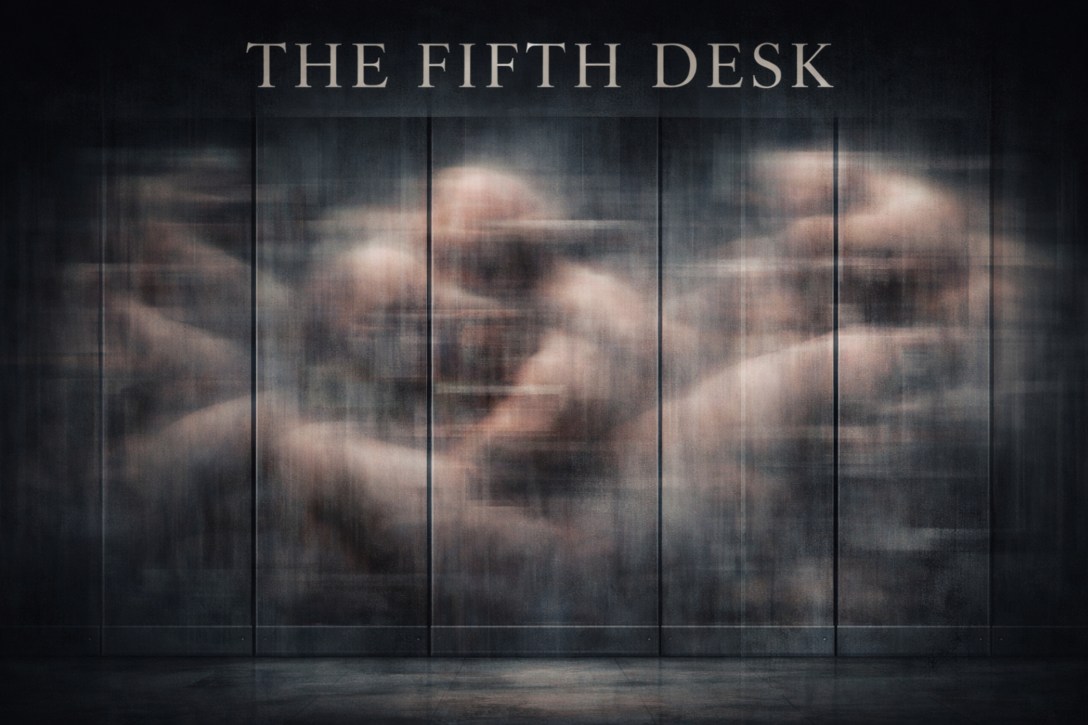
This sequence begins from a condition that was not immediately visible when one first encountered images like these. It once appeared that the body was being distorted—stretched, smeared, subjected to pressure by technical means that degraded its integrity. The violence seemed external, as though something had happened to the image after the fact. Only later does it become clear that this interpretation depended on an assumption that no longer holds: that there existed, somewhere behind the image, a body capable of appearing intact.
What enters these frames is not that body. It is matter that has already passed through systems that no longer recognize embodiment as a stable category. The early images still permit a brief hesitation. Flesh-adjacent tones gather into densities that resemble limbs or cavities; swollen forms suggest proximity to something once organic. But these recognitions do not hold. They flicker and dissolve, not because they are obscured, but because the conditions of visibility have changed. The body has not been damaged. It has been reformatted before it arrives.
This shift did not emerge in isolation. It belongs to the convergence of at least three pressures that reshaped the image long before this sequence made that reshaping visible. The first is technological: the rise of compression, transmission, and sampling systems that treat all visual material as data to be processed, segmented, and redistributed. The second is cultural: the saturation of the image field to the point where representation exhausts itself, no longer able to produce novelty or authority through depiction alone. The third is ontological: the gradual erosion of the body as a privileged site of meaning, replaced by systems that render all matter interoperable within the same circuits of exchange. The images in this gallery do not invent these conditions. They register the moment when those conditions become inescapable.
It is for this reason that distortion is no longer an adequate term. Distortion presumes deviation from an original form. Here, no such form is available. The image does not record a body undergoing transformation; it organizes material that has already been converted into a transmissible state. Circulation is therefore not an effect within the image but its governing logic. Everything moves laterally, without depth, as though the image itself were a channel through which matter is equalized. Flesh-tones do not describe surfaces; they behave as signals passing through a field.
At first, this circulation appears fluid. The eye follows smears and drifts, imagining continuity where none is guaranteed. It is tempting to read these images as viscous, as though the body had been liquefied into motion. This is the final misrecognition the sequence permits. By the middle works, the underlying condition asserts itself more clearly. Vertical segmentation emerges—not as composition, but as infrastructure. The image is divided into channels through which variation is sampled, repeated, and offset. What seemed continuous reveals itself as discretized. Each band holds a slightly altered iteration of the same material, demonstrating that once matter enters this system, individuality persists only as controlled variance.
The movement here is decisive: from image under pressure to image as pressure. The operations that once appeared applied from the outside are revealed as the internal logic of the image itself. Compression, duplication, and drift do not act upon content; they are the content. The body, accordingly, does not disappear through erasure. It persists as residue—skin-adjacent tones, bruised chromatic fields—but these no longer belong to anyone. They remain as color memory, detached from origin, circulating within a system that no longer requires reference.
What follows is not escalation but stabilization. The later images do not calm; they settle. Their fine-grained textures and narrowed tonal ranges indicate that the system has absorbed its material completely. What began as apparent violence resolves into administration. The image no longer convulses because nothing within it resists the processes governing it. This is not the destruction of the body but its full compatibility with the system that processes it.
The checkerboard work reveals what the earlier images concealed. What appeared as flow was never truly continuous. It was always structured by a grid that had not yet become visible. Here, that grid surfaces explicitly, exposing the discreteness underlying the entire sequence. The central disturbance does not rupture the system. It is already contained by it, a localized intensification anticipated by the matrix that surrounds it. This image does not conclude the sequence by adding a new element. It retroactively clarifies every image before it. The system was never fluid. It only appeared so from within the limits of perception.
Seen from this vantage, the historical force of the work becomes legible. These images belong to a post-photographic condition in which the image no longer serves as evidence of a world encountered but as a site where matter is reformatted for circulation. Under such conditions, the body does not vanish because it has been denied. It vanishes because it has been made fully compatible with the same systems that process all other forms of material. The distinction between flesh and signal collapses not through metaphor but through operation.
The epigraph gestures toward this condition in biological terms—exchange, passage, invasion—but the images extend it beyond the human scale. There is no longer a meaningful boundary between intimacy and transmission. To pass through another is not encounter but conversion. Contact becomes transfer, and transfer becomes the only mode of relation the image recognizes.
What this sequence ultimately reveals is not that the body can be distorted by images, but that the contemporary image begins only after the body has already been converted into a transmissible event. There is no original form waiting behind these works to be restored. There is only matter entering a system that segments, duplicates, and redistributes it until resistance becomes illegible. The body is no longer what the image depicts. It is what the image has already learned to process.
 The New Poetics