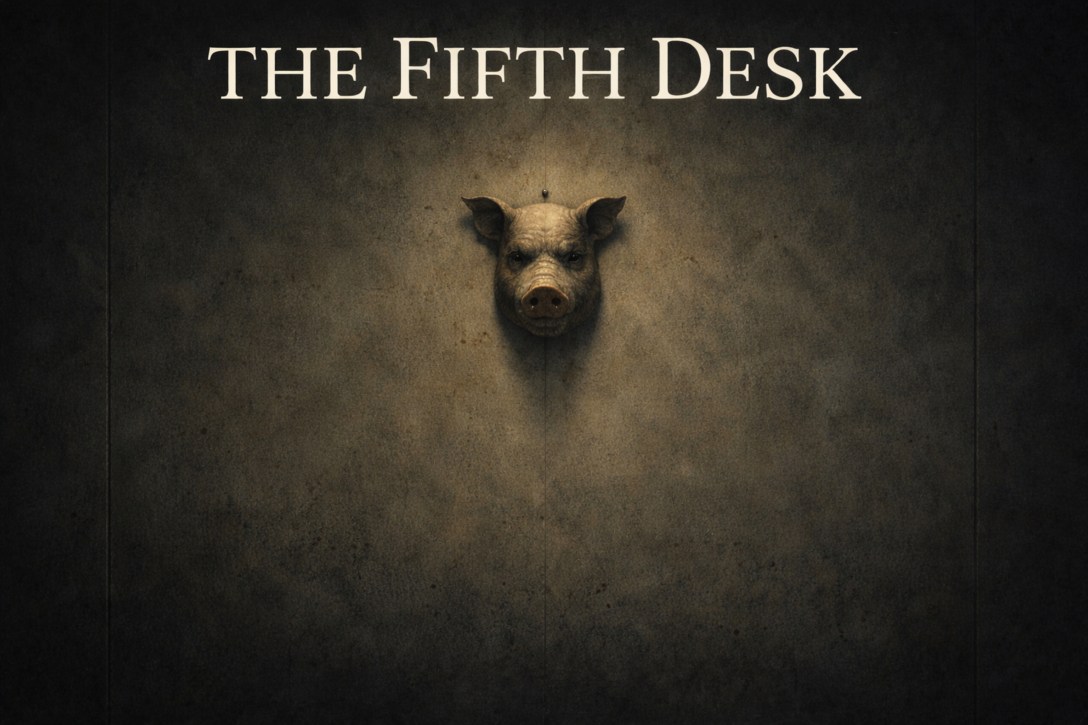
For a long time we believed evil was primitive.
That was the language people used when explaining acts that seemed to exceed ordinary cruelty. Violence was called animalistic. Greed was described as base instinct. Even when crimes appeared elaborate, the explanation usually moved backward in time: the offender had reverted to something older than civilization, something raw that modern institutions were supposed to suppress.
The assumption behind this explanation was simple.
Organization civilized the world.
Rules, procedures, and documentation existed to restrain the darker impulses of human nature. Bureaucracy was not glamorous, but it served a moral purpose. It replaced arbitrary violence with predictable systems. The office was supposed to represent the triumph of structure over chaos.
What we did not recognize at the time was that bureaucracy did not eliminate evil.
It reorganized it.
This transformation becomes visible in a moment that initially reads like grotesque fantasy: the appearance of a pig-headed figure wearing a suit who controls a young man through a collar and leash. The creature’s name is Gorky. Yet the most revealing detail in the encounter is not the grotesque anatomy, the whip, or the leash.
It is the way the creature introduces himself.
“Gorky was my name,” he says. Then, with a hesitation that feels procedural rather than mystical, he adds a second statement whose phrasing quietly reclassifies the entire encounter.
“The name of my office Cannot state.”
The sentence does not belong to mythology.
It belongs to bureaucracy.
A demon from earlier religious imagination would identify himself through allegiance or rank. He would speak of kingdoms, masters, or infernal domains. Gorky instead refers to an office. The word implies position, jurisdiction, hierarchy. It suggests that the creature standing on the field is not merely an agent of destruction but a functionary performing a task within an administrative structure whose upper levels remain concealed.
Evil, in this moment, is not chaotic.
It is organized.
The mechanisms through which Gorky operates reinforce this impression. Around Bobby’s neck hangs a collar. The collar connects to a leash. The leash transmits commands to the body. When the whip cracks, Bobby’s movements respond with mechanical immediacy.
The system functions through instrumentation.
The collar regulates the subject. The leash transmits instruction. The whip supplies correction. The apparatus transforms human behavior into something programmable. Bobby does not merely suffer under this arrangement. His body reacts as though it recognizes the logic of the mechanism already.
That recognition is the crucial detail.
The demon does not introduce oppression into Bobby’s life. The apparatus simply extends patterns that already exist. Earlier in the narrative we learn that Bobby’s father disciplined him with belts, striking him buckle-side down with the explicit intention of teaching obedience. The punishment was not only pain. It was instruction.
Violence became a form of education.
By the time Gorky appears with the collar and leash, Bobby’s nervous system has already learned the language of domination. The supernatural apparatus does not create the condition. It makes visible a structure that had been operating invisibly through ordinary human behavior.
The shadow world, as Dennis later realizes, does not invent cruelty.
It exposes its architecture.
This recognition transforms the encounter from a supernatural episode into something closer to an administrative inspection. Dennis does not respond to the creature with mythic gestures. He asks for identification. He demands that the entity state its name and position. When speech fails him he writes commands into the grass as if the field itself were a sheet of paper.
NAME. OFFICE.
The confrontation begins to resemble an audit.
Dennis’s instinct is procedural. He treats the encounter as if the creature might be subject to the same logic governing every other authority structure he has encountered. Perhaps the entity can be challenged through documentation. Perhaps the system contains rules capable of interrupting its own operations.
For a brief moment the strategy appears to work.
When Dennis seizes the leash and demands identification, Gorky does not react like a mythic monster defending its dominion. Instead the creature hesitates. The response carries the strange tone of bureaucratic compliance. The demon answers the question within limits, revealing its name but refusing to disclose the identity of the office it serves.
The refusal has the unmistakable rhythm of administrative procedure.
Certain information cannot be released.
The implication is unsettling.
The creature itself is not the highest authority in the system it represents. Like many figures operating inside bureaucratic hierarchies, it performs a task whose ultimate origin lies elsewhere. The leash, the whip, the collar—all of them appear as instruments issued from a structure that remains invisible even to the agent carrying them.
The demon is not sovereign.
He is employed.
Once this possibility becomes visible, the scene reorganizes itself. The field where the boys had been playing football begins to resemble a temporary workplace in which two systems collide: the informal world of childhood violence and the formal apparatus of the shadow administration. Dennis’s actions resemble the intervention of an unauthorized auditor attempting to interrupt a disciplinary procedure already in progress.
The outcome is ambiguous.
Gorky withdraws when challenged. But the withdrawal lacks the finality associated with mythic defeat. The creature does not dissolve into smoke or collapse in humiliation. Instead it retreats with a curious resignation, gathering its instruments and walking away as though the shift has ended.
The distinction is important.
Monsters can be destroyed.
Offices continue to exist.
The demon’s retreat suggests that the authority behind the apparatus remains intact. A worker may be forced to leave a site temporarily, but the institution that issued the assignment continues to operate elsewhere. The system persists even when one of its functionaries encounters resistance.
This detail captures something fundamental about modern forms of power.
Earlier societies imagined evil as the intention of identifiable figures: tyrants, devils, criminals whose actions could be traced directly to personal motives. Responsibility could be located in a single body. The defeat of that body promised liberation.
Administrative systems complicate this model.
When harm emerges from procedural structures, responsibility disperses across the network. The decision harming an individual may originate nowhere in particular. It emerges instead from the interaction of rules, classifications, and signals circulating through institutions that appear larger than any person participating in them.
Each participant performs a limited role.
No one claims the entire system.
The demon with an office captures this transformation with unsettling clarity. Gorky appears not as a lord of darkness but as a mid-level functionary carrying out instructions whose source cannot be disclosed. The true authority remains invisible. Only the instruments of enforcement become visible: the leash transmitting commands, the whip delivering correction, the collar fastening the subject to the system.
The structure should feel familiar.
Modern life is filled with similar encounters. People discover themselves constrained by procedures whose origins remain obscure. Documents arrive referencing patterns they did not know existed. Access disappears while matters undergo review somewhere beyond their perception. The individuals implementing these actions rarely appear to exercise personal judgment. They operate the mechanisms of a structure already in motion.
The system behaves like an environment.
Human behavior enters it in the form of signals. The signals trigger responses according to rules embedded within the infrastructure. From the perspective of the individual experiencing these responses, the authority behind them appears strangely impersonal.
This is why the demon identifies himself through an office rather than through a throne.
The language reflects the conceptual environment in which modern power now appears intelligible. Evil is no longer imagined as the eruption of chaos into an orderly world. It is imagined as the operation of systems whose procedures have become too large, too complex, and too distributed for any single participant to fully understand.
The supernatural encounter on the field does not introduce a new force into the story.
It reveals the administrative logic already shaping the world in which the characters live.
Bobby’s father taught the body to expect domination through violence. The demon extends that lesson through a more elaborate apparatus. Dennis attempts to interrupt the process using the only strategy available to him: demanding identification, insisting on procedure, forcing the system to acknowledge its own structure.
For a moment the tactic creates friction within the machinery.
But the machinery itself remains.
Later, when Dennis returns to his room, the pig mask nailed to the wall acquires a new meaning. The object is not a trophy commemorating victory over a supernatural creature. It resembles something closer to a piece of evidence preserved in a file whose investigation has not yet concluded.
A record of contact.
A reminder that the encounter was not an isolated anomaly but a brief glimpse of an administrative order operating just beyond ordinary perception.
The demon did not vanish.
He left the field because the task had been interrupted.
And offices, once established, rarely close.
 The New Poetics