For much of the nineteenth and twentieth centuries, the modern individual believed himself to be the center of the story.
He might have been mistaken, but the belief itself shaped the cultural imagination of the era. The artist, the hero, the rebel, the visionary, the tragic soul—each assumed that history unfolded around the drama of personal destiny. Even failure preserved the dignity of this assumption. The individual might be crushed, misunderstood, or exiled, but the scale of the conflict remained human.
The Romantic individual believed the struggle was between the self and the world.
Western culture organized its myths accordingly. The individual confronted society. The artist confronted institutions. The rebel confronted authority. Even tragedy preserved the sense that the human being stood at the center of the stage, locked in visible conflict with forces that could be named.
But sometime toward the end of the twentieth century, the stage itself began to change.
The opening chapter of The Pale Criminal registers that change with unusual clarity. It does not depict rebellion, catastrophe, or revelation in the traditional sense. Instead it captures a quieter and more disorienting moment: the moment when the individual realizes that the terms of the struggle have been replaced.
The modern individual no longer confronts the world as rival or audience.
He encounters structure.
Not the visible structures of law or ideology, but the deeper infrastructural systems through which contemporary life is organized—architecture, logistics, regulatory frameworks, urban design, technological mediation, administrative logic. These systems do not argue with the individual. They do not persecute him. They simply reorganize the environment within which his existence takes place.
The effect is subtle but total.
The Romantic individual disappears not through repression but through replacement.
The transformation unfolds through the figure of Dennis Flamingo. Nothing dramatic occurs to him. No tragedy announces itself. Instead something begins to grow quietly inside him.
Not illness.
Not madness.
Structure.
The language of the passage makes this unmistakable. Dennis does not experience emotional turmoil. He experiences infrastructure. Beams assume load inside his torso. Rivets seat themselves into marrow. Zoning reforms annex ligament by ligament.
The metaphors do not come from psychology or biology.
They come from engineering.
What the novel captures here is a shift in the cultural vocabulary of interior life. Earlier literary traditions described consciousness through emotion, memory, trauma, longing, or desire. The language of the inner life belonged to the language of the soul.
Dennis experiences something else entirely.
His organs behave like departments.
Breath resembles regulated throughput.
Thought begins to resemble administrative review.
It is as though the language of institutions has migrated inward.
The individual no longer imagines himself as a soul navigating the world. He imagines himself as a system undergoing calibration.
The city surrounding him reflects the same transformation. The Narrows is not depicted as a romantic metropolis of crowds and passions. It behaves more like a processing machine.
Elevators move with disciplined hesitation.
Radiators tick like clerks reconciling accounts.
Pipes adjudicate pressure.
Parking garages regulate access levels.
Bulletins certify structural tolerances.
The city does not sleep.
It processes.
Urban life no longer appears as drama but as infrastructure performing its functions. Citizens move through the environment as participants in a logistical choreography—entering elevators, scanning access cards, occupying calibrated spaces whose tolerances have already been calculated.
Even reassurance itself has become infrastructural.
The billboard Dennis observes—declaring in caramel-colored optimism that things are going to be okay—does not simply offer comfort. It performs stabilization. Its typography, its placement along commuter sightlines, its carefully balanced geometry of reassurance all function as environmental regulation.
Hope has been engineered.
Within such a world the myth of the Romantic individual becomes difficult to sustain. Dennis once believed himself exceptional, a figure temporarily overlooked by a society that would eventually recognize his significance. He carried the faint glow of youthful promise—the assumption that biography would one day bend toward recognition.
But the systems surrounding him have no mechanism for recognizing such claims.
They register variance.
This realization arrives through one of the quietest events in contemporary fiction. A woman walking ahead of Dennis on the sidewalk simply disappears.
Not violently.
Not dramatically.
She is revised.
The city absorbs the event without comment. Pedestrians continue walking. Traffic lights change. The municipal grid remains intact.
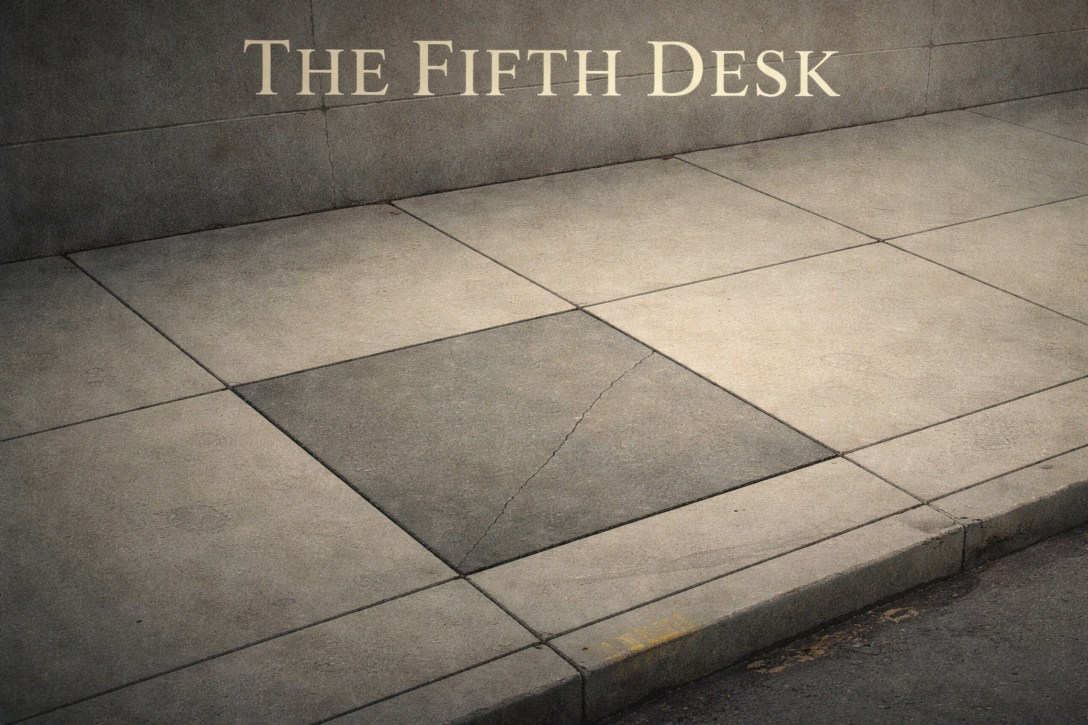
In that moment Dennis realizes something he had never previously considered: the ground beneath the citizen is not merely earth.
It is agreement.
The sidewalk functions as an unspoken contract between the individual and the city, assuring that weight will be supported and movement will proceed without interruption.
When that contract fails, the geometry of reality changes.
The square of pavement where the woman vanished becomes something like an administrative threshold—a place where ordinary assumptions about stability have been suspended.
Standing there Dennis experiences something extraordinary. He no longer feels like a person.
He feels like a value awaiting confirmation.
Height.
Mass.
Clearance.
Intent.
Categories assemble themselves around him as though some unseen system were registering his presence.
The ground has become a checkpoint.
What makes the moment so unsettling is the absence of drama. No authority appears. No explanation is offered. The system does not accuse or threaten.
It simply observes and adjusts.
Later, when Dennis attempts to enter the parking level he normally uses, his clearance has been recalibrated. No explanation is given. The system has not condemned him.
It has merely adjusted his depth.
This is the true horror of the chapter.
Modern authority increasingly operates not through law, punishment, or visible surveillance but through infrastructure—through the subtle recalibration of environments that shape behavior without needing to command it.
Elevation becomes permission.
Depth becomes restriction.
Movement becomes negotiation with invisible systems determining where the citizen may stand.
Procedure begins to acquire a metaphysical quality.
Events no longer occur through passion or catastrophe. They occur through adjustment, processing, calibration. A woman disappears not because violence erupts but because some threshold has been crossed within a system whose logic remains unseen.
Bureaucracy becomes cosmology.
The world begins to resemble an administrative structure processing its inhabitants according to criteria they cannot fully perceive.
The Romantic narrative dissolves.
What *The Pale Criminal* captures in this opening movement is therefore not simply an eerie event or a strange atmosphere. It captures a transformation in the cultural structure of modern life.
The individual once believed that history was the arena in which personal destiny unfolded. Increasingly history appears instead as the expansion of systems—technical, logistical, infrastructural—within which personal narratives carry diminishing authority.
The individual once confronted society.
Dennis Flamingo discovers that society itself has been replaced by something more impersonal: networks of structure that do not argue with the self, do not persecute it, and do not particularly notice it—unless it becomes variance.
This realization extends far beyond the novel.
Across the last several decades culture itself has increasingly shifted from expressive forms toward systemic ones. Music circulates through platforms rather than stages. Images travel through networks rather than galleries. Stories migrate across media infrastructures rather than remaining confined to individual works.
Meaning emerges less from the isolated voice of the individual and more from the interaction of systems—archives, platforms, institutions, algorithms, distribution networks.
The expressive mythology that dominated modern art for two centuries no longer adequately describes the terrain.
Something else has taken its place.
The recognition that culture now operates through structures.
The New Poetics begins from precisely this recognition. It does not assume that the artist stands outside the systems of modern culture. It begins from the opposite premise: that contemporary creativity unfolds inside environments composed of infrastructures—technological, institutional, and historical—that shape the conditions of meaning itself.
The task of art under these conditions is no longer merely to express the self.
It is to reveal the structures within which the self now exists.
In that sense the square of sidewalk in The Pale Criminal is more than a narrative device.
It marks the moment when modern culture realizes that the surfaces it trusted—individual expression, personal destiny, the mythology of biography—are no longer stable ground.
Beneath them lies another architecture.
And once that architecture becomes visible, the individual must confront a different question.
Not how to assert himself against the world.
But how to understand the systems through which the world now operates.
The storm, it turns out, was never the individual’s struggle with society.
The storm was structure itself.
And the square where the woman vanished was simply the first place where the ground gave way.
 The New Poetics