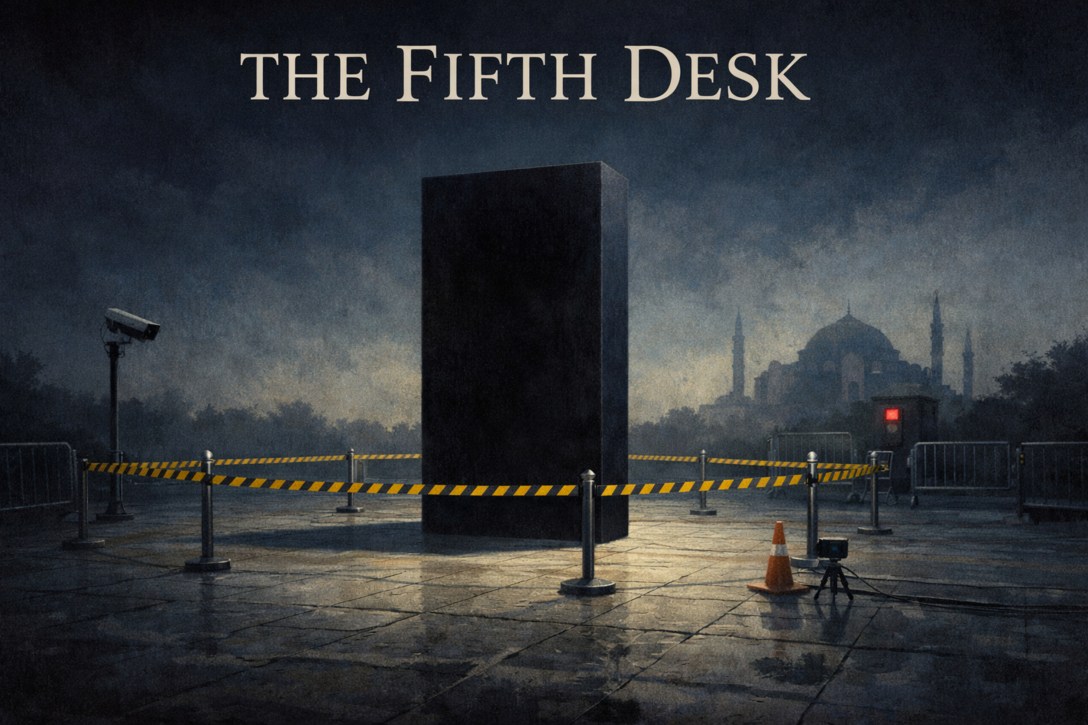
The black slab in the courtyard of Ayasofya was not treated as miracle.
It was treated as paperwork.
Within hours the object had been measured, categorized, perimetered, insured, and circulated through the informational bloodstream of the modern world with the quiet inevitability of payroll. Engineers discussed density. Analysts proposed alloys. Insurance underwriters drafted liability riders. Municipal authorities established buffer zones and patrol schedules. The news ticker delivered the update in the same neutral font used to report port delays and market fluctuations.
Exact same measurements.
The phrase repeated across broadcasts and internal bulletins until the object ceased to resemble mystery and began to resemble specification. A thing that appears once may be miracle. A thing that appears twice with identical dimensions becomes rule.
Repetition converts anomaly into classification.
The appearance of the second slab transformed the phenomenon from spectacle into infrastructure. The impossible had entered the world in duplicate. That single fact activated the reflexes of a civilization whose primary instrument of understanding is not myth but measurement.
Preliminary Object Classification Framework — Global Response Draft v1.2.
Category A: Natural geological formation.
Category B: Terrestrial fabrication.
Category C: Extraterrestrial artifact.
Category D: Coordinated psychological operation.
Category E: Unknown engineered intrusion.
Probability matrices were assigned. Spectrographic models circulated. Thermal scans were interpreted by consultants who had never approached the object. Insurance carriers drafted provisional language covering damages within a 2.3 meter perimeter radius while excluding compensation for symbolic disruption or existential destabilization.
The slab had not yet been touched.
But it had already been processed.
This reaction reveals something fundamental about the architecture of contemporary civilization. Earlier cultures confronted the inexplicable through narrative and ritual. The appearance of an impossible object would have generated prophecy, pilgrimage, denunciation, or worship. Even skepticism would have emerged in philosophical argument.
The modern system responds differently.
It measures.
Measurement precedes belief. Measurement outlives outrage. Measurement converts the unknown into something that can be entered into a ledger. Once dimensions are established, the object becomes manageable. Height, width, depth — these numbers function as coordinates within a world whose ultimate authority is quantification.
Exact same measurements.
The repetition of those numbers began to carry an unsettling weight. Two identical slabs suggested not accident but geometry — coordinates within a structure already inscribed into the world’s deeper substrate. Engineers debated anchoring mechanisms. Structural physicists speculated about density. One consultant suggested the object might be resting on probability rather than foundation.
The broadcast transitioned calmly to weather.
Meanwhile the system continued its work.
The first official response to the slab in Ayasofya’s courtyard was not interpretation but containment. Temporary barriers were erected. Security officers established a buffer radius. Citizens gathered behind tape lines with the uneasy stillness reserved for funerals and construction sites.
The object had violated perimeter.
In modern civilization, perimeter is sacred.
Earlier cultures organized the sacred around centers. The temple created a place where the divine could be approached. Pilgrims moved inward toward revelation. Rituals unfolded at the point of contact between human and transcendent.
The modern city operates according to the opposite logic.
Sacred objects are not approached.
They are buffered.
Establish perimeter.
Security replaces metaphysics. The unknown is not interpreted but contained. The sacred no longer produces pilgrimage. It produces restricted access zones and crowd management protocols.
Perimeter is theology now.
The slab’s greatest violation was not symbolic. It was procedural. The courtyard in which it appeared possessed surveillance cameras, credentialed entry points, and established security protocols. No vehicle logs recorded its installation. No access badges had been used. The object had entered a controlled environment without authorization.
Occupancy without clearance.
The system therefore attempted to reassert control through the only language it trusts.
Measurement.
Engineers examined surface density. Analysts debated material composition. Insurance carriers drafted coverage thresholds. Municipal contractors discussed removal procedures. Each effort assumed that once the object had been properly described it would eventually submit to procedure.
But the slab did not behave like an installation.
It behaved like a fact.
It neither requested permission nor acknowledged classification. It simply occupied space. Engineers could not determine whether it rested on foundation, anchor, or substrate. It appeared neither bolted nor poured. It stood without visible fastening.
In a civilization organized around authentication, such existence borders on heresy.
Authentication governs modern identity. The citizen does not declare who he is. He proves it. Card swipes open doors. Login codes activate terminals. Registry databases verify origin fields. Corporate portals grant access through procedural gestures that confirm the individual’s legitimacy within the system.
Access granted.
Identity is no longer narrative. It is verification.
This logic extends across every domain of contemporary life. Airports divide passengers into security zones. Office buildings regulate entry through authentication pulses. Digital networks gate information behind passwords and credentials. The individual moves through the world not as a self but as a credential repeatedly validated by invisible systems.
The monolith did not authenticate.
It occupied.
Occupancy without clearance is the ultimate violation of the administrative order. The slab’s silent refusal to participate in procedural logic exposed the fragility of the structures surrounding it. A civilization that depends on authentication cannot easily interpret a presence that ignores permission entirely.
Meanwhile the surveillance systems continued their work.
Cameras recorded crowd density around the courtyard. Predictive models calculated pedestrian flow. Heat maps tracked fluctuations in proximity to the perimeter barrier. The modern city observes everything with patient diligence.
Observation, however, is not the same as intervention.
Later that day, when Dennis Flamingo was assaulted in an alley behind Floyd, the surveillance grid registered the event. Cameras captured fragments of movement. Predictive algorithms evaluated recurrence probability. Insurance thresholds were consulted. Threat level assigned.
Threat Level: Low.
Response Recommendation: No Action Required.
The system had seen the incident perfectly. It simply determined that intervention was unnecessary. Surveillance replaces responsibility. The modern apparatus does not exist primarily to protect the citizen. It exists to record variance.
Street contact. Moderate impact. Clearance unchanged.
The assault became data.
Threat probability adjusted. Algorithm confidence recalculated. The dashboard refreshed. Sector stable.
This transformation reveals the deeper structure beneath contemporary civilization. The administrative imagination no longer interprets events in moral or narrative terms. It processes them as deviations within a statistical environment. Violence becomes an entry in a database. Suffering becomes a variable within a predictive model.
Meaning remains outside the system’s jurisdiction.
The slab in Ayasofya occupies a similar position. Analysts debate density and origin because those categories belong to the language of the administrative world. But the object itself does not participate in that language. It does not submit data. It does not request interpretation. It stands.
Exact same measurements.
The phrase continues circulating through networks of analysis and speculation. Engineers will measure again. Governments will extend perimeters. Insurance carriers will refine coverage clauses. Surveillance grids will monitor crowd response. The system will continue expanding its apparatus of classification around the object.
But the slab will remain indifferent.
Its silence reveals something the modern world has forgotten how to recognize.
Not miracle.
Not omen.
Simply the possibility that reality may contain structures beyond the reach of administrative thought.
The modern system assumes that authority emerges from organized frameworks — governments issuing permits, corporations managing infrastructures, surveillance networks regulating movement, algorithms calculating risk. Power flows through institutions that authenticate their own legitimacy through procedure.
The slab introduces a different possibility.
An object that occupies space without authorization.
A structure that appears without clearance.
A geometry that repeats itself without explanation.
Exact same measurements.
The modern world will continue measuring those dimensions. It will debate alloys, speculate about extraterrestrial fabrication, and draft insurance riders for unforeseen monolithic manifestations. The system will absorb the phenomenon into its databases and dashboards.
But the slab will continue standing in the courtyard, silent and rectangular, indifferent to classification.
It will not request access.
It will not authenticate identity.
It will not recognize perimeter.
And that indifference will reveal the deeper truth the system cannot fully process.
The slabs did not invade the world.
They revealed the world we had already built.
A civilization where mystery is measured, the sacred is buffered, the citizen is authenticated, and observation replaces responsibility.
Perimeter is theology now.
But the monolith did not ask where the boundary lies.
 The New Poetics