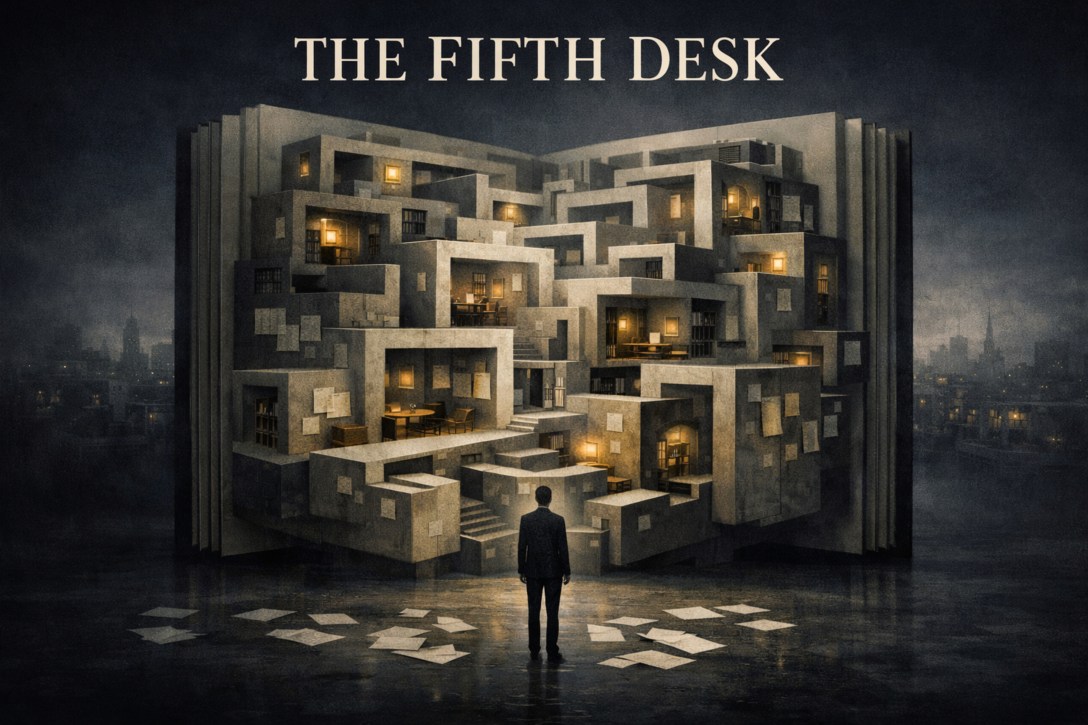
Literary history stories behaved like paths. A narrative began somewhere, moved through a sequence of events, and eventually arrived at a conclusion. The reader progressed through the work in roughly the same order the author had arranged it. Even the most complex novels preserved this basic structure: a line extending from the first page to the last.
The story unfolded.
This linear model of narrative proved remarkably durable. It survived the transition from oral storytelling to printed books, from serialized magazines to modern novels. Authors experimented with perspective, chronology, and voice, but the reader still experienced the work as a journey through a fixed sequence of pages.
The story remained a path.
Yet in the late twentieth century something unusual began to happen to narrative.
Writers started building worlds.
The shift appeared gradually at first. Certain novels expanded outward in scale, incorporating documents, historical fragments, bureaucratic records, newspaper clippings, and invented archives. Instead of presenting a single continuous storyline, these works assembled multiple narrative threads that intersected within a larger environment.
The reader no longer followed a single path.
They explored a landscape.
This transformation did not originate solely within literature. It emerged simultaneously across several cultural domains. Television series extended narratives across dozens of hours rather than compressing them into a single film. Video games constructed environments that players navigated freely. Online communities developed collaborative storytelling spaces where fragments of narrative accumulated over time.
Stories began to behave less like lines and more like systems.
A narrative system does not necessarily move toward a single resolution. Instead it establishes a world governed by internal rules. Characters inhabit this environment, events unfold within it, and the reader gradually learns how the system operates.
Meaning emerges from the structure of the world itself.
This shift reflects the broader cultural conditions described in the earlier essays of the Fifth Desk. Contemporary media environments are defined by vast archives, networked circulation, and complex systems of information. Audiences have grown accustomed to navigating intricate structures of data, images, and signals. Under these conditions the traditional linear narrative can begin to feel strangely narrow.
A world offers something different.
Instead of presenting a predetermined sequence of events, the narrative system invites the reader to inhabit an environment where multiple stories may exist simultaneously. Some threads unfold in the foreground while others remain partially hidden within the background of the world. The reader encounters fragments of history, traces of institutions, and hints of events that occurred long before the narrative began.
The story becomes one visible portion of a much larger structure.
This approach changes the role of the author.
In the traditional model the writer functioned primarily as a storyteller. Their task was to arrange events into a compelling sequence that guided the reader from beginning to end. In the systemic model the writer begins to resemble an architect.
He designs the world.
The author establishes the rules governing the environment: its institutions, histories, geographies, and internal logic. Once those rules exist, stories can emerge from within the system rather than being imposed from outside.
Characters move through the structure.
Events occur because the world makes them possible.
The reader experiences the narrative not simply as a sequence but as an encounter with a constructed reality whose boundaries extend beyond the visible plot.
This approach produces a distinctive reading experience. Instead of asking only what will happen next, the reader begins to ask how the world itself functions. Why do certain institutions exist? What historical events shaped the present conditions of the story? What unseen forces operate behind the actions of the characters?
The narrative becomes a form of investigation.
Readers search the environment for clues that reveal the deeper logic of the world. Documents, rumors, bureaucratic records, and fragments of conversation acquire new importance because they provide glimpses into the system underlying the visible events.
The pleasure of reading shifts slightly.
Instead of deriving satisfaction solely from the resolution of a plot, the reader begins to enjoy the gradual discovery of structure. The world reveals itself piece by piece as the reader moves through the text.
The story becomes an interface.
Within the framework of the New Poetics, this approach to narrative finds expression in a literary project known as Wormwood Press.
The name suggests something ancient and faintly poisonous: a bitter herb appearing in religious texts and historical medicine, associated with altered states and unsettling revelations. The choice is appropriate. Wormwood Press publishes works that treat narrative not as a vehicle for personal expression but as an environment in which systems of meaning unfold.
The novels emerging from this approach do not simply recount events.
They construct worlds.
Documents accumulate inside these worlds. Institutions develop their own bureaucratic languages. Histories branch outward from obscure incidents whose consequences ripple through the narrative environment. Characters navigate structures that appear stable on the surface but conceal deeper layers of organization.
The reader enters the system gradually.
At first the world may seem opaque, filled with unfamiliar terms and unexplained references. But as the narrative progresses patterns begin to emerge. Connections form between fragments of information scattered across different sections of the text. The structure of the world becomes visible through repetition and variation.
The novel begins to resemble a black box.
The reader encounters outputs—events, documents, conversations—but must infer the underlying rules that connect them. Meaning emerges not through explanation but through structural discovery.
Stories continue to unfold within this environment, but they do so as consequences of the system rather than as expressions of a single guiding voice.
The author remains present as the architect of the world, yet the narrative itself appears to operate according to internal logic that extends beyond any individual character’s perspective.
The story is no longer merely told.
It is generated by the structure that contains it.
Under these conditions literature begins to share something with the other artistic domains explored by the New Poetics. Music operates as a hidden compositional system. Images behave as signals within digital networks. Video reveals the instability of electronic transmission. Narrative joins these fields by transforming into an environment whose rules shape the events occurring within it.
The novel becomes a machine for producing stories.
Readers enter the system and begin the slow process of understanding how it works.
And somewhere inside that machinery, the world of the narrative continues to unfold.
 The New Poetics