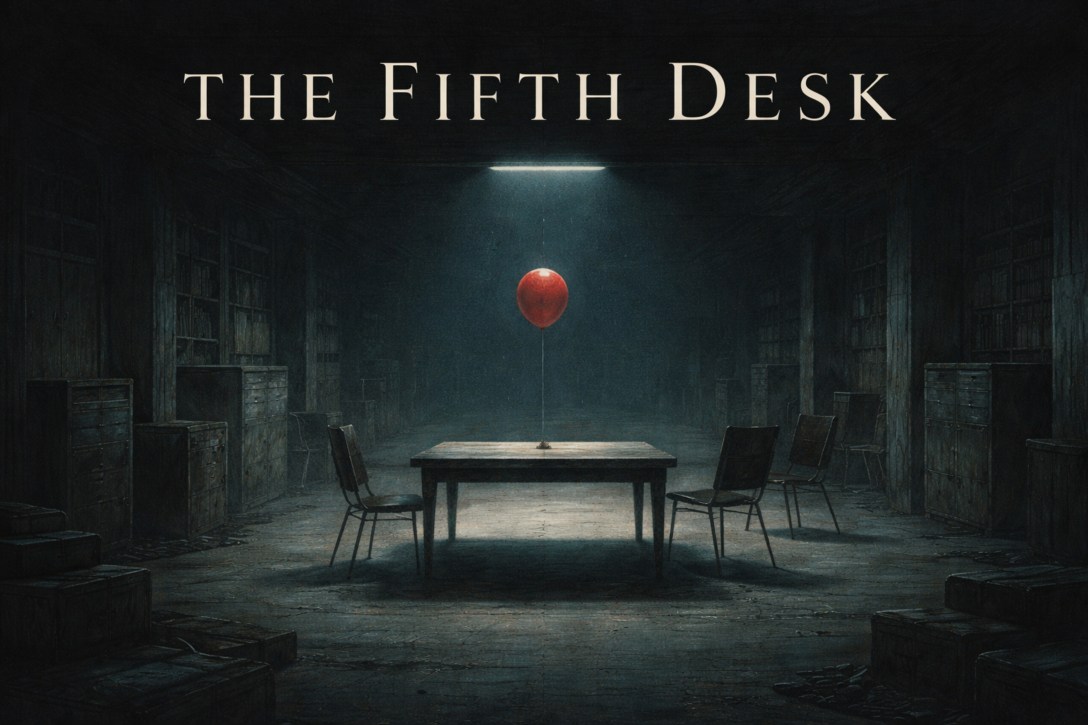
The bunker appears midway through Fathers and Sons, but the structure it reveals has been operating from the first page. By the time the characters enter it, the essential work of the story has already been underway for hundreds of lines. Pressure has been moving quietly through rooms, messages, corridors, meetings, meals, funerals, and absences. Aeneas has already been installed as a stabilizing presence within a larger human arrangement. The others have already learned, without fully knowing that they have learned, to distribute judgment around his existence. And the narrative has already begun the slow transfer that will become visible only after he is gone.
What the bunker does is not introduce mystery. It withdraws camouflage.
This matters because Fathers and Sons is not fundamentally a story about a hidden place, a red balloon, an anomalous space, or even grief in its familiar literary form. Those elements are real, but they are secondary. The story’s deepest subject is the movement of burden through a network after the central load-bearing figure has been removed. Its real drama lies in the fact that responsibility does not disappear when its most durable carrier disappears. It recalculates. It spreads. It seeks new points of support. The bunker is where that redistribution becomes legible.
At first the story can be mistaken for a sequence of highly controlled episodes arranged around secrecy, initiation, institutional depth, and metaphysical disturbance. The prose encourages that misreading because it refuses the usual explanatory comforts. Places do not identify themselves. Systems do not disclose their purpose. Instructions arrive without context. Buildings exceed their facades. People receive access, refusal, invitation, and exclusion without being told what principle governs the distinction. The reader is placed in the same position as the characters: inside a functioning order that reveals itself only through contact, never through declaration.
Yet even before the bunker appears, the story has established a more decisive pattern. Aeneas, Randolph, Caleb, Abelard, Lavinia, Terry, and Heloise do not merely inhabit the same world. They inhabit the same moral field. Their lives touch one another less through confession than through pressure. Messages arrive and are not answered. Meetings occur and fail to settle what they gather around. Institutions absorb people differentially, admitting some, refusing others, recording some forms of presence while leaving others unregistered. What looks, at first, like dispersed characterization gradually discloses itself as a system of unequal bearing.
Aeneas is central to this system, but not in the conventional way protagonists are central. He is not simply the person whose fate matters most. He is the figure through whom weight passes with the least visible distortion. He moves through the factory, the bunker, the archive of weapons and paintings, the anomaly near the ceiling, the numbered corridors, and the procedural depths with a composure that is not innocence and not mastery. He does not explain the system because he is not outside it. He holds inside it. That distinction is crucial. Fathers and Sons gives him the structural function of a load-bearing element. He is the person through whom contradiction can pass without immediate collapse.
This is why his disappearance changes everything while seeming, at first, to change so little.
The news of his death moves through the remaining characters not as a unified emotional event but as a series of differently registered failures of support. Terry receives it while counting change, Randolph while boiling water, Caleb through an already stabilized thread, Abelard in a room arranged for institutional handling, Lavinia in the chemically sharpened disarray of her own life, Heloise while folding laundry and preparing to become the medium through which the fact must pass into another body. These are not merely varied reactions. They are demonstrations of distributed burden under altered conditions. Once Aeneas is gone, no single person inherits his place. Instead the story shows the network beginning to carry him badly.
That badly is the point.
A weaker work would turn this into psychology alone. It would ask who loved him most, who failed him most, who knew him truly, who deserves absolution, who cannot go on. Fathers and Sons refuses that simplification because it understands that the pressure of modern life is rarely organized in such clear personal lines. People do not simply feel one another. They process one another through institutions, obligations, protocols, inherited roles, delayed messages, procedural assignments, formal meetings, and tacit arrangements that have no obvious beginning and no clean end. By the time grief arrives, it has to move through structures already built for other purposes.
The genius of the story lies in the fact that it turns this condition into form.
Its episodes do not accumulate like chapters in a conventional plot. They behave like connected chambers in a larger system. Each scene appears locally complete while quietly altering the pressure conditions of the next. The diner, the warehouse, the records corridor, the sealed gate, the room of negotiated intimacy, the funeral, the bar, the club, the bath, the school, the vacant lot, the restaurant, the final image of distributed stabilization—none of these scenes serves as simple backdrop. Each functions as an environment in which weight is being transferred, deferred, disguised, or briefly held. The story’s structure is infrastructural before it is dramatic. One moves through it the way one moves through a built system: not always understanding the whole, but constantly being shaped by it.
The bunker is therefore not an interruption in the story’s logic. It is its clearest expression.
Before the characters arrive there, the novel has already trained us in how to read such a place. Exterior and interior do not correspond. Access is uneven. Corridors revise expectation. Categories persist after use has withdrawn. Legacy systems remain in place long after their original rationale has vanished. Objects are preserved not because they are active but because they still bear structural significance. Artworks do not decorate. They orient. Numbers do not merely identify. They recur as instructions, permissions, refusals, and latent alignments. Space itself behaves like a record of prior decisions.
This is where the bunker exceeds allegory. It is not merely “the unconscious,” “history,” “the state,” or “memory.” It is a model of how contemporary systems actually feel from within when their purposes have been sedimented across decades of procedural use. The storage wings, obsolete devices, climate-held armories, revised labels, sealed archives, decommissioned Lagados units, preserved machines, overwritten signage, and incompatible numbering systems all point to the same condition: institutions outlive the explanations that once justified them, yet continue to organize human movement anyway. What remains is not transparent power but administrative afterlife.
Fathers and Sons understands that this afterlife is one of the defining textures of modernity. We increasingly live among systems whose functions are partly withdrawn from consciousness but whose effects remain intimate. We pass through schools, clinics, offices, platforms, data systems, bureaucracies, therapeutic vocabularies, legal structures, surveillance environments, and logistical architectures that do not need to explain themselves to shape us. Their legitimacy is often inherited, their procedures revised rather than rethought, their categories preserved through amendments, patches, and retrofits. The bunker is powerful because it feels less like fantasy than like the hidden truth of such environments brought to the surface.
But the story would still not be extraordinary if the bunker were only a brilliant institutional image. Its real ambition lies in what it places inside that image: the redistribution of burden after the loss of a central carrier.
When the surviving figures gather in the bunker, they do not arrive as a mourners’ chorus convened for revelation. They arrive as differently burdened participants in a structure that has already begun to fail unevenly. Terry brings the ache of impact and the exhausted knowledge that apology does not repair; Randolph brings the memory of refusal, of having been recognized well enough to be excluded; Caleb brings procedural correctness and the dawning recognition that correctness can coexist with catastrophe; Abelard brings the habits of authority after authority has ceased to organize experience; Lavinia brings the chemically mediated volatility of a person who has survived by converting consequence into sensation; Heloise brings the intolerable condition of being the body through which endings continue to move; Orion brings something else entirely, not innocence in the sentimental sense, but local recalibration, the ability to stand where the system briefly corrects around him.
That last point is decisive. Orion is not a symbol of purity. He is a structural event.
Throughout the later sections of the story, the environment repeatedly adjusts in relation to him. Floors level beneath him. distortions settle around his placement. The room quiets where he stands. The chaos chamber finds a center around his position. The balloon encounter distributes pressure through his gesture toward Terry. He is not outside the system; he is the point at which the system reveals that another arrangement is possible. This is why the novel’s treatment of generational transmission is so much richer than the title first suggests. Fathers and Sons is not mainly about inheritance as bloodline, patriarchy, or repetition of paternal authority, though all of those resonances remain active. It is about transmission of burden across generations under conditions where the old load-bearing forms have become unstable.
The fathers in such a world are not simply men. They are structures of carriage. The sons are not simply children. They are whatever comes next in the chain of support, whether willingly or not.
The title becomes devastating once the bunker clarifies the story’s architecture. Aeneas is not merely a lost figure remembered by those who remain. He is the absent support around which a new moral distribution must now form. The others do not only mourn him. They begin, unevenly and without agreement, to inherit the weight he had been helping hold. The question the story asks is not whether such inheritance is fair. It is whether any human system can proceed without it.
This is why the bunker’s central room matters so much. It is often tempting to describe that sequence in mystical terms, and certainly the story permits that register: the seam in the table, the basin of pressure, the sense of saturated surfaces, the room’s relational adjustments, the way statements alter the environment, the feeling that what is being asked cannot be solved by ordinary explanation. But the scene is even more powerful when read structurally. What occurs there is not revelation in the cheap sense. It is accounting.
Not accounting as bookkeeping alone, though the story repeatedly gestures toward ledgers, records, forms, registries, audit trails, protocols, badges, report lines, serials, amendments, threads, and procedural documents. Rather, accounting as the forced appearance of what has already been distributed. The room does not create burden. It reveals how burden has already been allocated and where it remains uncarried. This is why the language around the table keeps circling around terms like balance, ledger, review, accounting, and cost. The story is showing that modern responsibility is less often a matter of identifying one guilty actor than of recognizing a field of unequal bearing.
This is the most difficult truth the novel attempts, and also its greatest achievement. It is easy to write stories in which everyone is responsible and therefore no one is. It is easy to write stories in which one person bears the moral charge and everyone else reacts. Fathers and Sons avoids both failures. It insists that burden is distributed, but not equally; shared, but not dissolved; inherited, but not absolving. Terry can stand in something he cannot fully name; Caleb can recognize that procedure never closed the account; Heloise can insist, with terrible accuracy, that she has already paid; Abelard can discover that restraint was never the same as care; Lavinia can feel the unfairness without converting it into irony; Randolph can know that refusal leaves a shape even after the gate is gone. None of these recognitions cancels the others. Together they form the moral weather of the story.
The burial scene prepares this understanding with astonishing force. What appears there at first as supernatural refusal is inseparable from the logic of burden the novel has been building from the start. The coffin suspends, the machinery fails to complete its assigned operation, Heloise breaks open in accusation, procedure loses its authority, and the gathered figures discover that the event cannot simply be processed. This is one of the most important scenes in the collection because it identifies the limit point of administrative civilization. Systems can lower the body, speak the words, manage the sequence, assign the roles, and keep the time. But they cannot guarantee assent. They cannot make the burden of the dead move on schedule.
The coffin’s refusal to descend is therefore not a decorative marvel. It is a structural interruption. The normal mechanisms by which grief is socially processed cease to function. What is exposed in that suspension is the gap between procedure and carriage. The burial system can continue to perform itself, but the weight has not yet been redistributed in a way the living can bear. The dead cannot be “put away” because his burden remains active in the network. Only once that burden has begun to shift—once the ledger of the living starts to change—can descent occur. Even then, it does not happen through machinery. The ground rises to meet the coffin. The system is not repaired; it is bypassed by a deeper rebalancing.
That is the novel’s governing image.
To say that Fathers and Sons is about responsibility is true but insufficient. Many novels are about responsibility. What sets this one apart is that it understands responsibility as infrastructural. It is not merely an ethical feeling or a moral verdict. It is a load condition. Some people carry more because they are built, placed, trained, or coerced into carrying more. Some move freely because someone else is already bearing what would otherwise press on them. Some survive by refusing carriage until refusal itself becomes a burden. Some inherit pressure before they can name it. Some become, without consent, the place where unfinished things continue to arrive.
The bunker stages all of this by making architecture think. Its rooms are not symbols of inner life so much as environments in which historical forms of burden become sensible. The darkness room, the abyss room, the water room, the chaos room, the armory, the decommissioned compliance hardware, the archived machines, the preserved tools, the sealed garments, the relic objects, the unstable corridors, the non-identical clocks, the floors that change their agreement with the body—these are all modes of storage. They hold accumulated force. They preserve unresolved conditions. They make visible the fact that systems remember more than their operators do.
This is why the novel’s formal restraint is so essential. A more demonstrative prose would have reduced the pressure to statement. This prose does the opposite. It lets alignment, temperature, timing, spacing, sequence, posture, and recurrence do the work. The characters rarely interpret themselves correctly in the moment. The narration does not rush to help them. Meaning emerges through repeated operations: arriving early, waiting, being admitted, not being admitted, noticing a misalignment, correcting a surface, receiving a message, checking a watch, standing in the wrong or right place long enough for the environment to answer. Such repetitions create a narrative rhythm in which burden is felt before it is theorized.
That is one reason the essayistic temptation around this story must be resisted. One can say too quickly that the bunker is history, that the balloon is transcendence, that Orion is hope, that Aeneas is sacrifice, that the table is judgment, that the collection is about community after loss. All of those claims diminish the novel because they convert operations into meanings before the operations have finished disclosing themselves. Fathers and Sons is stronger than interpretation at that level because it does not merely symbolize a condition. It reproduces one. It makes the reader inhabit a world in which unseen systems are continually redistributing pressure among people who do not control the terms of that distribution but are nonetheless responsible for how they stand within it.
That reproduction is historically exact.
We live increasingly inside forms of life where burden is decentralized without becoming less real. Economic systems distribute precarity across households, gig networks, debt chains, and logistical infrastructures until no single institution appears to have caused the exhaustion everyone feels. Administrative cultures translate obligation into procedure, making it possible for people to harm one another politely, to fail one another compliantly, or to preserve unjust arrangements through the neutral language of continuity. Digital systems amplify this condition by archiving every interaction while clarifying almost nothing about who truly bears the cost. Public life becomes a sequence of redistributions. Private life becomes the hidden site where those redistributions are metabolized. Families, friendships, lovers, coworkers, parents, and children all inherit pressure from systems whose operations exceed their personal intentions.
Fathers and Sons is one of the rare works in the collection that understands this condition not as background but as destiny of form.
Its burden is therefore double. Within the story, it shows characters learning that no structure remains stable once the wrong weight is left unshared. Within the collection, it shoulders the larger task of explaining what many of the other pieces only approach from oblique angles: that contemporary life is organized less by isolated acts than by the movement of consequence across poorly acknowledged networks of support. The story can carry that responsibility because it never retreats into thesis. It lets the architecture speak.
Even the red balloon, which in a lesser work would become a sentimental emblem or an easy metaphysical sign, is handled with exact structural intelligence. It does not descend as message. It appears as pressure localized into form. It remains suspended, untethered, fixed against the weather, altering alignment without demanding interpretation. People register it bodily before they know what to think. Terry feels weight settling through his stance. Lavinia feels a familiar vibration return in steadier form. Caleb experiences awe without relief. Randolph notices not the arrival of pressure but the absence of his usual tightening. Orion addresses it without fear because he is already native to the logic by which it operates. The balloon is not closure. It is redistributed stability made visible for a moment.
This is why the novel’s ending is so much wiser than a simple reconciliation would have been. The group does not become whole. No final conversation resolves the past. No plan is made for permanent mutual repair. The burden is not erased. The system does not vanish. The city continues. Pipes carry water. electrical grids balance load. foundations settle. tiny preventions occur without witness. What changes is not the existence of weight but its distribution. For now, within tolerances too small to measure and too large to deny, the system holds.
That last phrase matters because it names the novel’s deepest refusal of illusion. There is no promise here that the new arrangement will remain stable forever. There is only the recognition that collapse has been delayed by shared carriage. This is not consolation in the sentimental sense. It is a severe, modern form of hope: not that someone pure will save us, not that the dead will explain themselves, not that systems will become just on their own, but that weight can sometimes be redistributed before total failure, and that such redistribution is the beginning of moral life rather than its end.
In that sense Fathers and Sons may be the collection’s most necessary work. It understands that the crisis of our time is not simply cruelty, fragmentation, alienation, or loss of meaning, though all of those remain real. It is the crisis of bearing: who carries what, on whose behalf, through which systems, until when, and at what hidden cost. Aeneas matters because he had been carrying more than anyone knew. The bunker matters because it makes the hidden ledger visible. The survivors matter because they do not all step forward equally, yet enough of them do to prevent the structure from failing entirely. Orion matters because the future enters not as innocence but as a new local arrangement of gravity. The story matters because it reveals that what looks like fate is often a pattern of unrecognized load.
I did not see that immediately. At first I saw only the force of the scenes, the strange exactness of the spaces, the brilliance of the burial, the uncanny coherence of the bunker, the suspended balloon above the lot. It took time to understand that the real subject was more difficult and more decisive. The story was showing, with unusual mercy and unusual rigor, that people live inside one another’s unfinished distributions. Some inherit debts they did not incur. Some benefit from carriage they never notice. Some become structures for others and disappear before the system can acknowledge what they held. Some learn too late that restraint was never enough. Some discover that presence itself can rebalance a room. And sometimes, for a moment, the ledger opens before total collapse and the living are given a chance to carry differently.
That is not redemption. It is accounting.
And it may be the only form of seriousness still available to us.
 The New Poetics