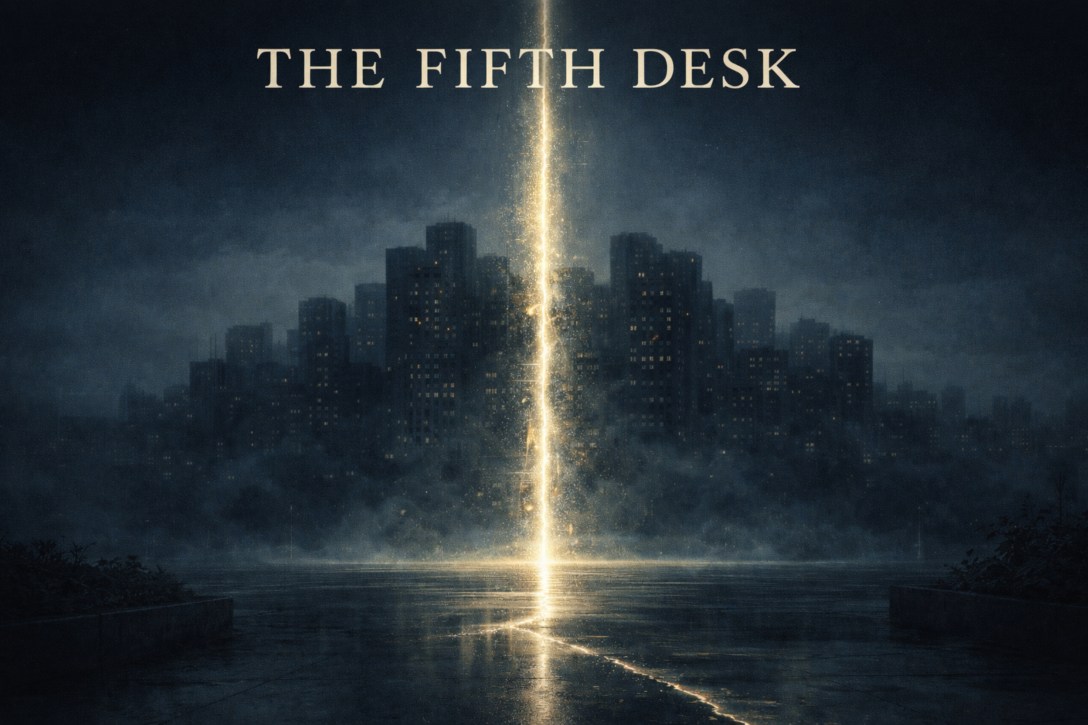
For most of his life the world had possessed a reassuring quality of continuity.
Buildings remained where they had been the day before. Streets followed the same lines across the map. Weather arrived in recognizable forms: rain, wind, snow. Even disruption appeared within familiar limits. A storm passed. Traffic resumed. Offices reopened the following morning as though the interruption had been absorbed into the ordinary rhythm of the city.
The stability of these surfaces made the world appear natural. It gave the impression that reality was a single, continuous fabric extending outward in all directions.
Only later did it become possible to notice something quieter beneath that appearance.
What seemed seamless often behaved as though it had been assembled.
One does not notice this immediately. The mind prefers continuity. But occasionally a small irregularity appears in the fabric of ordinary experience. Nothing dramatic collapses. The buildings remain standing. The streets remain where they were. Yet something in the alignment of events feels slightly off, as though two pieces of a larger structure have shifted against one another.
When that happens the surface of the world briefly reveals a seam.
A seam is not a tear. A tear suggests damage. A seam suggests construction. It implies that what appears continuous is actually composed of elements joined together with varying degrees of precision.
The strange storm that begins the day in the Narrows produces exactly this sensation.
From the balcony Dennis observes rain behaving in a manner that refuses the familiar grammar of weather. Water does not merely fall in sheets. It arrives in dense blocks that strike pavement with the blunt force of dropped furniture. The cloud ceiling above the city moves as though it possesses weight, swelling and shifting like a mass preparing to collapse.
The phenomenon is not subtle. It has the physical authority of a hammer striking stone.
Yet when Dennis turns on the weather broadcast, the system responsible for describing the storm calmly reports ordinary rainfall. Tropical moisture. Hazardous driving conditions. The robotic presenter delivers these phrases with perfect composure.
Nothing in the report is technically false. Rain is indeed falling across the city. But the heavy blocks of water striking the street outside the window do not appear anywhere in the description.
The storm visible from the balcony and the storm circulating through the broadcast infrastructure do not fully coincide.
Both continue operating.
Neither acknowledges the discrepancy.
The moment produces a peculiar sensation. It does not immediately suggest that reality itself has changed. Instead it suggests that the systems responsible for stabilizing the description of reality may be operating according to different instructions.
The effect resembles the slight misalignment that appears when two printed images fail to register perfectly on the same sheet of paper. The picture remains recognizable, yet its outlines appear doubled.
The same sensation appears later inside the Crocell office.
Outside, the city continues absorbing the violence of the storm. Water gathers in the streets. The sky moves heavily above the Narrows. Lightning illuminates the cloud ceiling like a brief inspection.
Inside the building, however, the administrative environment proceeds with impeccable normality. Workers exchange gossip. Lunch trays circulate across the cafeteria. The punch clock waits patiently for the next employee to verify his presence.
Nothing about these activities appears extraordinary in isolation. Institutions have always possessed the ability to maintain procedural continuity during disruptions occurring beyond their walls.
Yet the contrast between the turbulent environment outside and the mechanical stability inside produces a strange visual effect. It feels as though two environments have been layered across the same physical location.
One system processes rainfall.
Another processes attendance codes.
Each continues functioning as though the other did not exist.
The seam remains small, but once perceived it becomes difficult to ignore.
The deeper structure of this sensation begins to emerge only later, when Dennis revisits the film he assembled as a teenager.
Interference was created from fragments of television broadcasts combined with symbolic footage he recorded himself around Bayard Rye Village. The technique now appears familiar in an era comfortable with collage and remix, but its significance becomes clearer when viewed from a distance.
The film placed unrelated signals on the same visual frequency. News footage collided with staged imagery. Public broadcasts bled into private scenes. Images that had originated in completely different contexts appeared together within a single continuous stream.
At the time audiences interpreted the effect as experimental style. Students imitated the method without necessarily understanding what they were repeating. Teachers preferred to describe the work in the safer language of youthful innovation.
Only later does the deeper mechanism become visible.
Interference did not merely juxtapose images. It revealed how separate informational streams could occupy the same channel simultaneously without resolving into a single coherent order. Broadcast signals, personal experience, symbolic imagery, and ambient noise appeared together, each following its own internal logic.
The viewer encountered not one reality but several operating at once.
Seen from a distance, the storm, the office, and the old film begin to resemble variations on the same structural condition. Each reveals a moment when different systems responsible for producing the world fail to align perfectly with one another.
Weather behaves one way.
Broadcast description behaves another.
Institutional routine behaves a third.
Memory, arriving later, attempts to reconcile all of them.
The world does not collapse under these differences. The buses still run. The office still processes its employees. The broadcast continues reporting atmospheric conditions in calm, familiar language.
Yet the environment begins to feel slightly doubled, as though the layers composing it had been assembled with extraordinary care but not absolute precision.
Earlier societies experienced contradictions between perception and description, but the number of systems responsible for generating reality remained relatively limited. Information traveled through narrow channels—direct experience, local conversation, printed reports.
Contemporary environments operate differently.
Weather satellites translate atmospheric movement into data. Broadcast networks translate that data into narrative. Administrative institutions translate daily activity into procedural records. Digital archives store fragments of images that can be replayed indefinitely. Personal memory attempts to reconcile the entire arrangement after the fact.
Each system produces its own version of events.
Most of the time those versions align closely enough to maintain the appearance of a continuous world.
But occasionally the alignments drift.
The storm outside the window behaves differently from the storm described on the broadcast. The office routine proceeds as though the city were not flooding. A teenage film assembled from television fragments begins to resemble a model of the environment itself.
None of these discrepancies destroys the stability of the city.
Yet together they introduce a subtle but persistent sensation: the sense that reality may not be a single uninterrupted surface after all.
Dennis never articulates this thought directly. What he experiences instead is a vague but unsettling intuition that the world around him feels both genuine and strangely secondhand, as though its surfaces had been carefully reproduced rather than simply existing.
The language he reaches for is imprecise. He imagines the environment as something copied, altered, perhaps assembled from overlapping versions of itself.
The intuition sounds irrational when expressed aloud. Yet it corresponds to something real in the structure of the day he has just lived.
Modern environments are increasingly composed of layered systems responsible for generating, recording, and interpreting reality simultaneously. Media networks, administrative procedures, archives, and personal memory each attempt to stabilize the world in their own way.
When these systems operate in perfect alignment, the world appears seamless.
When their operations drift even slightly apart, the joins become visible.
The storm continues striking the city.
The office continues processing attendance.
The broadcast continues describing rainfall in calm, standardized language.
Reality has not broken.
But for a brief moment its construction becomes visible.
And in that moment the surface of the world no longer appears perfectly continuous.
It appears stitched.
 The New Poetics