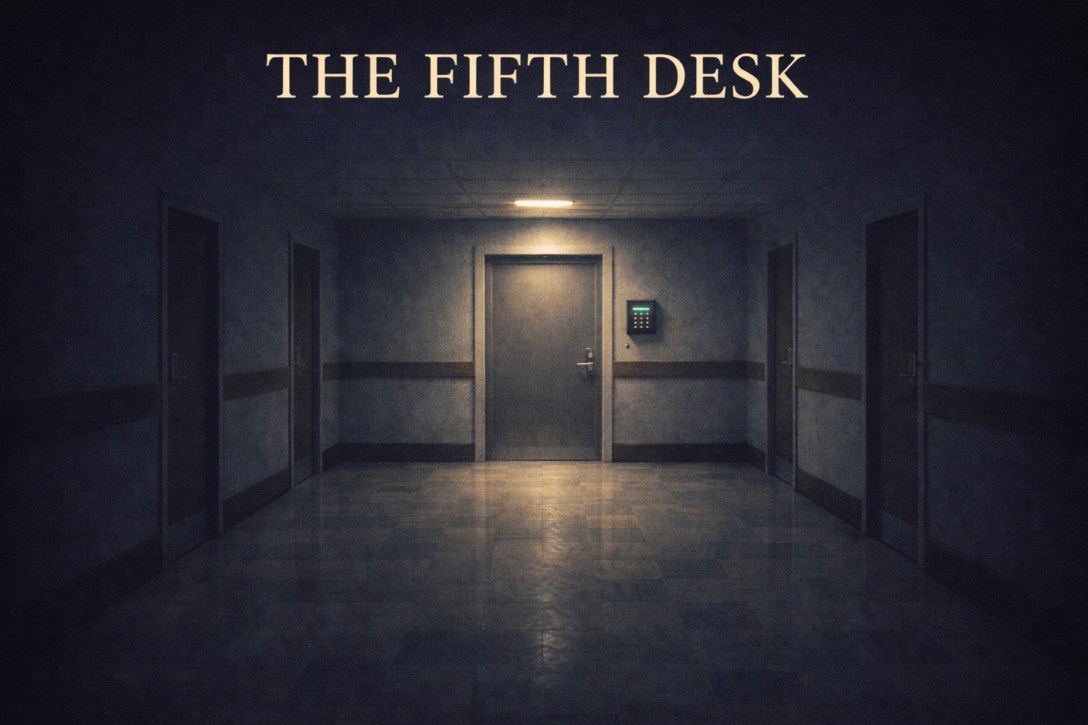
There are moments in literature when a building stops functioning as scenery and reveals itself as the governing structure of the narrative. Corridors become sequences. Floors become stages. Architecture begins to behave like a system through which the characters must move whether they understand its rules or not.
Chapter IV of The Pale Criminal belongs to that category of work. What appears at first to be a simple visit inside a retirement facility slowly discloses something more structural: the environment itself organizes the experience of the people within it. The building distributes movement, delay, relief, and observation with quiet authority. Nothing announces this power. It is simply there, embedded in doors, corridors, codes, and routines.
The chapter captures a cultural condition that has become increasingly visible over the past half century. Modern life is no longer organized primarily around open civic spaces or personal domains. Instead it unfolds inside managed environments: hospitals, managed housing, corporate infrastructures, government systems, digital platforms. Individuals move through these environments by permission. They enter through codes. They navigate through schedules. Their behavior is structured by procedures that existed long before they arrived.
The retirement facility in the chapter condenses this transformation into a spatial diagram.
Dennis senses the structure before he can name it. The floors feel sequential in a way that has nothing to do with architecture alone. Each landing carries the faint impression of a stage arranged in advance of his arrival. Even his own decisions feel rehearsed. He had promised himself he would visit his mother first, yet he drifts toward Vivienne’s room as though the detour had already been anticipated by the system surrounding him.
The building behaves less like a place than like an apparatus.
Within that apparatus Vivienne’s apartment offers the first interruption. Her room produces a temporary suspension of institutional logic. There are no access codes here, no verification, no schedules. Instead there is hospitality: pastries, cocoa, television, warmth. Vivienne performs the rituals of comfort with theatrical ease. She treats refusal as flirtation. She treats food as a form of absolution.
For a brief moment Dennis experiences life outside the machinery that governs his days. The sensation is small but unmistakable. In her room the world loosens its grip.
Such spaces are not accidental within institutional life. Systems rarely eliminate intimacy completely. Instead they generate small enclaves where human warmth survives in fragile suspension. Vivienne’s apartment functions as one of those enclaves, a pocket of hospitality existing within the administrative architecture.
Yet the sanctuary cannot endure. Time reasserts itself. Dennis realizes he has lost track of the schedule that governs the building. The detour becomes delay. Delay becomes anxiety. The procedural world returns with quiet inevitability.
When Dennis resumes his ascent through the building the narrative introduces an even stranger disruption. A procession of elderly residents moves through the corridor to strange ceremonial music. Women dressed in bright colors lead the line. Dancers in leafy crowns follow. At the center of the movement stands a young woman scattering flowers as though presiding over a seasonal rite.
The scene resembles a May Day festival that has somehow appeared inside a retirement corridor. The effect is not merely comic. It reveals the persistence of symbolic structures that institutions cannot entirely suppress.
Dennis sees the young woman as something like a goddess. The recognition occurs before conscious thought. She resembles an image from a memory that does not quite exist. When the procession passes, the hallway returns to its ordinary stillness, yet the moment leaves behind a residue of myth.
The appearance of this ritual suggests a second pressure operating beneath the institutional environment: the persistence of mythic imagination inside administrative life.
Dennis’s later reflections make this tension explicit. He remembers the games he and other children once played in Flamboro. For one summer they organized themselves into a justice society called the Little Punishers. They assigned ranks and titles with absolute seriousness. Each child assumed a heroic identity within a moral order they believed they could enforce.
The memory carries an unmistakable tenderness because it represents something that modern systems rarely permit. The children believed justice could be declared directly. They believed wrongs could be confronted without mediation.
The adult world Dennis now inhabits offers no such arena. Instead of quests and adversaries he encounters codes, floors, visiting hours, and administrative routines.
Yet the heroic impulse has not disappeared. It remains within him as a faint but persistent hunger. Dennis still longs for tasks that resemble heroic labor. He still imagines the possibility of an action that might restore moral clarity to the world around him.
The tension between that impulse and the institutional structure surrounding him forms the emotional core of the chapter.
The encounter with his mother introduces an even older form of authority. Throughout the novel she appears fragile, confused, and partially displaced by the routines of the building. Yet in a single moment she performs an act that bypasses the institutional system entirely.
She sees the unseen figure clinging to Dennis’s back.
Without hesitation she grabs the intruder by the ear and throws it out the door.
The gesture is almost absurd in its simplicity, yet it carries enormous symbolic force. The mother’s authority overrides both Dennis’s fear and the procedural environment surrounding them. For a brief moment an older jurisdiction asserts itself within the institutional space.
The building seems to acknowledge the disturbance. Somewhere beyond the door a mechanical relay clicks, as though the infrastructure itself has registered the event. Two systems briefly intersect: the bureaucratic structure of the building and a far older structure of familial protection.
The moment passes quickly, yet its consequences linger. Dennis feels a physical lightness along the axis of his spine, as though a burden has been lifted. The relief does not feel spiritual. It feels administrative, like a document temporarily cleared from a file.
The chapter’s final image extends this vertical axis upward. Dennis imagines something returning to the roofline of the building, maintaining position above the structure. The image suggests that observation itself may be embedded in the architecture. Surveillance no longer requires a visible watcher. The infrastructure performs that function silently.
Below lie memory and myth. Within the middle floors operate the procedures of institutional life. Above them rests an apparatus of observation that watches without speaking.
Dennis moves through these layers without fully understanding their arrangement. Yet he senses that the convergences surrounding him may not be entirely accidental. For a moment he entertains the possibility that his life might someday require an action rather than another compliance.
The thought fades quickly. Administrative environments rarely reward such speculation.
Yet the possibility remains.
What this chapter ultimately reveals is not merely the interior life of one troubled man but the structure of a cultural environment. Contemporary individuals increasingly inhabit systems that regulate movement, observation, and permission while carrying within them older narrative expectations about heroism, destiny, and moral action.
The tension between those two orders produces the atmosphere of The Pale Criminal.
The building is not simply the setting of the story.
It is the diagram of the world in which the modern subject now lives.
 The New Poetics