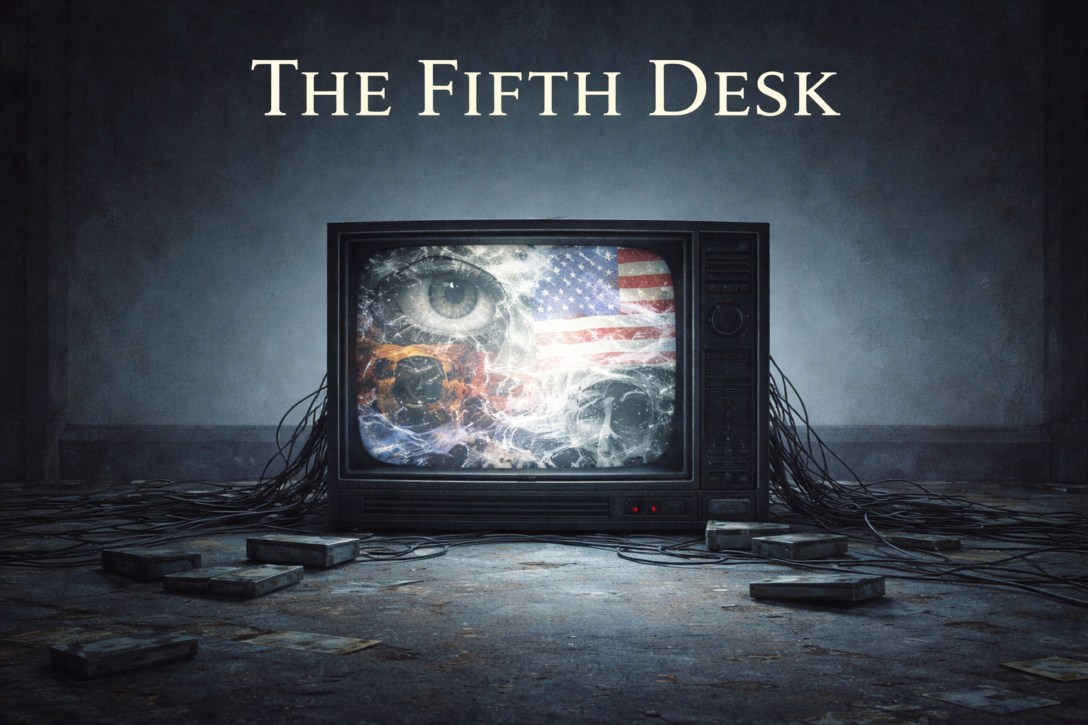
In the late twentieth century, before the internet fractured the visual field into millions of private channels, the television signal still ruled the cultural sky.
It was the dominant weather system of perception.
News, entertainment, politics, myth, advertising, scandal, aspiration, and fantasy all traveled through the same glowing rectangle in the corner of the room. If one wanted to understand what a society believed about itself, it was rarely necessary to consult its philosophers. One studied its broadcasts.
Reality arrived through the signal.
For those who came of age inside that environment, television did more than entertain. It organized perception. Images appeared faster than the mind could question them and narratives arrived faster than the culture could metabolize them. The eye learned to move at the speed of the cut. Emotions learned to respond to symbols that had already been rehearsed.
Television was not simply a technology.
It was a worldview.
A generation raised inside the broadcast environment did not merely watch television. They learned how to feel through it.
The sitcom laugh track instructed the audience when embarrassment should be funny. The music video taught them what desire should look like. The news broadcast demonstrated how tragedy was meant to appear.
It is difficult to convey to younger audiences how complete this system felt before the internet decentralized the screen. Television was not one medium among many.
It was the cultural bloodstream.
Inside that bloodstream, in 1998, a strange artifact appeared.
The work was titled Channel Interference.
It was twenty-two minutes long. Constructed from analog television captures, fragments of broadcast programming, popular music, political speeches, news footage, and staged imagery, the film refused conventional narrative. It did not tell a single story. Instead it subjected the television signal itself to a relentless process of collision and disruption.
The result was not simply experimental video.
It was an attack on the signal.
To understand why such an artifact could emerge from an unknown student at the end of the twentieth century, one must first understand the cultural weather system surrounding it.
The Cold War had ended. The internet existed but had not yet reorganized daily life. Cable television had multiplied the number of channels without altering the basic architecture of broadcast culture. Images flowed faster than ever, but they still arrived through centralized networks.
The television signal carried everything.
Sitcom laughter. Presidential speeches. Music videos. War footage. Advertising fantasies. Celebrity confessionals. Public scandal.
Once inside the signal, every image became equal.
A genocide could follow a detergent commercial. A presidential address could follow a wrestling match. A cartoon could follow footage of a riot.
Broadcast culture flattened the hierarchy of events.
This was the hidden grammar of the signal.
The signal did not organize meaning.
It dissolved it.
For a generation raised during the explosion of cable television, culture felt simultaneously larger and emptier. The world appeared hyper-visible yet strangely unreal, as if reality itself had begun to resemble programming.
This condition had already begun to appear across several artistic fields.
In literature, the novelist Don DeLillo explored the psychological effects of media saturation in White Noise, where characters lived inside a constant storm of advertisements, radio chatter, television broadcasts, and cultural static.
In cinema, filmmakers such as David Lynch began exposing the artificial glow of television culture and the darker realities beneath it.
In visual art, painters such as Gerhard Richter blurred the boundary between photography, media imagery, and painting, suggesting that modern perception was increasingly mediated by reproduction.
Even earlier, pop artists such as Andy Warhol understood that mass media imagery had become the landscape of modern consciousness.
Warhol painted soup cans.
Channel Interference turned its attention to the television signal itself.
At the same time, the emotional climate of youth culture had shifted during the previous decade. The synthetic optimism of the late 1980s had been punctured by the arrival of alternative music and a generation increasingly suspicious of spectacle.
In high school hallways across North America the figure who carried the authority of that suspicion was not a politician or philosopher.
It was Kurt Cobain.
Cobain represented a rupture inside the machinery of entertainment itself. With Nirvana he carried the ethos of underground punk music into the global broadcast engine of MTV.
The result was cultural dissonance.
A musician who distrusted spectacle had suddenly become the center of spectacle.
The youth culture of the 1990s lived inside the entertainment machine while distrusting it.
Channel Interference emerged inside that contradiction.
Its first audience was not a gallery or a festival circuit.
It was a school.
The film was submitted anonymously to a national student film competition hosted by the institution itself. The filmmaker was an unknown student, quiet and largely dismissed by the academic environment surrounding him.
The project had been developed privately and in defiance of attempts by the institution to discourage its creation.
When the film screened at the festival, there were no authorial credits.
The audience had no idea who had made it.
Students began discussing the film in classrooms and hallways without knowing its origin. The artifact circulated first as rumor and only later as authorship.
This anonymity amplified the aura of the work.
The film felt less like a student project than like a signal intrusion.
When the competition concluded, Channel Interference was voted the top film in the national contest. Only afterward was the identity of its creator revealed, surprising many who had already formed opinions about the work.
The quiet student whom the institution had largely ignored suddenly appeared as the author of the most intellectually aggressive film in the festival.
The moment possessed the structure of a small myth.
The invisible author.
The mysterious signal.
The revelation.
In retrospect the strange history of the film mirrors the logic of the work itself.
Channel Interference behaves like a pirate broadcast.
What distinguishes the film from ordinary collage or montage filmmaking is its governing method, which might be described as the grammar of interference.
The film does not simply juxtapose images. It treats the television signal as a system that can be disrupted and repurposed.
Television imagery is captured from broadcast, stripped from its original context, and placed into new relationships that produce radically different meanings.
Entertainment footage collides with historical violence.
Political speeches collide with pornography.
Religious symbols collide with commercial imagery.
The signal becomes unstable.
This method places the film within a larger artistic lineage.
It recalls the collision editing of Sergei Eisenstein, who believed meaning could emerge from the conflict between images rather than their continuity. It echoes the cut-up experiments of William S. Burroughs, who rearranged fragments of language to expose hidden structures within media culture.
In music, a similar logic was already emerging through sampling culture, where hip-hop producers dismantled the recorded past and rebuilt it through fragments.
Channel Interference applies that logic to the television signal.
One of the film’s most revealing sequences begins with footage from America’s Funniest Home Videos.
The program is built on harmless humiliation. People slip, fall, collide with furniture, stumble during family celebrations. The studio audience laughs.
Within Channel Interference that laughter is not allowed to remain innocent.
The montage cuts abruptly to imagery associated with racial violence, including footage linked to the beating of Rodney King.
The laughter continues.
Entertainment becomes cruelty.
The sequence escalates as the triumphant strains of Beethoven’s Ode to Joy enter the soundtrack.
Civilization celebrates itself while brutality unfolds.
Another sequence exposes the theater of political virtue.
A speech by Bill Clinton appears on screen.
The montage violently intercuts the speech with pornographic imagery.
Public virtue and private appetite collapse into the same spectacle.
The sequence concludes with a stark title card that reads RAPE IS LOVE.
The phrase appears less like provocation than diagnosis.
At first the structure of the film seems to promise revelation.
The montage unfolds across three symbolic domains: the Underground, the Mad Dog Ward, and the Overground.
The architecture resembles philosophical dialectic or religious cosmology.
But the arc is false.
There is no revelation.
The viewer remains trapped inside the signal.
One of the film’s most striking quotations comes from Un Chien Andalou by Luis Buñuel. The famous eye-slicing scene appears as a symbolic attack on perception.
But by the late twentieth century the gesture had already been performed.
Television had already cut open the viewer’s eye.
The final movement of the film abandons satire entirely.
Images of crucifixion, suffering, and religious symbolism appear in rapid succession. The montage ends with a red screen and a biblical quotation: a light shines in the darkness and the darkness has not overcome it.
The quotation does not resolve the film.
It introduces a paradox.
Even inside a corrupted signal environment, truth may still exist.
Seen from the distance of decades, Channel Interference appears less like an isolated experimental video than like a weather event within the cultural atmosphere of the late broadcast era.
The film emerged just before the collapse of centralized media.
Within a few years the internet would shatter the signal into millions of fragments.
What Channel Interference sensed intuitively was that art could no longer operate simply as expression.
Culture had become a system of signals.
And if culture is a signal system, the artist’s role changes.
The artist becomes an engineer of interference.
An unknown student dismantled the television signal and rebuilt it into a machine of contradiction.
For twenty-two minutes the dominant medium of the era stopped behaving like a window and began behaving like a wounded organism.
The image flickered.
The transmission stuttered.
And through the noise another form of art became imaginable.
Not expression.
Interference.
 The New Poetics