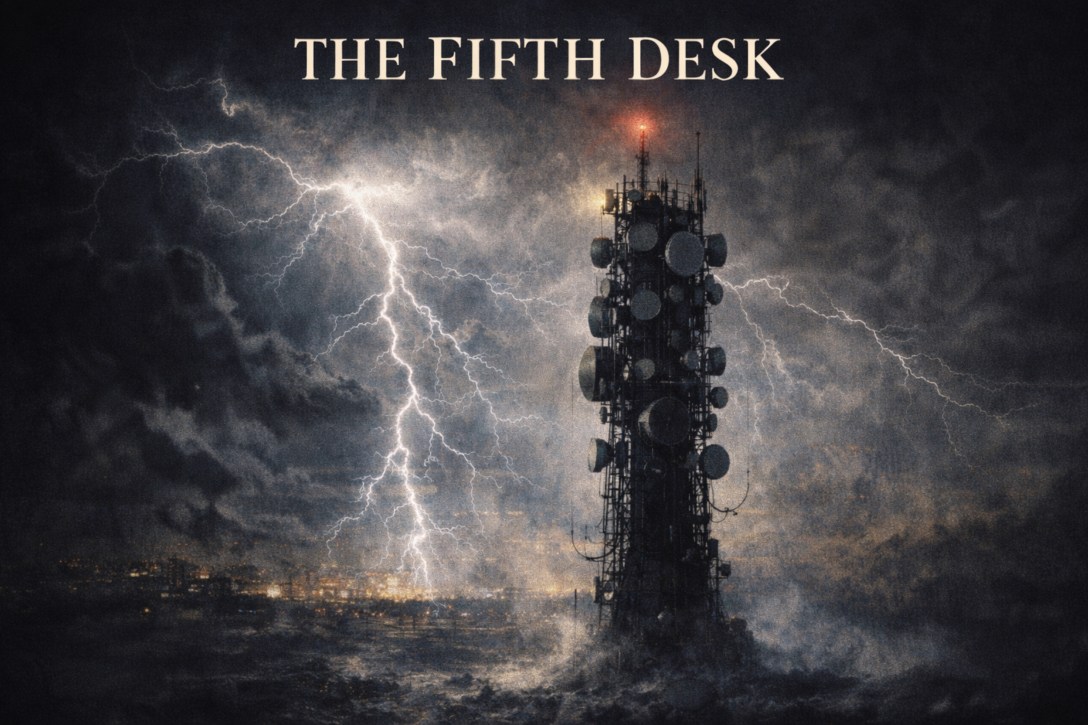
At first the work appears in scattered forms. Images emerge here, music there, a set of ideas circulating in essays or conversations. The connections between these elements may not be immediately visible. Each experiment seems to occupy its own territory, responding to the peculiar conditions of its medium.
Over time, however, a pattern begins to appear.
What once seemed like separate efforts gradually reveals itself as parts of a larger structure. The works share a vocabulary, a set of questions, and a common orientation toward the cultural environment in which they have emerged.
The New Poetics arrived at this moment slowly.
The essays published at the Fifth Desk have described the conditions that now define contemporary culture: the collapse of the expressive model of art, the expansion of the digital archive, the rise of algorithmic identity, and the transformation of images, sounds, and narratives into signals moving through networked systems.
Under these conditions art begins to behave differently.
Instead of functioning primarily as the outward expression of an individual voice, it increasingly operates through structures. Artists design environments in which materials interact according to rules that shape the resulting work. Meaning emerges not from confession but from the behavior of the system itself.
This transformation touches every medium.
Images, music, video, and narrative all encounter the same cultural environment: a world defined by digital archives, algorithmic circulation, and networks through which cultural signals travel continuously. Each medium responds differently, but the underlying conditions remain the same.
The New Poetics therefore does not appear as a single style.
It appears as a system.
Within this system several domains have emerged, each investigating the same cultural transformation through a different medium.
The first of these domains is Wormwood Press.
For centuries narrative behaved primarily as a path. A story unfolded across a sequence of pages, guiding the reader through events arranged by the author in a particular order. Even complex novels retained this basic structure.
But contemporary narrative increasingly behaves like an environment.
Readers encounter worlds rather than simple plots. Documents, histories, institutions, and fragments accumulate within the text, allowing multiple stories to emerge from the same underlying structure. The reader does not merely follow events but gradually discovers the system that generates them.
Wormwood Press explores this transformation.
Its works construct narrative environments whose internal rules shape the events that occur within them. Characters move through institutional structures, historical traces, and mythologies embedded in the world itself. The story becomes one visible expression of a deeper architecture.
The novel becomes a system capable of producing stories.
The second domain is Channel Interference.
The moving image once presented itself as a stable recording of reality. Film captured light reflected from objects in the world and preserved that sequence of images for later projection. Even fictional cinema relied on the assumption that the frame represented a coherent visual surface.
Digital media changed this condition.
Video is now transmitted as data moving through networks. Frames are broken into packets, compressed, reconstructed, and streamed across devices operating under varying technical constraints. Most of the time these processes remain invisible, preserving the illusion of a stable image.
Occasionally the machinery reveals itself.
Compression artifacts fracture the frame. Motion dissolves into blocks of color and noise. The signal tears across the screen before reassembling itself.
Channel Interference treats these moments not as errors but as material.
The work explores what happens when moving images are allowed to behave according to the logic of the systems that produce them. Footage becomes input for processes that distort, fragment, and recombine the signal, revealing the hidden infrastructure of digital media.
The image becomes a field of electronic weather.
The third domain is The Skin Trade.
Within the networked image economy the human body has become one of the most persistent signals circulating through digital culture. Photographs travel across platforms where algorithms measure attention and amplify images that capture it efficiently.
The body appears within this environment not simply as a physical presence but as a surface shaped by lighting, filters, compression, and patterns of circulation.
The Skin Trade investigates this transformation.
Images of the body are treated not as stable portraits but as signals moving through technological systems that continuously reshape them. Distortions produced by digital processing become part of the visual language. The figure persists within the image, but its appearance reflects the conditions of transmission rather than the stability of the original moment.
The body becomes surface.
Surface becomes signal.
The fourth domain is BlackBoxPop.
Popular music remains one of the most recognizable cultural forms in contemporary media. Songs still circulate through familiar structures—verses, choruses, hooks—that allow them to travel easily across radio, streaming platforms, and algorithmic playlists.
Yet beneath this recognizable surface the internal logic of music production has changed.
Digital studios allow sound to be assembled through layers of sampling, processing, and recombination. The finished song emerges from a network of technical procedures that remain largely invisible to the listener.
BlackBoxPop treats this condition as its central material.
Albums function as closed systems governed by compositional constraints that generate songs as outputs. The listener encounters the music as a set of signals—melodies, rhythms, hooks—while gradually discovering the structural patterns that connect them across the record.
The song becomes the surface of a machine.
The fifth domain is The Fifth Desk.
While the other arms produce artistic work, the Desk studies the cultural environment surrounding that production. Its essays observe the technological, institutional, and psychological shifts reshaping contemporary media.
By tracing signals across different domains—music, images, narrative, and online platforms—the Desk attempts to reveal the larger system in which these artistic experiments take place.
The Desk does not judge the work.
It studies the weather.
From this vantage point cultural phenomena appear as pressure systems moving across a landscape shaped by technological infrastructure and historical change. The critic records these movements, identifying the forces that produce new forms of art.
Together these five domains form a single ecosystem.
Each investigates the same cultural transformation from a different angle. Narrative constructs worlds. Video reveals the instability of signals. Images transform the body into a circulating surface. Music assembles sound through hidden production systems. Criticism observes the larger environment in which these processes unfold.
The New Poetics is therefore not a style.
It is a system of inquiry.
Artists working within its framework recognize that contemporary culture operates through networks of signals, archives, and algorithmic circulation. Instead of resisting those conditions, they treat them as materials.
They build environments.
Within those environments images distort, sounds recombine, stories unfold, and signals move through infrastructures that shape how culture behaves. The work becomes a field of operations whose patterns reveal themselves gradually through experience.
The system does not explain itself immediately.
Like the black boxes described in earlier essays at the Fifth Desk, it presents outputs first. The structure becomes visible only through time, repetition, and investigation.
What began as scattered experiments in narrative, image, music, video, and criticism now appears as a coherent structure responding to the conditions of the networked age.
The New Poetics asks a simple question from multiple directions:
How does art behave once culture becomes a system of signals?
Each arm of the movement offers a different answer.
Together they form a machine for exploring the landscape of contemporary media—a structure through which images, sounds, stories, and ideas continue to move.
The system remains open.
And within it the signals of culture continue to unfold.
 The New Poetics