Popular music was understood as a form of emotional transmission.
A singer felt something.
A band translated that feeling into sound.
A listener heard the result and recognized the emotion contained within it.
The technology of recording allowed the performance to travel across distance, but the underlying mythology remained intact. Somewhere at the origin of the song stood a human voice expressing an interior state.
Pop music depended on this image of the expressive performer.
Even when production techniques became more sophisticated—multi-track recording, electronic instruments, studio effects—the cultural narrative surrounding the music continued to emphasize personality. Albums were described as confessions. Lyrics were treated as diary entries. The voice of the singer stood at the center of the work, carrying the emotional weight of the song outward toward the audience.
Yet by the end of the twentieth century something had quietly begun to change.
The structure of pop music remained recognizable. Songs still moved through familiar shapes: verses, choruses, bridges, hooks. But the processes that generated those songs had become increasingly complex. Recording studios evolved into environments where sound could be assembled piece by piece. Digital workstations allowed producers to manipulate recordings at microscopic levels, adjusting pitch, timing, texture, and spatial depth.
The performance was no longer the finished object.
It was raw material.
Within the studio environment sounds could be layered, fragmented, reversed, stretched, and recombined in ways that no single performer could execute in real time. A vocal line might pass through dozens of technical procedures before reaching the listener’s ears. A drum pattern might be assembled from samples recorded decades earlier. A single chord could contain traces of multiple instruments blended into a composite sound that existed only inside the recording.
The song emerged from a process that resembled construction.
The artist did not disappear from this process, but the role of the artist began to shift. Instead of standing before the microphone delivering a moment of emotional authenticity, the creator increasingly operated inside a system of production tools that shaped the music long before it reached the audience.
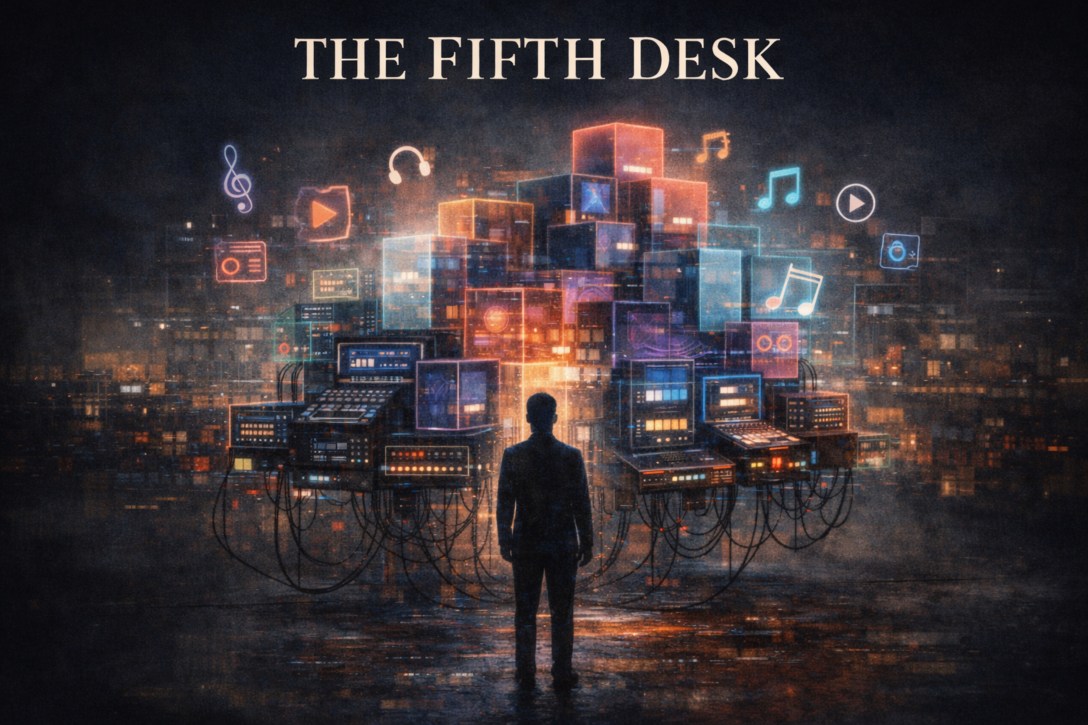
The studio became a machine.
The outputs of that machine still resembled songs, but their internal logic had changed. Beneath the familiar surface of pop music lay a network of compositional decisions, technical constraints, and algorithmic processes guiding the arrangement of sound.
The listener rarely encountered this machinery directly.
What they heard was the finished artifact: a sequence of sounds that felt coherent, memorable, emotionally charged. Yet the path through which those sounds had come into existence often remained partially hidden.
The song functioned as a kind of black box.
Inputs entered the system—melodies, samples, fragments of rhythm, vocal performances—and outputs emerged in the form of polished tracks ready for distribution. The internal transformations connecting these inputs to their final form remained invisible to the listener.
This opacity did not diminish the power of the music.
In many cases it intensified it.
Listeners sensed that something complex was happening beneath the surface of the recording. Certain songs possessed a structural density that rewarded repeated listening. Layers of sound revealed themselves gradually. Small details embedded deep within the mix surfaced only after the listener had spent time inside the sonic environment.
The music invited investigation.
One returned to the track not simply to experience the emotion again but to discover how the structure of the sound held together.
Under these conditions pop music began to resemble a system.
The recognizable surface of the genre—the hook, the chorus, the rhythm—remained intact because those elements functioned as signals. They allowed the song to travel easily through radio broadcasts, streaming playlists, and algorithmic recommendation systems. But beneath that surface the internal architecture of the music could become increasingly elaborate.
Pop provided the interface.
The system generated the work.
This transformation became particularly visible in the album format. While individual songs continued to circulate widely through digital platforms, certain artists began treating the album itself as a coherent structural environment. Tracks interacted with one another through recurring sonic motifs, shared production techniques, and conceptual constraints that governed the overall design of the record.
The album became a field of operations.
Within that field the listener encountered a sequence of songs that appeared distinct yet subtly connected. Rhythmic patterns might echo across multiple tracks. A particular vocal treatment might return in altered form later in the sequence. The tonal palette of the record could remain consistent across different songs, creating the sense that the listener was moving through a single sonic architecture rather than a collection of unrelated pieces.
Meaning emerged from the system.
This approach did not abandon pop music’s traditional pleasures. Hooks remained powerful. Choruses still arrived with the familiar satisfaction of release. The difference lay beneath the surface. The emotional experience of the music emerged from a structure designed in advance rather than from a spontaneous act of confession.
The listener could sense the design without necessarily identifying its rules.
In this environment genre itself began to behave differently. Earlier forms of pop music often treated genre as an identity: rock, disco, hip-hop, electronic. Artists aligned themselves with these categories, and audiences understood the music within those frameworks.
But once production tools allowed sounds to be recombined freely, genre became less an identity than a material.
Fragments of different traditions could coexist inside the same recording. A rhythmic pattern associated with one genre might appear beneath a melodic structure drawn from another. Synthetic textures could merge with acoustic instruments. Historical references surfaced briefly before dissolving into new configurations.
Genre became a resource.
The system assembled its elements according to the internal logic of the work rather than the boundaries of musical tradition.
For listeners raised on earlier models of authorship this transformation sometimes produced confusion. The music still sounded like pop, yet it did not behave like the expressive narratives that had once dominated the genre. Lyrics might resist straightforward interpretation. The emotional tone of the track could feel strangely indirect. The voice of the singer might function less as confession than as another layer within the sonic architecture.
The song seemed to be doing something else.
It was.
Within the framework of the New Poetics, this condition is not treated as a deviation from pop music but as its next structural stage. The external form of pop remains valuable precisely because it provides a stable interface between the system and the listener. Familiar musical signals allow the work to circulate through the vast networks of contemporary media.
Behind that interface the internal logic of the music can become far more complex.
This approach defines a practice known as **BlackBoxPop**.
The name describes the condition in which pop music presents a recognizable surface while concealing the rule that governs its construction. The listener encounters the outputs of the system without immediate access to the internal procedures that generated them.
The album functions as a black box.
Songs enter the cultural environment as signals that can be enjoyed immediately—rhythms that move the body, melodies that linger in memory—but their deeper coherence reveals itself only through careful listening. Patterns emerge across tracks. Structural decisions become visible through repetition and variation. The listener gradually infers the governing condition behind the work.
Meaning unfolds through structure.
In this model the artist does not disappear from the music. Instead the artist operates as the architect of the system. He selects the rule, defines the constraints, and arranges the materials that will interact inside the sonic environment.
The listener encounters the result as a field of signals.
Pop music continues to do what it has always done: travel easily, attach itself to memory, repeat in the mind long after the track has ended. But within that familiar experience something else has taken shape.
The song is no longer merely an expression.
It is the output of a machine whose logic reveals itself slowly, one listening at a time.
 The New Poetics