
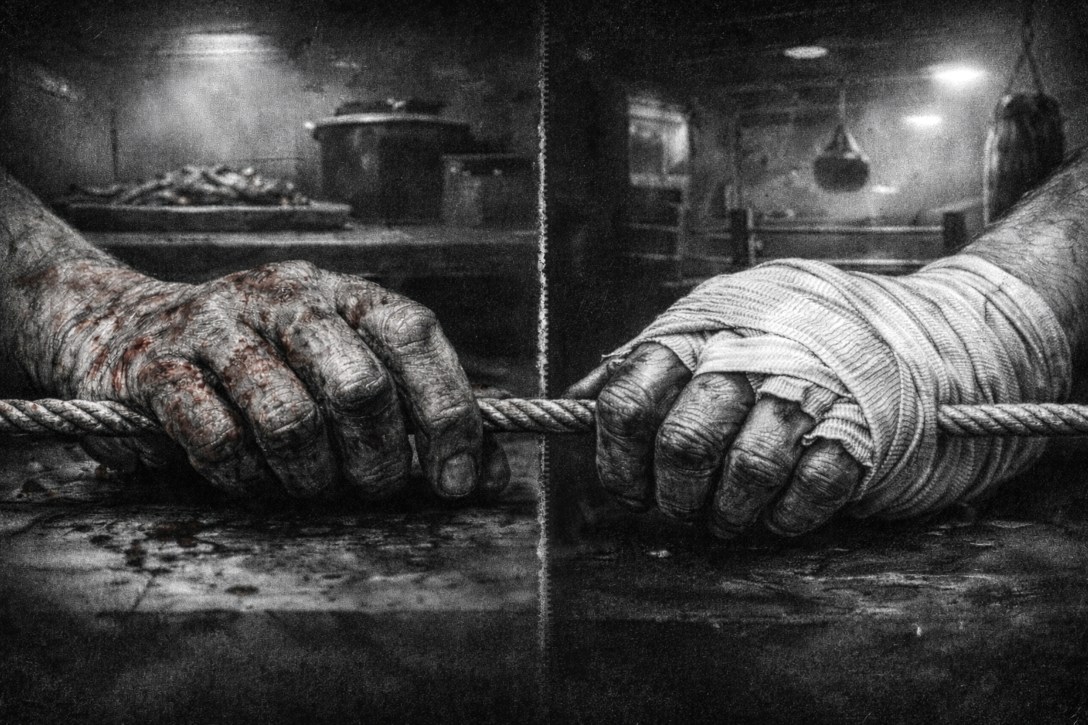
Butcher
“Are you still to learn that the end and perfection of our victories is to avoid the vices and infirmities of those whom we subdue?”
Plutarch, Parallel Lives
I
EVERY MORNING AT ELEVEN the butcher tossed the expired and discolored meats into the bone-can. When the can filled to the brim, he wheeled it to the receiving dock and dumped the spoiled meats into a larger disposal unit that was serviced weekly by an outside contractor. What this outfit did with the animal waste was a topic of endless conversation in the meat department. Were the putrid animal relics returned to the earth? Rendered into makeup? Ground into dog food? Reconstituted into meals for the homeless? These buzz sessions formed around the bone-can as fouled meats were knifed from their packages in slimy clusters.
The butcher slid the scabbed cooler door open and stepped into the brisk refrigerated room. His boots stuck to the greasy floor, slowing his tread, as he tipped the container back onto its wheels, gripping the cylindrical handle, and steered it toward the sprinkler room. The sprinkler room sat between the electrical room and the garbage room, just off the receiving docks, its floor pitched toward a central drain fitted with a catcher for loose scraps.
Many years ago the butcher had coined the bone-can, with considerable enmity, as “the great asshole of Satan,” a phrase that had withstood the trial of time. The bone-can now doubled as a test, measuring an apprentice’s stomach. The commingled mound of decomposing meat was more than some could endure after breakfast. They didn’t slaughter carcasses onsite anymore, so the bone-can was as dicey as things got in the meat department. “If you can’t stare down the devil’s back door, day in, day out, then you can’t cut it in this business,” the butcher told his staff. They took it to heart.
Just before reaching the sprinkler room, the butcher stopped dead in his tracks and eased the can to the ground. “Stupid,” he said aloud to himself. He had forgotten to empty the bone-can before taking the container to be cleaned. It was not a mistake he usually made. He enacted the same rite every couple of days when the can had filled to the brim, instinctively knowing the best angle to recline the container for the drive, his raw callused hands, flushed from the refrigerated air, gripping the abraded moss colored handle, and adjusting the angle based on the weight being carried.
He did not tolerate distractions. Daydreams were not for him. He kept to his routines, meticulous, even formal, but never fussy. The other laborers followed his methods because they were clear and precise. Tried and tested. He tipped the can back onto its wheels and retraced his steps toward the receiving dock, moving quickly to correct the mistake. He sometimes wondered whether the work remembered him from day to day, or whether it simply accepted whoever stood there long enough to repeat the motions.
“Watch out, old man!” yelled a tall, heavyset boy from the grocery department, skirting the butcher’s white coat and square, arched back as he barreled toward the garbage room. The butcher dropped the can onto its haunches and shook his head, ignoring the grocer’s affront. Not in fear of the boy’s three hundred pound frame, but uneasy of being chanced upon by some other putterer, as if his lapse would disrupt the balance wheel of the supermarket.
The butcher wheeled the bone-can to the receiving dock and dropped it onto the ramp, saturated with rust and grime from the steel leveling boards to the braided cable that lifted the rollup door. The dull thud of plastic on metal pulled the receiver from his stupor at the desk a few feet away. “You heading for a smoke?” he said without looking up.
“Might as well,” the butcher replied, taking his second smoke break before lunch. Some mornings the rhythm arrived late, or not at all.
The alarm wailed as they pushed through the door beside the receiver’s desk, which sagged on a two-by-four and a stack of borrowed meat totes. The butcher had shored it up himself, quick and improvised, the way things were always done at Loman’s. A contracted handyman would have charged half a day’s wage.
“When they gonna fix that alarm for you, Ben?” the butcher said. “Don’t it piss you off already.”
“They gotta fix my desk first,” the receiver said. “Then the alarm gets its turn. Why don’t you have a look at it later?”
“Rewiring alarms ain’t in my contract. Pretty sure it violates my basic union rights.”
“Is that right, Jack.”
“Uh-huh. Unless you want me returning them totes to their proper owners.”
“No, no. Don’t do that. A broken alarm I can live with. A tipping desk’s another story. Them cheap fuckers will do anything to dodge a repair bill. ‘Maybe next quarter.’ I gotta work now. Can’t wait till next quarter.”
He shook his head. “I’m starting to like the alarm anyhow. Reminds me of my ex-wife.”
“Which one?”
“All my exes live in Texas. That’s why I hang my hat in Grimsby.”
“I’ll drink to that.”
The butcher squatted onto a sea-green milk crate, eased a stainless flask from his coat, and took a mouthful of whiskey.
“Geez, Jack,” the receiver said. “What are we doing in Grimsby? End of the line.”
“I’ll drink to that too.”
He swallowed again, quicker this time. The burn pleased him. He lit a cigarette, then the receiver’s.
“You change brands?”
“Yeah. That native shit was killing my lungs. Can’t fuck with emphysema forever.”
“You sleeping at all?”
“Ain’t easy to sleep standing up.”
“Some of the hosers in my department manage it.”
“Stupid hosers.”
“Yup. Stupid.”
The butcher drew on his cigarette. Smoke lifted into the brisk, bright autumn sky, cloud-marble and high. The whiskey and tobacco held his thoughts at bay for a moment. With no work in his hands, they drifted back anyway—first to the mistake, then onward, catching on other things.
“How’s Gregor doing?”
“Having more fun licking his balls than I ever will.”
“That’s only because you’ve never had the pleasure,” the receiver laughed.
“Amen to that,” the butcher added, but he did not laugh.
“You coming back inside?” the receiver asked, standing from the polyethylene milk crate. It clung to his jeans for a moment before dropping back to the cement, tilting, then settling among the horde of cigarette butts.
“No. I’m gonna smoke some more.”
“Buzz when you want back in.”
“Yeah.”
“You want me to ready the truck for the boner?”
“Suit yourself.”
“Ah fuck it. Do it yourself, Frenchy.”
“Yeah.”
The receiver bent his body and put the plastic card that hung around his neck to the door and the safety unlatched and the alarm grieved loud like before. He disappeared behind the gray weather-beaten door with the flecked paint and the rust colored sores that dug into the metal.
The butcher considered pulling the slim, dog-eared Plutarch from his blood-dappled coat, then thought better of it. Instead his Gordian thoughts shifted to his ex-wife Niobe. She had said something the other night in the back seat of his car that had stayed with him.
“You look like you’re in love, Jean-Jacques,” Niobe hummed. She rested her cowboy boots on his lap and tugged her flared dress free beneath her.
“You know I can’t get enough of your cookies, doll-face,” the butcher said, deep from years of smoking and hollering in noisy, capacious warehouses. “Is it just me or are they tastier now? And don’t call me that. My momma used to call me that and you ain’t my momma.”He straightened his sweaty hair, which Niobe had twisted and curled in every direction, matting the black mane to the back of his neck and slanting it over his ears. Beneath the dome light, the creases in his forehead drooped like clotheslines taut with wash.
“I didn’t mean with me. And thanks. It’s nice to know you can still compliment me even after I’ve pulled my panties back on.”
“Pull them down and I’ll tell you another.”
“Don’t change the subject on me. Is it one of those Grimsby skanks you work with?”
“You sure know how to kill a man’s buzz. Why don’t you just let me enjoy this a minute,” the butcher said, pulling up his trunks and jeans. He reached into his pocket and pulled out a fold of money. “Don’t spend it all in one place, you know. Maybe get the kid something nice.”
“You don’t have to be like that, Jack. I’m not breaking ‘em. I’m just a little jealous.”
“Jealous a’what? You have a husband.”
“That doesn’t mean I can’t get jealous when you cheat on me.”
“What’s the matter with you? You can be one crazy bitch sometimes.”
“Yeah, but you came good didn’t you?” She leaned onto him and kissed him impetuously on the lips, her right hand cupping his crotch.
“What a mind-screw you are. I pity that oaf who lives with you,” he uttered with the unlit cigarette between his lips. He emphatically struck a match against the box and animated the tobacco with it.
“Doug’s all right. But no one gets me hot like my Frenchman. Give me a drag off that cig.”
“Yeah, right. As long as the bread’s hot out of the oven, I’m your guy.”
“You and your supermarket jargon. You’re all lost up in that place. Always were. Give me a drag of that Lucky, will ya?”
He handed her the cigarette. “Regular work, regular pussy, what’s not to like?”
“You lousy pig! Okay, you can take me home now. I’ve heard enough for one night. You used to be classy, Jack.” She sat up hastily, flicking through the crisp bills with her briery fingernails, drawing tobacco with her ample lips. “How much is here anyways?”
“You’re telling me you don’t know by just eyeballing it? Maybe I should change the dome light.”
“Very funny. Forget it. I’ll count it later.” She leaned over and shoved the tuft of cash into the sprawled purse lying on the rubber mat. She straightened her hair a little in the rearview and then handed the cigarette back to the butcher without looking. She applied a fresh coat of red over her mouth and then slid a tissue between her scarlet lips.
“A little short this month. I had some unforeseen expenses.”
“It’s okay. You’re good for it, right?” she said, razzing him, her green olive eyes burgeoning beneath her thin-plucked brow.
“Oh, sure. You can count on ol’ Jack. If not, you can send Doug to break my legs. You know where I live.” He exhaled the robust tobacco smoke from his nose, the cigarette changing places, hand to mouth, mouth to hand, in an igneous trail of agitation.
“Oh, sure. You can count on ol’ Jack. If not, you can send Doug to break my legs. You know where I live.” He exhaled the robust tobacco smoke from his nose, the cigarette changing places, hand to mouth, mouth to hand, in an igneous trail of agitation.
She leaned in and caught his lower lip between her teeth, pressing her knee into his thigh.
“How’s the boy?”
“Aeneas is fine. He’s playing the drums now. Got himself a kit for the basement. Plays those old records you love.”
“Yeah.” He rolled the window down some and flicked the cigarette outside. The trees shook softly from the veering wind and the tickled leaves coyly whispered amid the intertwined branches.
They’d come to this spot before. The smooth clearing beneath the weeping trees in front of the woods. It could be spooky at night. The butcher left the high beams on, saturating the dark woods with light. There was a .38 Special in the glove compartment in case anything but the darkness slunk out from the depths. Too many perverts itching for a peek.
“Come on, don’t look so glum. We did good with Aeneas. I was just kidding earlier. Don’t look so crestfallen.”
“I don’t know the meaning of the word. You decent? You ready to go?”
The butcher was startled out of his reverie by the 18-wheeler that was pulling into the receiving bay, trailer first. The driver was eager to unburden his carriage, engine chugging, wheels turning, slowing, stopping, then turning once more, until the trailer’s edge met the deck, and then the entire rig just shut down, transmission snuffed. The driver exited the cab and slammed the door behind. He walked past the butcher, nodding his lidded head, and walked up the perforated metal stairs to the weathered door where he buzzed the receiver with an unflagging tintinnabulation. The butcher peered over at him with weary annoyance. Ben popped open the door and he greeted the bearded, boulder-sized driver.
“Jerry! Long time no see!”
The rollup door came jangling up at the dock, the rig’s cargo door unlatched with a hollow thunk, cranked up, rollers squeaking, and then the hydraulic leveler started doing its thing, rising, unfolding, lip elongating, and then falling, bridging the gap with a dull thump. The receiver began unloading the rig with the electric jigger, making a bumping noise whenever he crossed the threshold. The butcher tried to ignore all these auditory distractions, the cigarette between his fingers smoldering to the core.
The butcher put out his cigarette and decided to return to his work. He was temperate with his drink and yet he slept till noon, he thought, And sometimes all day long. Yeah right, Pseudarch. Consistency. History will not permit it. He rapped at the ulcered door with his craggy knuckles and the receiver let him in.
II
THE BONE-CAN WAS SLATHERED with the remnants of beef, venison, pork, chicken, lamb—fat and sinew clinging in streaks and clots. The butcher sluiced it with cold water and soap, working a stiff brush along the brim, bristles scraping coagulated blood and fat from the petroleum.
Stenciled in white on one side were the warnings: Do not use for hot ashes, building material, debris, dirt, dead animals, solvents, or flammable liquids.
Below that: Max Load 70 KG / 154 LBS.
And beneath it, an identification code—214 # 0014 232—to distinguish this can from all the others just like it.
On the front, in bold capitals: ROTHSAY. Inedible Meat Products Only. No Plastic. No Styrofoam. No Polyethylene.
At the center was the Earth, printed in white and ringed by the recycling arrows, chasing one another in a closed loop.
ROTHSAY RECYCLES. Improving Our Earth.
The butcher paid no attention to the print tattooing the bone-can. After nearly two decades at Loman’s, he had learned to look past what he couldn’t change. Once, he’d taken it personally—the waste, the dumping of unsold meat. Heinous because it was avoidable. With discipline, with care, with someone willing to watch the counter and the order guide closely, losses could be reduced. Those managers existed. They were rare.
Loman’s stores kept getting bigger. The fresh-meat counters grew wider and longer. They needed mass just to look full. Eye candy, the managers called it, without irony. Trays stacked three high, all day, even though only half the meat ever sold. Full counters signaled abundance—fitness—no matter the cost. Throwing meat away was simply part of the business. They called it shrink. Something meant to be reduced, in theory. In practice, it never was.
This was design and execution. Point and profit. The butcher fought with management over the waste and gave the meat managers hell, but it changed nothing. By the time he finished thinking it through, the terms had already shifted. Upper management could always find another body to push a button. They said as much behind closed doors. If you can’t take the heat, get out of the kitchen. Every time a meat manager pushed a button, another animal died.
When pork tenderloin went on special, stores burned through skids of it at a time. A skid held fifty cases. Each case held eight vacuum-sealed tenderloins. Four pigs per case. Two hundred pigs per skid. Multiply that by the number of skids, the number of stores. The count climbed fast. Loman’s always over-ordered. It was policy. Superabundance. At those prices, they weren’t just selling meat—they were training people to eat more of it.
Everyone obeyed the great chain of being. It began with Loman, from the firmament, and progressed downwards, from the President all the way to the part-time workers on the floor. In between these pillars lay the great incalculable corporate chain. New links were being added all the time, lengthening the chain, and it grew more and more distant from ground level, from the stores, and thus more and more unfathomable as time went by.
Management was to introduce a new operating system in the New Year, the much-vaunted “C.A.O.” program that Loman spent millions of dollars to develop, which would order product for the counters on its own, without manual aid. The Computer Assisted Ordering program would purportedly increase the efficacy of ordering, replacing all manual ordering in time, and reduce “holes” on the shelves by over ninety-nine percent. There’d be less meddling from ineffective, dissenting hands. With the C.A.O. in place in the New Year, store conditions would be better than great, they’d be perfect.
The butcher found himself troubled by it all. Computer programs replacing workers—there was nothing the union could do about that. Some changes couldn’t be stalled. There was nothing he could do either. Except leave. That was always the answer. But he stayed. He liked the work. He was used to the industry. Better to reign in hell than serve in heaven. No matter how carefully he tried to preserve things—the pace, the tone—it kept changing. It always would. They didn’t build them like they used to. So he learned to stop caring. To be indifferent to the ritual of the bone-can. Sometimes he grumbled with quiet indignation. Sometimes he grumbled because lunch was near.
After cleaning the can, he returned it to the cooler for storage, and geared for a return to the cutting block. Before he even managed to reach the floor to inspect his case, he was halted by one of his fledgling apprentices who was waiting by the produce department’s doors, the quickest route onto the busy commercial floor congested with shopping carts and baskets, the preferred route because it afforded an Archimedean vantage of his work. The beef to the left, roasts and then steaks, prime rib, sirloin, premium roasts, and then the strips, Delmonicos, porters, and tenderloins, then the lamb, the pork, the sausage, and the chicken. A modest display case by company standards. And yet the butcher’s yield was first-rate. They buried him in Grimsby where his artistry was lost.
His pismos were state of the art. Silver skin removed to a hair’s breadth. Flesh immaculate. Fat removed to the extent that whatsoever remained cast the steaks in the greatest possible marbled light, diameter proportionate throughout, defying reason, perfect cylinders, like they were carved from red marble. At the heart of Loman’s racket, Queen’s Quay, they’d come far and wide for his cuts, chefs and restaurateurs. He was a professional with distinction in the industry. In Grimsby, he was just another laborer, work serviceable, nothing else much mattered.
In Toronto, he’d brought his own tools to work—a steak knife, chop knife, sticking knife, skinning knife, cleaver, steel, block brush—strapped across his butcher’s bandoleer. He’d moved through the store marked by them. In Grimsby, he used company stock. The steel was dull, resistant to the hand, but he made it work. There was no room for complaint. No cut left uneven. He could still fillet or butterfly tight to the bone.
“Mrs. Crompton is here for her Chattelbreeund special.”
“Chateaubriand, Crawford. Cha-teau-bri-and. There’s no fucking chattel. When you gonna learn?”
“Sorry, Jack. She been waitin’ a while.”
“Let her wait.”
Mrs. Crompton came every two weeks, like clockwork, for her beef tenderloin roast. Her husband was a Progressive Conservative MPP in the Niagara region and often away on business. She drove the forty klicks from her home along the QEW to Grimsby to buy her meat in person. It wasn’t the cut she needed. A phone call would have done. Mrs. Crompton preferred ritual.
She dressed for it, black stilettos, sheer stockings with a seam, a fitted pencil skirt and belted trench. Dark Wayfarers. A pinstriped fedora. And the white Hepburn gloves. She came to Loman’s like that, moving through the aisles with her practiced body and unbroken stride, stirring the men as she gathered what she needed for dinner, sometimes carpaccio, sometimes tartare, sometimes a simple roast. She ordered the beef tenderloin last. The butcher prepared it for her as if she were any other customer.
Watching her from the block, the butcher sometimes felt it rise in him when the white opera gloves brushed her cheek, paired with that practiced, statesman’s-wife smile. She never washed the gloves. She wore them for everything. That was the Crompton special, and it undid him. She liked the pretense—the butcher’s red hands working the meat, the precise cuts, the twine drawn tight and neat, the clean violence of the blade. The gloves carried it back to her. The smell. The suggestion. Beneath the finery she came undone, off balance, while nothing on the surface betrayed it. No one noticed. Only the butcher knew.
“Steaked, Mrs.?” the butcher asked, his red hands—redder with blood—working the meat with a single-minded intelligence: looping the twine, cinching, knotting, sliding down to the next mark.
“No, no—whole. Leave it whole. I’m making a roast tonight.”
The question had caught her off guard, but she recovered quickly.
“What’s that?” the butcher called, the fans roaring overhead.
“Whole! Leave it whole, please!” she said louder, polite and flushed, the attention prickling.
“No frills, huh?”
“That’s right. Just me and the husband.”
“A little candlelight.”
“No. He doesn’t go for that. Just a roast and potatoes. Maybe artichokes. Or asparagus. A bottle of wine.”
Her reflection hovered in the glass. Featureless. A raw meat matte.
“Meat and potatoes. My kind of guy.”
“Mine too,” she said, keeping her face composed.
The thought came unbidden, the cooler’s sharp air, the damp smell of cardboard, her face pressed up against it, then vanished.
He swept the trimmings into the chute, set the four-pound roast on peach paper, lifted it to the scale, printed the label, wrapped and sealed it, and slid it across the counter.
“Is this AAA beef?” she asked, studying the label.
His fingerprints were still on the paper, dark and wet, smearing her white opera gloves. Neither of them mentioned it.
“Angus, ma’am.” He tipped his cap slightly, catching her face.
“From Alberta?”
“Somewhere in the States, I think.” He wiped his hands on his apron. Tobacco and whiskey lingered in his mouth, the taste rocking back and forth. He wanted to spit—but there were customers waiting.
“Oh, well. It’s still good, though?”
“It’s excellent, mam.”
“Oh. Well. It’s still good, though?”
“It’s excellent, ma’am.”
“Please—call me Flora. So you personally guarantee the quality of this meat?” She held his gaze, deliberate now.
“Yes. Personally. If you find it disagreeable, I’ll repay you out of my own pocket.” His tone softened despite himself, courteous, almost polished.
“Is that a butcher’s promise?”
She liked coaxing those refinements out of him—the manners buried under habit. She’d learned early they were there. Given time, given wine, they surfaced.
She smiled at him, measured and knowing, and waited.
“No. It’s Jack’s promise,” he said—and hated himself for it a second later.
“Okay. It’s been a pleasure, Jack,” she said, setting the roast into her cart beside the Parisian potatoes and scallions.
“Indeed. G’day, Flora.”
“Good day to you, Jack.”
Mrs. Crompton finished her shopping and left the store. She headed into town to tend to her errands, then home to shower and prepare dinner.
The butcher returned to his block. He touched up the case, trimmed the skirting peach, rotated the steaks, pulled the drier cuts. He tightened everything, brought the color forward, the red of the beef, the darker wine of the lamb, laying the meat right for the Grimsby brood.
It was noon. He told the boys to have the block cleaned before he got back from lunch. He didn’t make it far. His name came over the PA, calling him to the manager’s office. That never happened in Grimsby.
They smell blood, he thought. After the day he’d had, it figured.
He didn’t know how bad it was until he stepped inside and saw Longsteifler, the district manager, and Cross from the union, already seated in Ratched’s office.
III
“COME IN JACK,” RATCHED SAID, leading the butcher into his office with a trained gesture both welcoming and guarded, shutting the door behind them. The friendly, animated look on Ratched’s face was swiftly replaced by some stony, draconian expression as he stepped past the butcher and between Longsteifler and Cross, who were standing across from each other on the taupe carpet, flanking the room, arms crossed over their chests, exchanging nervous humorless glances.
Ratched took his place behind his cluttered desk seated in his ox-blood executive armchair, a clutter that looked contrived in its disarray, dropped his elbows over some stat sheets and interlocked his fingers, stanching the blood flow at the knuckles. Cross nodded his head and verbally greeted the butcher, while Longsteifler mechanically lowered his eyes and tried to stare through him like an x-ray machine. He strongly felt that he had a faculty for reading people and so he did this.
The butcher reached up and lowered his cap over his eyes by way of an ironic salutation to union leader Noah Cross. His name a cruel joke, evincing a flash of advocacy, a ray of vindication, when in truth he stood for nothing but the worst of betrayals. His name was like some twisted collation of Old and the New Testaments.
“Please, have a seat, Jack,” Ratched said, flagging the drawn chair that was also angled premeditatedly. The butcher shouldered the invitation aside.
“I’m fine where I am,” he replied. He had rehearsed this conversation without knowing he had. He’d done it many times before, in smaller rooms, with lesser men.
Longsteifler and Cross renewed their tongueless parley through wide, censuring eyes. The butcher felt uneasy; the situation felt entirely rehearsed—the stooges flanking him like two esurient cranes, the binders and files arranged like bayoneted toy soldiers on the shelves, the jejune chair deceptively positioned in the center of the room like a wolf trap ready to spring, and behind the teak desk covered with scrawled papers and manila dossiers sat Ratched, the spiteful, rhadamanthine executor of the interrogation. He betrayed nothing to his interlocutors.
The butcher’s bristly, weathered face was incongruous to their expectations, catachrestic even. They knew his face well enough, especially Ratched, who could inspect it daily if he pleased, and therein lay the problem. The butcher’s mien suggested something trustworthy, something that hit close to home. His hardened features conveyed the very essence of the blue-collar man they all depended on to keep the business, with all its sticky work, afloat.
The butcher’s face complicated matters. It refused the shape they preferred. It carried something stubborn and familiar, something that sat poorly with the file already open on the desk. Ratched noticed it, the way one notices an error in a ledger, and looked away.
The image of Loman’s as a family type business was important, yes, but it wasn’t the catalyst for this inquisition. Their grey orthodoxy, their bien pensant, was a pious sham, nothing but bourgeois canting meant to preserve their fogyish white-bread strata. It was the butcher that drew the swarm, a longstanding grievance now furnished with a workable pretext for dismissal, a discharge Longsteifler and Ratched had dreamed about for years, a way around union red tape.
Loman himself had heard echoes of the butcher’s dissenting antics all the way from his ivory castle on the Bridle Path in Toronto. Zoe Vrabec entered the conversation late, by name only, and then did not leave it. From that point on, everything arranged itself around her absence. Files aligned. Timelines shortened. The room seemed to agree, without saying so, that the matter had found its proper shape.
“Jack, don’t be alarmed. We’re all friends here. Eric and Noah have joined us to see if we can solve our problems amicably.”
“You’re the problem, Ratched,” the butcher spat.
“Come on, Jack. Ted is trying to be decent about the whole thing. We’re all friends here, right Eric,” Cross said, nodding toward Longsteifler, who stood with his hands in his pockets, as if shrinking from the candor the room had slipped into. When he finally spoke, urged on by Cross’s supplicating gaze, his voice came unsure at first, feeling for the proper note of assent until he found the correct modulation, the precise waffling frequency a man of his authority was expected to supply.
“Yes, of course, we’re all friends here and,” a hesitation followed, a brief internal misfire, a failure in the executive P.R. system so carefully cultivated over years of restraint, mitigation, and managed coolness, of meeting people halfway and smoothing things over when the shit hit the fan, all of it suddenly at risk because of one obstinate butcher who refused to find his place in the scheme of things, snarling at the hand that fed them all.
“There’s no need for that kind of behavior, Jack,” said Cross distantly, tossing his two-cents into the fray, affecting personal injury with a sad, sympathetic expression. J’adoube, the stock in trade of a glib union negotiator.
“Okay, here’s how we’re going to do things,” Ratched resumed, endeavoring to regain control of the room. On the wall was a framed photo of Ratched on a pier holding up a big fish from a chain, a bass or a pike. Further down, there was a picture of his smiling, four-piece family before the mint R.V. on a camping trip. “I’m just going to get to the point here. Jack, we were willing to tolerate your shenanigans as long as they were small fry. But this we can’t ignore. You’ve royally fucked up.”
“Get to the fucking point,” the butcher said. Even though he had figured out the destination of their chinwag, he was eager to know what dirt they’d managed to scrounge up, so as to measure the allegation, parry it, and then bat it back with extreme prejudice. Like a seasoned poker player who’d seen the flop and raised the ante, he now anticipated the river card for his next bet.
“You fucked up with that bakery girl, Jack. We got video of you and her in the parking lot,” Ratched said with visible discomfort.
“Is that right?” the butcher answered, and there was something melancholy in his voice, a frog he needed to clear, a tell he needed to restrain.
“We don’t see any reason to involve the police at this juncture. But you’re done here, Jack. You have no business being with us any more,” Ratched concluded. Longsteifler scanned his subordinate with pleasure. Cross held his gaze to the floor.
“Bullshit!” the butcher shouted contemptuously. “Cross, you got nothing to add? Don’t my ten bucks a week purchase me any defense from the union.” Had he anticipated this turn of events, sensed the accusation beforehand and merely played the part of the hunted? Weak means strong and strong means weak, a rule of thumb at the poker table, but this game was more complex. Perhaps a new set of rules were required to assess the range of tactics across the board.
Ironically, Cross was startled by the mention of his name in the same breath as the union. He snapped out of his daydream and scrambled to contribute to the conversation in a graceful manner. The problem was he had nothing of value to say at that moment and he knew the butcher would light on that fact in an instant. He didn’t want to arouse the ire of the butcher any further than he already had by being present in the room. There was also the ethical matter of the butcher being a loyal member of the union for the last two decades, a fact that made Cross feel superficially indebted and obligated him to respond judiciously.
First he simulated a look of profound interest, of deep absorption, like he was wrestling with some portentous moral dilemma, and then a stern mood washed over him like the bracing splash of aftershave. He shook his head and opened his mouth with grave import.
“He’s right, Jack.”
“Get this asshole out of here!” the butcher erupted. “I don’t need his help.”
“Hold on a second,” Cross pleaded, his little satiny hands held aloft in supplication. “I didn’t mean, what can?” he said in rapid staccato, hoping his earnest mien would fill the blanks. Beads of sweat were forming across his baldish forehead.
“Get him out before I defenestrate him out your window.” Cross looked to Ratched for counsel. “Don’t look at him, Cross, look at me! I’m the one paying your wages. Me and the rest of them ham-and-eggers down there you’re tweaking,” the butcher hollered, pointing with both hands to the vitrine behind Ratched at the far end of the office. He hurled his fist at the door behind him and it rattled in its frame. Longsteifler leaned sideways timidly, while Ratched made himself smaller in his chair. Cross, with his clammy hands still in the air, pushed himself back a pace from the butcher like a mime trapped in a box.
Ratched thought to call up security but resisted. Longsteifler thought about how much he hated being around these wheelhorse industry types, with their lunch-pail lingo and brown-bag attitudes. Things were much comfier at the head office, the air lighter, he could breathe easier. He despised doing the store tours, walking the floor with Ratched and his ilk, the stock “guest” badge pinned to his sport blazer, the petrified looks from the staff filling the shelves, the damp jittery proletarian handshakes, it all amounted to nothing for him, a token for the workers, it nauseated him, the entire piddling pageant.
Cross pawed through his mind, anxiously seeking the definition of “defenestrate,” pronouncing the word over and over in his head, his internal lips and tongue masticating it every which way, with little success.
The butcher turned the knob and opened the door. The fanfare from the hallway wedged in and trickled through the room like the ambient murmur of a river. “You!” he barked at Cross, “Out!” Cross peered skittishly at Ratched one more time and Ratched nodded. Cross cleared his throat, flattened his black polo shirt over his ribs with his perspiring hands, wiping them over the cotton and leaving an alluvial imprint in their wake.
He made for the door the butcher held open. “Good day, gentlemen,” he sheepishly uttered and exited without looking at the butcher, who was scowling something fierce, lips held so tight they could have seared from the pressure, penumbral eyebrows engulfing the whites of his eyes.
“You too,” the butcher said to Longsteifler. “You ain’t got no business here.”
“What do you mean?” Ratched asked on behalf of Longsteifler, who pressed his powdering gaze at the blood stains on the butcher’s cadaverous coat and apron. The apprehension Longsteifler felt was insensible to him, but it was there, large as an elephant in the room. He didn’t dare admit it to himself, nor did he deny it. The cadaverous coat, the bloody apron, these were the accouterments of a primitive non-literate order he could not understand. Maybe Ratched could speak the butcher’s language. He certainly could not.
“He ain’t union, he ain’t H.R. He’s got no business knowing my business,” the butcher said, still holding the door ajar.
“Eric’s here’s in an advisory role in lieu of Henry’s absence,” Ratched replied.
“His advice ain’t needed. Tell him to be on his way.”
Ratched and Longsteifler exchanged a terse look. A bleeping page over the P.A. cleaved the silence in the room. “He’s right, Ted,” Longsteifler said. He nodded to Ratched and passed through the half open door, en passant, ignoring the butcher. The door slammed upon his egress.
IV
“Alright, Ratched, let’s have it already,” the butcher said, then ambled deeper into the room, circling in front of the chair facing Ratched’s desk and fell onto it with a bowling thud.
“You’re one rude son of a bitch?” Ratched said.
The butcher leaned back into the stiff beige stacking chair, the sort of chair you’d encounter in a classroom, a similarity that likely informed the mind selecting the office chairs in the first place. The humiliating feeling in the principal’s office, that suppressing feeling in first period English or history, was probably the intended goal of the décor. Now a grown man or woman, called into Ratched office’s, the belittling feeling of the chair, the beige plastic poking, jabbing, filling out your back, even if you’d done nothing wrong, cut down to elementary size, presided over by Ratched in his executive, high-backed, rich-burgundy arm-chair, pneumatic seat height adjustment, waterfall seat edge for good circulation, tilt tension adjustment, brass armrest tacks, mahogany wood base with dual wheel casters, the boss of it all, the manila dossiers, the hefty binders containing the confidential history of the store and its employees, and the widescreen vitrine to lord it over them.
“Don’t I know it,” the butcher answered, leaned back in his chair, and when it didn’t yield to his weight, rocked back harder, pitching the weight of his back into the beige plastic and it squeaked from the tension.
“You really think you’re something special, don’t you?” Ratched confidently declared, leaning forward in his chair. “You’re no cowboy. I worked stores out west. Calgary. Edmonton. Those some real cowboys. You? You’re just some union backed pepper. Nothing special.”
“So you’re a real stud hound, eh, Ratched? Sunk your spurs into some real good ones in Calgary? No need to fret. I’m sure your rodeo days ain’t behind you,” the butcher said.
“Yeah, but I’m not a fucking terrorist either,” Ratched snapped, losing control of his stung emotions, leaning over his desk with flattened palms, elbows pointing outwards.
The butcher halted his rambunctious rocking. The room was silent enough that Ratched could hear the butcher breathing through his nose. He continued. “Yeah, that’s right. We did our homework on your mother. The FLQ. Bombings, kidnapping, murder. That’s some messed up shit. That’s the kind of family you come from? No wonder,” Ratched said.
The butcher exploded from his chair, fists bulging at the end of his white coat like two burly fisherman’s knots, but he paused at the threshold of action and considered, briefly, some bleak prospect, before leaning over Ratched’s desk, strong-arming the contents in a fluid raking motion, over and onto the floor with a loud crash, pencils over pens, dossiers, a calendar, a mug of cold coffee splashing across the taupe carpet, and a picture frame with a high-school graduation photograph of Ratched’s gawky daughter, shards of glass everywhere. Ratched stood and unintentionally pushed the ox-blood armchair away with the back of his legs.
He reached for the phone and lifted the ebony receiver to his ear, nervously punching the three-digit extension to the security office on the ground floor. Before Ratched could connect, the butcher reached over the desk toward the phone and wrapped the extension cord around his index finger, tearing it from the wall. Ratched backed away from the desk, pushing the high-backed armchair to the vitrine, still holding the listless receiver to his ear, even though the phone was amputated from the line.
The butcher lifted himself from Ratched’s desk, maw jutting out, and for the first time Ratched confessed to himself that he was afraid of this man, in these close quarters, without Longsteifler and Cross in the room, anything could happen. Things weren’t going according to plan. His strategy had derailed with the desk clearing.
He stood too close. He knew that much. The room adjusted around him—chairs, breath, the small movements men make when they are deciding whether to sit or rise. He waited, without quite knowing for what.
“You were saying something about my mother,” the butcher said, looking Ratched in the eye, watching him break eye contact to survey the wreckage around his desk. “Continue.”
The butcher strode over to the wall beside the desk that housed the picture frames. He stepped onto the toppled pencils and a couple snapped under the weight of his boot. Beside the picture frames of Ratched with the fish, and the four-piece family before the RV, was a certificate of “Excellence in Management” that Ratched had won at some supermarket award gala in the 80s, when he was managing a store out West.
The butcher jabbed his craggy fist through the narrow sheet of glass, smashing the pane, and pulled the parchment free with his fingers. He looked at the certificate and made as if to read it, then abruptly crumpled it with both hands, making short work of it. Noticing his knuckles were scratched from the blow, he wiped the blood from his hand with the crumpled parchment and threw it at Ratched, striking him on the chest.
Why can’t they hear the noise, Ratched thought, referring to Longsteifler and Cross. Neither man was within earshot. Longsteifler had gone to the hot deli for a cup of Joe. Even though he detested the in-house recipe, he needed it to calm his nerves, maybe a cigarette after. He thrust his granulating gaze to the cash lady, atomizing her to the quick, and she trembled like a flickering flame upon returning his change. His radiating leer still worked. Cross had gone to the washroom to relieve his tension in a different fashion.
“You want me gone? You want me out?” This was where the butcher had been steering the conversation all along. The shawl of acrimony, the Vesuvian eruptions, the stone-cold stratagems, they were all negotiating tactics, trenchant avowals of blunt compromise misunderstood by the scheming trio as salami tactics, a divide and conquer undertaking, with the butcher attempting to eliminate the opposition slice by slice. On the surface, this was true. The butcher had cleared the table by cutting off his enemies. But his true goal, after he realized what they’d dug up on him, was to have a one-on-one with Ratched.
He’d intuited the accusation fairly early into the proceedings and he knew that Longsteifler and Cross would only complicate things. Management wanted him gone. They’d always wanted him gone. It was just a matter of time. The butcher had had a good run, but he couldn’t evade them forever, especially with the way he carried on, speaking his mind, doing things his own way, battling policy and company standard when it conflicted with his way, “the better way.”
Whenever they’d tried to come down on him, he’d maneuvered the union rules to shelter himself, finding loopholes in their disputes against him, marshaling support from his coworkers, demonstrating that his method was the best. He always had his nose to the ground, expecting the worse, on the lookout for what was coming his way. You don’t live and work like the butcher did without having to pay the price. Everyone has to pay the piper someday. The butcher was now ready to cut a deal.
It was unthinkable for him. But from the moment he laid hands on Zoe, from the moment he let her reach into his pants in the janitor’s closet, this day was coming. A wolf only needs to get trapped once. When she put her mouth on him, when he leaned back and allowed it, with the brooms and mops as witnesses, his destiny was set in motion. Fait accompli. And then Ratched had to go and mention his mother. It was a sore spot. She had disappeared over twenty years ago, without a trace. They didn’t know if she was dead or missing.
“Gimme fifty thousand as severance and I’m history.” It grieved the butcher to utter these words, wounded him in places too deep for language to convey. It was akin to selling out. But he had to take care of his own, to cash in his chips while there was still a prize to be had.
For almost twenty years he’d made Loman’s his home away from home. When he’d left Quebec in his twenties, he was looking for the good fight. He’d come from a culture of bohemian utopianism. La belle époque. Anti-authoritarianism, free love, cooperative business enterprising, acid tests, and other hipsterisms survived the trip from Quebec, but the non-violent means he’d left behind like a shed skin.
He’d left behind the Quebec Aces and his dream of ever playing for Les Canadiens, his father, Professor Emeritus Etienne Louis, renowned Classical Civilizations expert, his mother, Winona Louis, who had disappeared, willingly or unwillingly, without a trace in the early 70s, the imprint of her left behind in their two-storey family home in L’Ancienne-Lorette, which his father had maintained in her absence, scholarly, like an archivist, as a means of keeping her shadowy presence tellurian, grounding the residue of the life she had once lived in familiar objects, obsessively containing it within the articles she’d left behind. Heat, light, oxygen, dust, these were the enemies that degraded her memory.
He’d left the memories of his lovers, his neighborhood friends, the games they played, a Bruegelian cornucopia, the schools he went to, the hockey rinks, the goals, the fights, the glory, Les Glorieux, the Forum, the malls, the playgrounds, the sights, the sounds, the smells, he’d left it all behind, his whole Quebecan life and its carnival lights.
Leaving Quebec was like dying and coming to Toronto was like awakening in some leaden-grey Dullsville, a placeholder of a city, Dog River, Moose Fuck, Upper Rubber Boot, with your memories of having lived a sensory life intact, but without anything quick or tender within you to trigger a response. Living in the ashen past was the best most expatriates could effectuate. The butcher still managed to make the best of it without attempting to get back to the land of the living.
“There’s nothing for you,” Ratched mumbled, putting the comatose receiver down on the shambles of his desk. “Loman’s denied you any such package. The union too. They’ve washed their hands. There’s nothing.”
“I’ll get my lawyer to—“
“You’ll get your lawyer to do nothing,” Ratched cut in, and the butcher allowed him to complete his thought, despite the fact that his voice trailed off between clauses. He was starting to regain some of the equilibrium that had scattered along with the articles on his desk and wall.
“Loman’s gonna spend all of it, whatever your severance package may have been and more, on lawyers and judges, he’s prepared to spend it all just to make sure you don’t see a single penny. You know how many friends he’s got in Parliament? I warned you. You’ve made this personal now. The richest grocery tycoon in the country and you wanted to take him on with your piffling shit.”
And that was it, the trump card Ratched had stored up his sleeve for months, until everything was complete, until every notable shred of evidence had been collected and assembled in his dossiers, the lunch-hour quickies in the butcher’s Camaro, the video footage of the 68’s gentle oscillations in the parking lot, the butcher’s unlawful drinking and smoking on the job, time theft, truancy, insubordination, violations of company policy, suspicions of back-door dealing, sweet-hearting, corrupting the youth, all diligently recorded. Even the hush-hush material they finagled by installing a secret closed-circuit camera in the backroom washroom behind the thick-rimmed, two-way mirror, a contrivance Loman himself had cash financed. Like in the boiling frog parable, the butcher had been submerged in tepid water for years, but the temperature had now become scalding.
He started walking around the perimeter of the desk toward Ratched, who cowered toward the wall, not knowing what to do and expecting the worst. The butcher drew near and pushed him back against the wall with a convincing thrust to the chest. But it wasn’t Ratched he had set his sights on. It was the executive armchair, which he accosted with vehemence, lifting it from the ground with a deep squat by the quadruped mahogany base. He placed one hand on the hub below the chair, the spoke print embedding onto his palm, and the other on the telescopic column cover, hoisting it waist-high and leaning the seat cushion against his chest and shoulder.
He took a couple of strides toward the vitrine that dimly reflected the scene from Ratched’s office and saw the heavy Saturday traffic below, the floor abuzz with the Grimsbian throng shifting their shopping carts across the thoroughfare at the foot of the lobby. Without a second thought for those below, the butcher lifted the ox-blood chair overhead and heaved it toward the vitrine, wheels squeaking amid the casters, where it made a shattering splash and fell twenty feet below in a shower of spidery glass, landing in a vacant spot between the shoppers, hitting nothing but the waxed floor.
The ergonomic design busted instantly, cracked through the gas-springed column, which separated from the mechanism plate, causing the chair to fold into itself, legs dichotomized from the body. There was all kinds of clamor from the floor, screaming and shouting, bounded by a wave of panic. Somebody mistook the chair for a body, thinking someone had jumped from the second story and broken in half at the waist. Another shopper dropped her basket, scattering groceries wide, a flotilla of bright oranges pitched toward the broken chair and glass debris. People pointed up at the shattered vitrine. A deep drone circulated amid the thunderstruck shoppers, reaching the butcher’s ears as he peered through the breach. Ratched remained against the wall, mouth agape, stupefied like King Knut before the tide.
Several Loman employees were drawn to the scene like bees to honey, waywardness, disorder, delinquency, honey to worker bees. The meat clerks saw the butcher overlooking the accident from the fractured vitrine. He’d paid no attention to the razor-edged glass overhead that cut the back of his neck as he withdrew from the rupture. Blood began to coat his neck and brook down his throat and collarbone, making the wound look more serious than it was. Security finally burst into the office, arresting the black Goyan tableau.
V
THE SECURITY GUARDS WERE WALKING THE BUTCHER DOWN two flights of stairs to the security office to contain him until the proper authorities arrived. They walked on either side of him, two strapping men in their twenties, but they did not dare touch him. He walked unaided, tending to the wound abaft his neck with some plicated paper towel he’d obtained from the men’s washroom down the hall from Ratched’s office. All of the patrons on the second floor stared at him with amazement as he was led past their parasoled lunch tables. The collar of his coat was red-branded.
On the landing separating the open-concept staircases, the trio passed an elderly lady minding her own business, head down, feet fixated on the tiles, eyeballing her loafers and absorbed by what was sliding down the length of her heel. The butcher’s nostrils were overrun by the stench of fresh shit. He looked at the old lady as she eased the warm pile down her boot by tenting the pleat in her pant. L’esprit de l’escalier. When she was finished with her mishap, she absconded from the mezzanine, walking up the next flight of stairs, indifferent to the steaming muck she aborted on the landing, and made her way to the women’s washroom past the lunch area.
By this time, security had ushered the butcher near the scene of the accident. The cleaners were sweeping the debris together in a circular compass around the disjointed executive chair. Employees from all over the store were gathered there. Friends of the butcher. His cabal from the meat department caught sight of him passing the wreckage and ran up with concern.
“You okay, boss,” said Atman, the young Indian boy the butcher had taken under his wing for the last couple of years. “You’re bleeding,” he said, pointing to the butcher’s neck, overrun with blood.
They were a strange pair, but they worked indefatigably well together. The butcher never having to repeat his commands twice or question Atman’s obedience. The young man eager to learn and improve himself, a blank slate for the butcher’s manifold experiences and ideas. He’d bucked his own father to learn from the butcher. Dropped any plans of post-secondary school and taken any shifts directed his way. Abandoned shifts, sick calls, last-minute additions, if he got the call, he’d be there before you could snap your fingers. Sometimes he’d drop by on his days off just to see how things were running. If the butcher needed a quick face up, even off the clock, Atman would do it and then get promptly lectured. “Never off the clock,” the butcher would chasten, “That’s the beginning of thralldom.” Atman would take note. He was a vessel of the butcher’s. One of the many illegitimate sons he’d fostered at Loman’s over the years.
“I’m okay,” the butcher mumbled. He looked at Atman and Crawford, the avid new hire Atman was chaperoning. “Take Crawford and head back to the shop. This doesn’t concern you.”
“But boss,” Atman started and then hesitated. The security guards stood idle while the meat men conversed. They all knew each other, gone for coffee runs and smoke breaks together. But it was different now. They were departmentalized by the situation. It was in Atman’s eyes. One word, one look from the butcher, was all he needed.
“Atman!” the butcher growled with a deathly stare. With that, the apprentices acceded, turned tail, and headed back to the meat department. While the meat manager was on vacation, the butcher was running shop, sending orders, delegating routine tasks, commandeering the schedule, directing staff. Saturday was a busy day for meat at Loman’s. The Spaniard cleaning crew would have the mess cleaned up in no time and things would return to normal. The eager Grimsbians were here to shop. A little accident would not deter them. The next meat crew would not arrive for another hour. There’d be no relief until then. Atman and Crawford were at the helm now. They could handle it. They’d been trained to run things. Even without the butcher.
At the foot of the produce department, by the grape display, stood the receiver. He nodded at the butcher when their eyes met. The receiver looked wretched. The butcher would have patted him on the shoulder if he were beside him. They’d known each other since Wasaga, going back twelve years now.
“Always get the receiver on your side,” he’d taught Atman. They’d been through a lot together. When the receiver went through his last messy divorce and was displaced from his home for a spell, he stayed with the butcher for six weeks at his apartment on Davenport in Toronto, wrestling with Gregor for the couch. They’d drink at the Irish pub across the street, where, to the butcher’s glacial chagrin, the receiver karaoked to Sinatra deep into the night, his distended brioche jutting out. They’d go through a case of beer easy watching the butcher’s beloved Habs pound on his Maple Leafs, griping and moaning the whole time.
The butcher was there when his first daughter died from ovarian cancer at twenty-eight. They held wake together. Carried the coffin abreast. Buried Caroline, shovels in hand, shoulder to shoulder. And then they held their own totemic wake. They stayed up together for three days, getting foggy and fricasseed in pubs all over town, kerb-crawling black velvets along Jarvis, parceling out the railroad bible wherever they could, in any after-hour joint they could smoke out. None of it was honorable, but the receiver had to get the devil out of him before he did worse to himself. The butcher stuck with him the whole time and got just as bladdered. That meant a lot to the receiver. It meant the world. Now the butcher was going the other way.
The receiver wanted to back him up. He was older now, but he felt he still had a say. He never cared for the butcher’s politics. He’d listen to his idealistic prattle after a bottle of good whiskey, hearken to his palaver while in a lush haze, but he’d never internalize the butcher’s theories. It was the politics that would get the butcher in trouble one day, the receiver always said. It didn’t take a soothsayer to see that coming. He didn’t like to mix politics and work. He left that task to the union. That’s what his dues were for.
Security led the butcher around the corner and through the exit doors, disappearing from view. The receiver took a deep woebegone breath and returned to his post. He hadn’t felt this awful in years. When he reached his desk, a team of drivers were waiting for him, jabbering and heckling, pink manifests in hand. He didn’t hear a word. He walked past the unshaved, flannelled cluster and through the blighted, wailing door. If he’d ever needed a cigarette this bad before, he couldn’t remember. The bright autumnal sun greeted him, braced him at the pit of his stomach like a guardrail.
The butcher was led into the office, one guard in front, one in back. He had no intention of staying put, no desire to talk to the cops. The one in front had his back turned. He didn’t have the time or energy to waste on a scuffle. They’re just kids, he thought. Put the fear of God into them.
Over one wall were embedded screens in tile formation, like a checkerboard or chicken wire fencing, each seven-inch monitor observing a different part of the store. Cameras were barnacled all over the place. You had to fix your stare along the ceiling to find the camouflaged watchmen. The butcher espied the terminal observing the meat department. He saw Atman serving a customer at the case. Replenish, he thought reflexively. The command ran through his mind like a sleep-twitch.
The butcher had been tight with the previous security team before they were transferred to another store. They often drank together at a local pub after work. He even sparred with one of them at Tully’s gym, the watchman a decent amateur boxer who’d fought Golden Gloves in British Columbia. Despite being twenty years his senior, the butcher held his own, pushing the youth away with counterpunches, punishing him when he got too close with combination shovel hooks to the liver.
It so happened that that watchman had obtained classified video footage and landed it straight in the butcher’s lap. Loman’s cronies had come to Grimsby nightly over two months in the spring to change the tape from the CCTV rig covertly stashed behind the two-way mirror in the employee washroom. In their haste, they overlooked the fact that they too were being recorded.
Shrewd enough to spot an opportunity, the watchman investigated the washroom, perusing the suspicious thick-rimmed mirror, which he removed from the wall with tools from his truck, only to find the diabolical camera rig behind it, recording away. He removed the damning evidence and pocketed it, then replaced the old tape with a blank one. Loman’s cronies would notice how vacuous the fresh tape was, but what could they prove?
Management transferred him to another store on a hunch. Maybe it was a glitch. Or maybe somebody had got to the tape. Loman would murder them if he learned they’d botched this. So they pulled strings and transferred the watchman and his partner. And the watchman sold the tape, nothing special, people using the can, washing their hands, fixing their makeup, to the butcher for a tidy sum.
It was invaluable. His coup de grâce. The centerpiece of his conspiracy against Loman. His ace in the hole. Taping people in the toilet was a no-no. “Let’s see the courts throw this one out. Let’s see Loman’s PR system smooth this over.” Loman would come out in the media a depraved weirdo-pervert. There would be no settlement. But he still wanted his fifty thousand buy-out for his years of loyal service. The butcher was committed to writing his own ticket.
He had to get out of the security office before the fuzz arrived. That was the only thing that stayed put. Everything else shifted. He thought of the Mark 3 on his calf, not as an option so much as a fact. He didn’t know if he would reach for it. He didn’t try to decide.
The men were younger, broader, their size arranged more than earned. Still, the butcher didn’t feel ahead of them. He felt the room closing—desk, walls, the stale bite of cleaner. His breathing was shallow. He noticed it and couldn’t slow it.
“You better lay a lick on us both, Jack,” the thick-necked watchman said. There was no heat in it. “It’ll look better.”
The other one stood back, rubbing his palms on his pants.
“Not too hard.”
The butcher nodded, though he wasn’t sure to what. He shifted his weight and his foot caught the edge of the mat near the door. It slid. Just enough. He lurched forward and put a hand out to steady himself, knocking his knuckles against the desk. The sound was sharp in the small room.
For a second no one moved.
“Hey,” the second man said, stepping back instinctively, his hand coming up too fast, as if to block something that hadn’t happened yet.
“Easy,” the first one said, but he was already tensing, shoulders rising.
The butcher straightened, heat flushing his face. The strap at his calf tugged as he moved, reminding him it was there and nothing more. Whatever had been agreed to had slipped its outline. He could feel it—the way a small thing had tipped the room, how what followed would no longer belong to anyone’s plan.
VI
THE MEAT TRADE WAS HARD LABOR FOR HARD MEN. When the butcher first came up in Toronto, it wasn’t tame the way it was now. You learned quickly or you didn’t last. The floor ran on its own rules. If you showed weakness, they found it. You were ridden, needled, worked until you broke or learned to hold. The full-timers were brutes. They drank on the job. Smoked over the block. Life was a cigarette and a splash of Johnnie Walker, the chuck bin serving as ashtray—bone, fat, and cinders ground together.
There was one man in Toronto who took an early interest in the butcher, an Albanian named Amyntas Kushtrim, known on the floor as the Balkan Bear. He worked out of the St. Clair store and saw something in the butcher worth shaping. Most people called him Amen.
“Amen, pass the cleaver.”
“Thank God for Amen.”
“Amen to that.”
There was a rumor that followed him—that he’d killed a man once over a disagreement and fed the body into the bone-can. No one said it out loud for long. If you’d spent any considerable amount of time with the Balkan Bear, say the amount of time it took him to break down a carcass, which wasn’t very long at all, working from the extremities in toward the animal’s core, first with the knife and then truncating with the hacksaw, hewing and shearing and hackling with rambunctious transport, you’d probably believe it.
He was no artist with the knife, just a skinner, a boner, a hacker, a run-of-the-mill, mom-and-pop type of freewheeling butcher. He couldn’t seam for the life of him. His focus had been driven to dross over the years with the binge drinking, crooking the elbow so often he couldn’t straighten it out, popping the pharmaceuticals, “Suzy Qs,” “dilly dallies,” until he slurred and was permanently cock-eyed. But the sawing and the hacking and the cursing, he had those mechanics down. The Balkan Bear looked dangerous, talked dangerous, and dangerously scuffed around the building. But he got the job done, swifter than most. And he had a coronary way with the staff, a real backroom way with the boys. So Loman’s kept him around. So long as he remained useful.
It happened before the cameras. A missing persons report brought the police to Loman’s, but nothing there demanded a closer look. They kicked the tires, asked a few questions in the meat department, including the Balkan Bear, who was running the place.
No one said much. No one knew anything. The Bear answered calmly and let it pass. Nothing stuck.
Finding nothing at Loman’s, the police moved on.
The missing man, a scarred Slavic thug by the name of Goran Mladic, worked part time at Loman’s in the meat department and was chiseling the company along with the Balkan Bear. Whoever filed the report knew nothing of their partnership. They were taking Loman’s to the cleaners, running a backdoor operation with the driver who hauled the foul meats and the night crew receiver who knew how to blot out their footprint. The design was simple. It came from the Balkan Bear’s dampened mind, no whiz by any measure, but seeded well enough to grasp the basic physics of criminality.
Mladic met the Balkan Bear in a Wang house in Chinatown. They were waiting on the same massage girl and struck up a conversation while she finished with her client. Serbian and Albanian relations were not always so easy, but they broke the ice without effort, the talk tipping toward crookedness with little preamble. Both men were braggarts. Credentials surfaced quickly.
The Balkan Bear planted the hush hush arrangement in Mladic’s skull and found him willing. Mladic had longstanding ties to criminal life, having run a skin house and a protection racket back in Bosnia under the Brotherhood. His surname helped. A name like Mladic carried weight that Stanko, his matronymic, or Vlasic, a common village name, never could. Mladic worked well enough as a trade name.
The indecent scars he wore came from the work and he bore them as proof. Getting cut was part of goon business in Kosovo. Everyone carried something. The prostitutes he chaperoned favored sliding knives hidden on their bodies, insurance against rough johns or disputes over money. The knives were easy to use one handed, which made them popular. One hand on the mark, the other on the handle, a thumb press and the blade appeared, light and quick. It was enough.
Mladic preferred a straight razor. It became his trademark, along with the scars. The girls feared it. He kept a homemade shiv for blunt work, but favored the razor when he got close, when he could feel the struggle. It made things bloody. Mladic believed there was dignity in it, a sense of craft, something old and familiar.
The razor itself was a vintage five eighths with a buffalo horn handle and surgical steel, an heirloom from his father. He remembered watching his father shave, stropping the blade, drawing it along the leather, the patient rhythm, the soft twirl at the tail. He would sit warming the toilet seat, staring, mesmerized by the rise and fall of the blade.
Mladic lived illegally in Toronto. Crime was not a choice but a necessity. He dealt drugs, pimped, kidnapped, stole cars, robbed houses, held up convenience stores, trafficked arms. None of it stuck. Money burned through him. He had a drug habit, gambled, spent freely on prostitutes, beat them, carved them when the mood struck. He did everything except work a steady job, which was precisely what the Balkan Bear offered him at the Wang house, with something extra on the side.
It was a four way score. Nothing to retire on, but steady, clean enough. Product came in the back door, sat a few days, then moved out with the spoiled meats. Bone cans carried fresh vacuum packed cuts to lesser vendors. Books were nudged. Inventory adjusted. Shrink absorbed the loss. No one noticed. The Balkan Bear had run it for years with the same crew and now needed one more body.
He needed muscle on the wholesale end. Others in his department were too loose, too eager to show off cash at lunch or after work. One man was enough. Papers were forged. Mladic got a part time slot, two shifts a week on the Bear’s days off, full coverage assured.
At first things ran smooth. Mladic adjusted poorly to work. He tried cutting meat and failed. He showed up late, when he showed up at all. He irritated the crew with his sour ways. Days became weeks, weeks months. He passed probation only because the Balkan Bear carried him. Union protection followed, a brotherhood unlike any he knew. He resented the weekly dues. He was used to being paid for muscle, not paying for it.
Mladic was a terrible employee. No skill, no service sense. The Balkan Bear kept him off the floor to avoid attention. His face unsettled customers. Drag him face down through Kosovo and the result would not differ much. The Bear said nothing of this. Explaining Mladic’s role to the crew was hard enough. Less said was better. They assumed a favor was owed and kept quiet. Product flowed. Vendors paid. The Bear took forty, the rest split three ways. Everyone was satisfied. Loman’s noticed nothing.
By the early eighties, business was booming. This was when Loman’s fortune set. Loman’s Choice went national. The brand spread fast—television spots, magazine ads, celebrity endorsements—until LC was everywhere. Customers cleared the shelves. Homemakers were sold on convenience. Money poured back into the company as quickly as it came in. Loman took it public and the stock leapt. Investors rushed it. Competitors fell behind. He no longer owned a chain of supermarkets. He owned the supermarket. It was where everyone shopped. But that wasn’t enough. Loman didn’t want it to be the place to shop. He wanted it to be the place to be.
He built cafés into the stores. Hot delis for food on the move. Gyms for women, with day care attached. Dry cleaners. Pharmacies. A Loman-branded financial pavilion offering basic banking. The profits rolled back into expansion. The more he earned, the more he added. The stores grew outward, swallowing services, employing anyone willing to work, a workforce large enough to carry the model across the country and beyond it. Loman didn’t concern himself with small losses. A few thousand skimmed here or there meant nothing to him. He was focused on scale.
The skimming operation only hit a roadblock when the skimmer became the skimmee. Mladic had the bright idea of raising prices upon delivery, without the go-ahead from the Balkan Bear. He caught a whiff of opportunity and snagged it, cooking up some featherbrained scheme to augment his commission. Some of the smaller vendors resisted at first, but succumbed before long. What the traffic would bear. They were all making money, so what if the margins shrank a little. Mladic leaned on them with his pitted, zigzagged face and redirected the difference into his own pocket. That was the new score. Mladic’s ingratitude, bred in the moonlight, bred in the bone.
The Balkan Bear was none the wiser, his return holding steady, until barbecue season arrived and prices rose fifteen to twenty percent in anticipation of the sizzle. Losses had to be recouped somewhere. If the Bear was paying more as a manager, the vendors would have to swallow some of it to keep the victual flowing. He charged Mladic, in his role as middleman, with delivering the news.
What was a vulture from Kosovo to do. Mladic was enjoying the new score far too much. He could afford extra scag and more than one chippy a week. He had no intention of letting things slip back into narrow ways. So he raised prices again to cover the spike, but this time the vendors balked. Margins were skirting the red and there was no point bootlegging for a bantam sum. Four of the first five along his route showed him the door and then the curb. He didn’t bother with the remaining three.
He needed new customers and fast. He wasn’t prepared to fall on his sword just yet. Mladic went fishing without the Balkan Bear’s knowledge, hitting the circuit hard, but finding few takers at his new lupine prices. Muscle was no help here. These weren’t pimps or dealers, but legitimate owners who might bend if the price were right. Where finesse was needed, Mladic offered brawn. The effort was clumsy, the vendors saw it coming, and they gave him the boot.
Mladic refused to go quietly. At his last stop, Bob’s Supermarket on Gerrard Street just east of Cabbagetown, stifled and exasperated, he pulled down end displays on his way out, a colonnade of jarred pickles crashing to the floor and making one dilly hell of a mess. Bob didn’t call the cops. Instead he phoned Loman’s at St. Clair and asked for the meat manager. He knew the Balkan Bear from an earlier solicitation, when the Bear was canvassing for black market clientele and Bob had turned him down, already set up cheaper with the Chinese from Spadina.
Bob laid it all out, threatening police unless restitution was made. Blanched by the implication, the Balkan Bear mumbled an oath to calm him, and before Bob was off the line, the Bear had already settled how and when to deal with Mladic. There would be no conversation, no testing the water. Guilt was certain. Mladic had been tried and sentenced. Loose ends needed tying.
They were meant to meet later that day at the St. Clair store to settle accounts. In the basement was an enclosed cooler. They took the elevator down and worked the rounds in monkish isolation. Only the meat crew had access to that squalid room they called the dungeon. There was an electric floor saw, an industrial grinder, a circular slicer, stainless equipment stands holding the daughters of the trade, including the Balkan Bear’s favored tool, an orange and black polyurethane mallet filled with lead shot, meant to minimize surface damage. He kept one wherever he worked, one in his car, one at home.
Like Mladic, the Balkan Bear had cultivated a taste for debasement. He’d wreaked havoc in the suburbs with the dead blow mallet, dogs, wandering cats, and he was moving up the food chain. At night he imagined house calls, circling quiet neighborhoods, choosing the right door, ringing the bell, hearing the muffled steps inside, his heart racing, posture calm as the linden tree on the lawn. He pressed his heavy head into the pillow and licked the brine from his lip, staring into the benthal night.
There was a brief scuffle. No mallet, no razor. Only the Balkan Bear’s fists, hammering Mladic’s face to pulp in seconds. He was killed on the dungeon floor and made to disappear. Sectioned on the band saw, reduced on the cleaver, fed through the grinder, parceled into the bone can, washed into the drain. Afterward, the next step was obvious. The Balkan Bear needed a replacement.
VII
IT WAS THE SUMMER OF 1977. Shoeshine boy Emanuel Jacques had just been murdered. The city was in uproar over how seedy Yonge Street was becoming with body-rub parlours and strip clubs. Shortly after, unrelatedly, the Charter of the French Language was passed by the Parti Québécois. And Jean-Jacques was looking for full-time work because he’d knocked up Niobe and had decided to stick by her. He came knocking on Loman’s door and the Balkan Bear answered the call with open arms.
Jean-Jacques was hired as a part time clerk but his gung-ho attitude put him on the map in no time and before long he was getting the forty-hour guarantee. He had to stand on his toes and learn on the fly if he was to compete with the other ham-and-eggers for the lock. The minimum wage in Toronto in 1977 was $2.65. His take-home pay, after taxes and union dues, was around ninety dollars per week. Loman’s was not in the habit of paying overtime so Jean-Jacques had to settle for the ninety and stretch his paycheck as if it were elasticated. He hadn’t left Quebec with very much to his name. He’d loaded the Plymouth Roadrunner to the brim on a Thursday, with a couple of suitcases full of clothes and assorted knickknacks, like his hockey gloves from his brief stay with the Aces. He had five-hundred dollars in his pocket and the crumpled phone numbers of a couple of contacts in Toronto, friends of friends, with places where he could crash until he set himself up.
Jean-Jacques arrived in Toronto toward the tail end of March in ’77. It was a brisk four-degrees Celsius when he pulled off the Don Valley Pkwy on Adelaide. It was seven in the morning and he was desperate for a place to sleep. Six-hundred highway klicks through the dead of night had left him fatigued. Coffee and amphetamines had carried him across the freeway. Jean-Jacques dialed the scrawled numbers from his pocket and they rang again and again with no answer. He grew impatient with the rote noise and dove back into his orange Plymouth and parked on George Street across from the Moss Park Armoury to catch some shut-eye. He lived out of his car the first week, having only dialed his contacts once more, with the same droning result. He nearly froze the second night in his Plymouth parked on Washington Avenue nearby St. Thomas’ Anglican Church. He went out and bought a thick woolen blanket from Honest Ed’s the next morning, shivering to the very core of his body, his teeth rattling like loose coins in a jar.
Jean-Jacques was at his lowest ebb. He didn’t leave Quebec on the best of terms. He was twenty-nine and perennially dissatisfied. With McGill and the Aces firmly in the past, Jean-Jacques didn’t really have anything on the go. He was knocking about from job to job, parking cars, washing dishes, laying bricks, banging around town mostly, bunking with friends, living out of a suitcase. He was a jack-of-all-trades but master of none. It was his wit that separated him from others. At school, it was amazing what he could hear in a lecture and how he’d synthesize the material he eavesdropped upon, scribbling away some notes on foolscap he had borrowed from some cutie in the second-to-last row, drawing pictures of cars he wanted to build. It was the act of eavesdropping that developed a sort of talent in Jean-Jacques for free thinking.
He would never hear the lecture verbatim. It was like watching television with the radio on. The two mediums bled into each other but remained intact. And so it was with the lectures. He’d hear the teacher’s voice, but he’d pick up on cues and subtleties of the material, packing and unpacking ideas in the air with one part of his brain, while another embossed the hood curvature of some muscle car on paper. His train of thought hardly ever ran on a horizontal plane during his youth. It was like an expressionist painter landing in the Ashcan School, Jean-Jacques way of thinking was misunderstood and often lambasted.
His own father, Etienne, could not stand to have a lengthy conversation with him because they differed in so many ways. Where Etienne built-up to a point, slowly scaling to the tip like William F. Lamb, Jean-Jacques leapt from peak to peak like some skydive daredevil. Nobody knew how he did it. It was almost like Jean-Jacques tapped into some unconscious frequency that discharged the prolegomena of any conversation or discourse. This is why they couldn’t keep him out of McGill, despite the fact that he never did any homework or take any notes in class. He’d write essays on the day they were due without preparation and ace them. He’d improvise his way through tests and exams like Charlie Parker flowing through a melody.
He played hockey in the same mercurial way, seemingly eavesdropping his way into the privileged conversation. He found a way to channel the talent of Aces alumni like Doug Harvey and Jean Beliveau and Guy Lafleur. He was nothing to brag about during practice and was rarely spotted anywhere near a gym conditioning himself. He was smoking when he was ten years old and snorting burgers, fries, and milkshakes on a daily basis. He barely sat still long enough to practice anything. He worked on cars all the time. When he wasn’t working on cars, he was racing his buddies on Rue Saint Paul, Rue Notre Dame, wherever the action was good. But he didn’t practice. He just threw himself into the mix and did that thing until he did it right. Lapalissade.
He played hockey like his idol, Maurice Richard. When the game was on the line, a fire burned within Jean-Jacques to rise to the occasion. Not that he styled himself after “the Rocket.” Aside from the number 9 stitched across the back of his jersey, there was nothing imitated about his stride across the ice. He scored and checked and fought too much and too good. He was irrepressible when he jockeyed to the net. His ice pals called him “Caribou Rouge” or “Red Caribou” because he skated without fear and could not be stopped when charging to the crease, antlers down. He had a native intelligence for the game that could not be taught. There was an economy and unpredictability to his on-ice motions. He didn’t play the game in any traditional fashion, which made him difficult to read. Was he a speedy power forward with delicate hands or a thug who happened to be in the right place, at the right time? His stats were too impressive to ignore for long. The way he scored goals, threw his body around, and fought, was special. He landed a tryout with the Aces for the ’69 season.
Jean-Jacques was invited to training camp in September. He showed the letter to his father, who shrugged his shoulders and said, “What about school?” He let the letter fall from his hands like a deciduous leaf and returned to his study, shutting the door behind him. Poisoned by his father’s reaction, Jean-Jacques wandered the streets listlessly. He found his girlfriend of the time, Fanette Pare, at one of the local delicatessens, and they went for a walk to the park together, taking turns on the swings while puffing off Marlboroughs. They lay in the Autumn foliage, bodies half covered by the Maple’s honeyed blanket, and they spoke about the future. She was twenty, in her second year at McGill, majoring in linguistics. She had hoped to become a speech therapist in order to help people in ways she couldn’t help her brother, who was born with an unconquerable stutter and still living with his parents well into his forties.
Jean-Jacques only wanted to prove his father wrong and to stay true to the dreams of his youth. He reached back to himself at fifteen and eleven and seven, handing down the invitation to skate with the Aces and he felt collectively vindicated. Every homeward call he’d ignored while sporting on the streets, every grounding, every punishment he’d endured at the hands of his father, lectures about how he’d never amount to anything if he ignored his studies, words that shackled him to the brick and mortar of his neighborhood, were rungs on the ladder to the hockey summit. When he ran away from home at ten years, and raced down the streets until his little heart almost burst in his chest, he ran and he ran, the neighborhood chant in his ears, “Caribou! Caribou!” The police found him three days later deep in the forest, half-unconscious near the ravine, nearly dead from hypothermia. His mother tore at her hair and face at the sight of Jean-Jacques ashen complexion, a waking nightmare that never left her sight. He didn’t leave her side for a year after that. Taking leave from her career as a domestic violence counselor, she challenged herself to home school Jean-Jacques for a year. In that lost year Winona rekindled her connection to her ancestral roots.
Winona was of Metis descent and started to rethink what that meant when she sat down to develop a curriculum for Jean-Jacques. Ce que chante la corneille, chante le corneillon. Her father, David Asham, was proud Metis and refused to speak English around the house. He addressed his wife and daughter in Michif, a mixed language consisting of parts Cree and Canadian French and First Nation borrowings. Her mother, Roselin Melanson, was of regular Quebec ancestry, parents and grandparents both French Canadian. The marriage dissolved after Winona’s father disappeared when she was five. David left the house one day to get some cigarettes and milk and never returned.
Roselin remarried a few years later to a respectable Union representative in the textile industry. They raised Winona in their household until she was nineteen, when she left home to attend McGill and study criminology. She got an apartment in downtown Montreal and worked part time as a waitress to support herself. She met her future husband, Etienne, at McGill in a Canadian history survey class. They married shortly after graduation and Winona never returned home. She never became a lawyer like she had planned but became a social worker instead and felt tremendous satisfaction giving back to her community. She gave birth to Jean-Jacques when she was twenty-six. After twenty-two hours of intensive labor, Winona rightly won the naming rights over her son and named him after her favorite French philosopher, Jean-Jacques Rousseau, trumping her husband’s Ancient Greek predilections.
She hadn’t thought of her Metis descent for a good long while. She had thought of her father over the years but he was a marginal figure in her life. She barely remembered him. Growing up, there were hardly any photos of him around the house. Roselin wanted to forget about David after he abandoned them, destroying most of his photos in a hot-blooded fit one evening. He hadn’t been the best choice in husbands. He smoked, drank, gambled, fought on a regular basis. For some reason he thought many of these things were a celebration of his Metis ancestry. He flounced from job to job like a nomad while Roselin held down the fort with her legal secretarial position. But he was handsome and kind to Roselin and irrepressibly romantic. Coupled with the fact that he was Roselin’s first love made him difficult to forget. But she managed to do just that after three years without a single phone call or letter from David.
Winona started connecting the dots. She called Roselin and asked questions about her father. Roselin admitted that her father had attempted contact with her again maybe ten years after he had abandoned them. He had cold-called Roselin one night and they spoke briefly before Roselin told him never to call back again and hanged up the phone. David said he was living in Moose Jaw, Saskatchewan and mining for a living. He had asked after Winona, wondered how old she was and if she ever asked for her daddy. Talking about David brought Roselin to tears and Winona changed the subject to appease her mother, chalking her newfound paternal interest to curiosity. But it was something deep seeded. She felt that she needed to learn about her father if she were understand her Metis heritage. She had reached the phone operator in Saskatchewan and asked if there were a David Asham listed in Moose Jaw, to which she received a negative. Her search died in its early tracks. Her next natural inclination was to study history.
She took Jean-Jacques with her to the Redpath Library on McGill’s campus. She pointed out the gargoyles perched atop the roof and spun delicious stories for her little son. They spent long hours together in the beautiful Romanesque halls of the library. Winona reading books like The History of Canada by William Kingsford and the Chronicles of Canada by Wrong and Langton. Jean-Jacques was nose deep in Action Comics #241, “The Super-Key to Fort Superman,” which was the first appearance of Superman’s Fortress of Solitude. He was happy to be away from school. He missed his friends, yes, but the bespectacled teachers, the yellow classrooms, the grey hallways, they were a distant vinegary memory now, and he wondered how long these golden dream would continue. Those two months they spent together in the sunlit halls of the library, Jean-Jacques would never forget. Redpath, with its high Romanesque ceilings and long stained-glass windows, was his Fortress of Solitude and he felt a sense of peace and discovery there. It wasn’t long before mother and son together graduated to texts and decisions of more complicated import. Il faut réfléchir avant d’agir.
VIII
THE BUTCHER DROVE ALONG THE QUEEN ELIZABETH to his home on Victoria Avenue. It was a twenty-minute drive to the community of Vineland where he was renting a 1300 square foot home with a barn garage. It was much too large for Gregor and him. But it was all he could find on the short notice he was given when Loman’s had transferred him to Grimsby from Thunder Bay. He talked the owner down from his original asking price and put down a six-month deposit. He didn’t intend to remain past the term, but Gregor and him liked it enough they’d decided to stay. They’d been living there for over two years now.
The three-bedroom house was close to town and to the store. It had an enclosed porch and a country sized eat-in kitchen. And Gregor finally got his own room. A family could live comfortably here. For the two of them, it was a palace. The butcher was paying more rent than he was used to, but considering the comfort he and Gregor were living in, it was worth it. It was time they lived a little. The Spartan routine was getting stale. The butcher was even thinking of settling down for the first time in a long time. He could afford to buy the home outright with his savings. With the recession still scourging real estate, now was as good a time as any.
He had thought a good many things. How he could buy some chickens for the barn garage, install a coupe with some nest boxes and a few perches. How he could set up his weights and his heavy bag. He could get his tools out of storage and pick up restoring automobiles again. Plant a garden out back. The spare bedroom he’d keep empty, just in case. But he didn’t dare broach the subject, not even with himself.
The knuckles on his right hand smarted when he shifted the stick. He’d probably decked the watchmen harder than either of them would have liked. The butcher was never any good at pulling his punches. “Not too hard,” the guy had said. He fell funny when the butcher struck him, making a whooping sound. They don’t make them like they used to. He’d probably take the guys out for a drink sometime to make amends. For now, there were more important matters to attend to. The back of his neck was stinging. The blood had run dry, but he still needed to take a look at it. He’d be in one hell of a mess if his neck got an infection or needed stitches.
He ran into Longsteifler in the parking lot as he stormed out of the store. He was having a smoke, pacing around the lot, so deep in thought he didn’t see the butcher coming. The butcher edged up to him from behind, a foot away from Longsteifler’s heels, and said abruptly, “You gotta a light?” Longsteifler flinched and turned to face his querier. He took one look at the butcher’s no-nonsense expression, yelped, dropped his cigarette, and turned to run. But it took a second for that to happen.
When his loafers finally got the better of the asphalt, he sprung himself north in the direction of the fences, toward the highway, accidentally farting from the exertion, khakis flung footloose, dancing in the wind. He was panting like a dog as he accelerated past the buggy-boy, who laughed his ass off at the sight of Longsteifler’s wild dash, zigzagging around the cars that were blocking his lane. The butcher chuckled too and made a beeline to the ’68. He had to get home and batten down the hatches. There was a storm of trouble coming his way.
He was making great speed along the QEW. The posted limit was 100 km/h. The ’68 was pushing 140 klicks, practically chewing the asphalt in its charge. He couldn’t afford to be stopped by the cops. At these speeds, he wasn’t thinking. He was inviting the very thing he was running to get away from. His dour mood had gotten the better of him. The public deposition didn’t help, being removed by security, the familiar faces in the crowd looking on, maybe even reprovingly. But that was all his doing. He was always grandstanding.
He always swore that when Loman’s finally took him down, he’d scare up a spectacle so large everybody would notice. With the inception of industrialization, fearful workers used to destroy machines by tossing their sabots, “wooden shoes,” into the machinery. The ergonomic chair pitched through the vitrine was no different.
The ‘68 skid into the driveway, stopping just behind the pickup, the ‘85 cobalt Ford F-250. He had to get things ready in a hurry. He wasn’t sure if the cops could find him, but he wasn’t willing to wager his livelihood either. He had to pack a bag and get Gregor out in a flash. He made for the side door, slid the key inside and stepped past the threshold. Gregor wasn’t there to meet him like he usually was. And there was a foul odor in the air. It smelled like shit.
“Fuck,” the butcher said aloud to no one in particular. “Gregor,” he called out. No response. And then once again, louder, “Gregor!” But again there was no response. No barking. Not even the sound of his paws rustling on the hardwood. The butcher flicked the light switch and turned to walk up the stairs leading into the kitchen. Before he reached the top, Gregor’s fluffy, salt-and-pepper face peered around the corner. His heterochromic green and blue eyes were glazed and panicked.
“Hey, boy,” the butcher said in a coddling way, slowing his step, preparing for the worst. He was relieved to see Gregor was alert. For a second there he’d prepared for life without him and in that second there was an eternity of dissolution. “What’s the matter? You feeling ill?” Gregor started to whimper. He was too proud to begin the conversation with his master that way. But now that the butcher had broken the ice, Gregor abandoned his stoic posture.
The butcher reached the top of the stairs and entered the kitchen. Gregor was lying on the hardwood, his paws shielding his master’s slippers. The stench of shit was overwhelming, suffocating the butcher’s olfactory, but he didn’t flinch. He was used to it by now. It was tracked all over the kitchen floor. “Fuck,” the butcher said, and Gregor whimpered once more, lowering his head onto his paws, flattening his ears as if chastened by the butcher’s remark.
“It’s okay, boy,” the butcher said, soothingly, bending to stroke Gregor’s salt-and-pepper coat. His hind legs were soiled. “Can you get up?”
Gregor slowly rose to his feet. His hind legs were late to respond. The butcher lifted Gregor’s tail to see the damage, but the husky emitted a growl and lightly snapped at the butcher’s hands. “Hey now. There’s no shame. I’ll clean you up quick.” He led Gregor to the basement, toward the laundry room, which was a wide area with a drain in the floor.
The butcher attached the hose and started to rinse Gregor’s fur with warm water. He worked shampoo into the fur and scrubbed it around with a soft brush, building suds all over the husky’s hindquarters. Gregor didn’t give him any more trouble. After brushing the mess from Gregor’s legs and tail, he rinsed him off and rubbed some perfumed lotion into his fur. Then he toweled him off, drying Gregor’s coat as much as possible. It would have to do. He didn’t have the time to blow dry him.
“Gregor, you stay down here. I’ll come back in a minute.” The butcher grabbed a pail and filled it with water, one quarter of the way, and added hydrogen peroxide. He took the pail and mop and headed back upstairs to the kitchen to clean the remaining mess. He was careful with the hardwood, in case he decided to buy the place one day. Not too much liquid. He gathered the majority of the diarrhea with paper towel. When the floor was reasonably clean, he put the wet mop to work, making figure-eight motions over the open floor, side to side, overlapping each stroke and flipping the mop-head as he moved back. The peroxide was working on the floor, but it still made one hell of a smell in the dirty compartment of the bucket when he strained it. The butcher then went onto his hands and knees and dried the hardwood with rags. He hoped the shit wouldn’t stain. The whole job took about fifteen minutes.
“The cops are coming and I’m on my hands and knees like some fool.” Or maybe the cops weren’t coming at all. The butcher had taken sufficient care to cover his whereabouts from the state. Loman’s did not have his current address. The Ministry of Transportation was out of sync. Ditto the bank. He had a PO Box for any mail. He paid the landlord cash. He had negotiated a special deal with him to keep the bills in the landlord’s name. He just kicked up extra in rent every month. The butcher took these steps to keep his identity secret, just in case of situations like the one he was facing. You never know when you’ll need an extra half-hour to bathe your dog and clean shit off your hardwood when the fuzz is on your tail. Nobody had ever called the butcher careless.
Gregor had been recently diagnosed with bone cancer and the vet bills were piling like a bad case of hemorrhoids. He wasn’t good with illnesses and doctors. When he came down with some bug, he’d ignore the aches and pains and fevers and carry on with his work or stay home and drown it with a hot toddy. That wasn’t going to work with Gregor. Bone cancer was something the butcher couldn’t afford to ignore. Gregor couldn’t carry himself like he used to. The butcher found that out the hard way during their last hike through the trees.
They were racing up the muddy hills of Wilket Creek, past the wild mushrooms and sapling trees, when Gregor’s legs swept out from under him and he slid down the wet hill, unable to get back to his feet. He struggled in the mud, twisting and thrashing among the twigs and conifer, but he couldn’t regain his foothold. When the butcher reached Gregor, he just lay there sagely in the muck. He bent to lift Gregor and the husky gave a start as to help but faltered. The butcher managed to lift Gregor half way up before slipping and returning to his knees. He groaned and dug deep and with a second effort lifted the sixty-two pound husky. It was a long sloppy walk back to the car. Luckily there were no other hills on the way. The butcher never broke stride once. Gregor placidly hung his head, peering at the moving ground below.
There were signs of sickness with Gregor long before the collapse at Wilket, but the butcher had ignored them all. He’d lost some of his prodigious appetite. He wasn’t as energetic through the trees anymore. And there were the occasions when he’d lost control of his bowels. The butcher turned a blind eye to all these things. He changed Gregor’s food brand. Chucked the Loman’s brand to the wayside in favor of some organic type mash that had flax-seeds and blueberries and oatmeal on the card for triple the price. When that didn’t work he started cooking for Gregor himself. He made stews and roasts that Gregor hastily gobbled up, which seemed to brighten his mood in the interim, but the end result was the same. Gregor was struggling to get by and so the butcher began to reconsider his policy of no doctors and no hospitals.
After the incident at Wilket, he took Gregor to see a veterinarian. The husky’s first ever visit. The butcher had patched up Gregor himself when the need had arisen. Cuts and scrapes he managed, but this was something else. The first battery revealed the cancer. It was waiting to be discovered in a sunburst pattern around the femur. The medicines the vet prescribed took away some of the inflammation and helped reduce Gregor’s pain. The next course of treatment would be more expensive and more intrusive.
The butcher had awaited the news in the waiting room of the animal hospital at Yonge Street. The vets weren’t expert enough for the task in Grimsby, so the butcher shelled out extra dollars for Toronto’s elite. The place came highly recommended from the vet in Grimsby. He was a good and humble elderly man. He couldn’t help Gregor himself and thought Toronto might be the better option. The butcher agreed and made the drive with Gregor in the passenger seat. Gregor looked for rabbits along the highway whenever his pain subsided, sleeping the rest of the time, making soft afflicted noises whenever the Camaro hit a bump or changed lanes aggressively.
The butcher had a history of avoiding hospitals. He wasn’t present at the birth of his own son at Mount Sinai hospital. His wife had done it alone. The hospital air had anesthetized him, it had made him numb, made him forget his own body, lose sight of himself, wander from the ground of his being. So he’d wandered to a bar on Church St. and got drunk instead, watching his beloved Canadiens outlast Cherry’s Bruins in game two of the Finals. His indignant brother-in-law had called him at the bar when Aeneas was born, minutes after Lafleur scored the winning goal in overtime. The bar had been full of queers who were eyeing him strangely because he seemed so out of place, but the butcher did not pay any attention. The Molson in his hand and Le Canadiens were all he needed to blank out his worries.
Nothing newsworthy happened at the animal hospital this time around. He didn’t bail for a drink at any of the local dives. He toughed it out, waited for the dreaded news, numbly flicking through the sports section of the newspaper. He read about how the Canadiens were retooling for the coming season after missing the playoffs for the first time since the ‘69-70 season. He was just twenty-one then. Playing professional hockey himself, a short stint with the Quebec Aces of the AHL. Rejean Houle was hired as GM for the upcoming season, replacing the famed Serge Savard, the Savard of the “Spin-o-rama,” who’d played with the legendary Canadiens of the 70’s, hoisting eight Cups in a little over a decade.
The butcher remembered that Houle was drafted first overall by the Canadiens in ’69 too. The butcher thought it was an omen. But he wasn’t sure what it augured. He figured things couldn’t get much worse. As long as the Canadiens raised a banner to the roof of the Forum every few years, things would be fine. As long as St. Patrick was tending the nets, things would be okay. Roy was the Canadiens’ link to the legends of the past. And he would pass the torch one day to the next French-Canadian hockey hero.
Even as a little boy, he felt his destiny was closely tied to Les Habitants. A lot of little Quebecer’s did. A winning season concealed many sins for the Province, lifted many a dreary day. It was ingrained in the culture, the red-white-and-blue of the hockey sweater. “Real battles were won on the skating rink. Real strength appeared on the skating rink. The real leaders showed themselves on the skating rink.” Les Canadiens were the peoples shining beacon. It was the team’s last year at the Forum. Next year they would be playing elsewhere. Sometimes things changed for the better and sometimes they just changed.
He thumbed through the news. His inflamed, sleepless eyes cast a wide net over the print, gathering prodigally. He nervously awaited the CT-Scan to conclude its investigation. Waited for the news that Gregor would need chemotherapy if he were to survive. If the chemo didn’t take, they would have to amputate. The butcher signed the dotted line for the treatment to commence. The amputation he wouldn’t allow. Truth was he didn’t like any of it. “Chemo.” The word alone made him want to break something. But he wanted to give Gregor a fighting chance. What was the alternative? He was probably tough enough for the alternative, the famed Alexandrian solution, but he couldn’t bring himself to do it. He signed the dotted line and several thousands left his hands. The chemo was to commence in a few days time.
He left Gregor in the basement while he swiftly packed a duffel bag in the bedroom. A change of clothes. Socks. Underwear. A comb. Deodorant. I need a bottle, the butcher thought. Don’t wanna get stuck in some hotel with nothing but cable and a minibar. Dressing for the cut. He lifted the duffel bag from the mattress and walked it into the living room. He had a fifth of Walker’s ready to go. He packed that. The first aid kit from the washroom. He took some cans of dog food from the cupboard and packed them as well. And water. He took an empty jug from beside the fridge and filled it from the tap. He took these supplies to the pickup. Gregor was listening to the stirrings of his master from below, but he didn’t dare leave the basement until the butcher came to fetch him. He was a loyal and well trained husky. He’d been having trouble with the stairs as of late. He just licked the fur under his legs contentedly, waiting for a signal from his master.
“Fuck, what about Crompton? I can’t backpedal now.” He opened the screen door and went back inside to the kitchen. He opened the fridge and took out a piece of meat from the back of the fridge that was contained in a clear, zipper bag. It was a cow’s tongue. He got it fresh the other day, special order, from a friend of his who worked at an abattoir. The butcher then returned to the bedroom and removed a type of whip from the closet. It was made from the pizzle of a bull. It was shaped like a corkscrew and was about 50 cm long. There was a black handle on one end, with a leather wrist strap. It had a tawny, ochraceous color like dried pasta. He walked back to the kitchen and slid a little over the drying hardwood.
He took the bagged cow’s tongue and placed it within a larger plastic zipper bag. He then opened the freezer door and took the ice tray out and broke some cubes into the zipper bag to preserve the tongue for the trip. It wasn’t a long drive to Crompton’s, but he wasn’t expected at the house on Niagara Stone Road for at least a few more hours, so he needed to preserve the tongue as faithfully as possible. It was nearly two in the afternoon. She was expecting him at six. Gregor and him would have to drive around for a few hours. He took the cow’s tongue and the bull’s pizzle to the truck and placed them away from the maturing sun, which was burning its brightest above the house.
He organized and maneuvered things around the truck, stuffed his necessaries under the seat and in the glove compartment, to make room for Gregor to lie down. He rolled the bloodstained butcher’s coat and apron he was wearing into a ball. He felt the Plutarch protruding, so he removed it from the pocket and tossed it onto the dashboard. “Fate leads him follows it, and drags him who resists.”
He usually left these articles at work. Loman’s had a laundry service that took care of the soiled coats and aprons every couple of weeks. He threw the balled bloodied vestures outside the truck. He put the cow’s tongue in a small picnic cooler that he kept on the vinyl hump for emergency sandwiches and beer. The eight-inch, two-pound tongue fit snugly against the Molson. The butcher then heard something and halted the cleanup. Gregor had started to bark. The butcher paused and listened. Gregor didn’t relent. Something was going on. The butcher exited the cab backwards, walked back to the house and opened the screen door, poking his head in.
“What do you want!” the butcher shouted, annoyed with the husky now. Gregor didn’t answer back. The telephone was ringing. Gregor was merely alerting him. The tolling came from the kitchen. The butcher headed up the stairs and wavered before the black receiver. He didn’t have time to spare but not knowing would kill him. Who is it? That question unleashed a torrent of doubts and suspicions. The fuzz wouldn’t call ahead of time. The caller was insistent. The butcher hashed things over. He had to know. He lifted the receiver from the base but he didn’t say anything, holding his breath.
“Hello?” the voice said. It came faintly, as if she hadn’t meant to let it ring so long.
The butcher held the receiver a moment.
“Zoe,” he said finally. The name came out quieter than he expected. He exhaled, slow, like he’d just noticed his breath again.
“Jack—where have you been? I tried you at work and Atman said something happened, but he wouldn’t say what, he just—” She stopped herself. “Are you okay?”
“Yeah. Yeah.” He dragged a chair back with his foot and sat. The wood scraped louder than it should have. He reached for the back of his neck, then thought better of it and let his hand fall. The cut was tight now, pulling when he moved. “Where are you calling from?”
“A payphone. Outside this restaurant. I drove out for lunch. I couldn’t—” She broke off, regrouped. “It doesn’t matter. What’s going on with you? I’ve been worried.”
“Easy,” he said, though his voice didn’t quite follow the instruction. “Everything’s fine.”
“I hate when you say that,” she said. “That’s what you said last time.”
“And the time before that.” She paused. “I don’t know why I keep asking.”
He glanced at the clock by the cupboard. Ten to two. The second hand ticked unevenly. “Zoe, listen, I—I can’t really talk right now.”
There was a pause. He could hear traffic behind her, someone laughing nearby.
“What do you mean you can’t talk?”
“I just can’t. Not long.”
“But I’ve been trying to reach you for days. I finally got a calling card and I—”
“I told you to call collect,” he said, sharper than he meant to. He straightened in the chair and looked out the window. The truck door was still open. He felt a flicker of irritation at himself. “Sorry. I didn’t mean—”
“I don’t want to be a burden.”
“You’re not.”
“You always say that.”
“I mean it.”
She didn’t answer right away.
“You don’t have to say it like that,” she said finally.
He closed his eyes. “Zoe.”
“I think about you a lot,” she said, then quickly added, “—that sounds stupid.” She kept going anyway. “I mean, not all the time. I still go to class. I still do things.” She stopped. “I don’t know why I’m explaining that.”
He said nothing.
She stopped herself, then laughed once—short, almost dismissive.
“That came out wrong,” she said. “I don’t mean it like—” She trailed off, then added, casually, “I mean, I think about a lot of people.”
“There’s this guy in my philosophy class,” she said suddenly. “He wears the same jacket every day. It’s disgusting.”
She waited, as if for Jack to object.
“Anyway,” she said. “That’s not important.”
“Sometimes I can’t remember you right,” she said. “Like your face comes out wrong. Or your voice does. It’s like my head fills in the rest.” She paused, as if waiting for him to correct her. “Anyway. It doesn’t matter.”
“It’s okay,” he said, though he wasn’t sure what he meant by it.
“Do you still—” She stopped. “Never mind.”
It occurred to him, not for the first time, that Zoe was probably calmer when he wasn’t around. Less careful. He had observed speaking more freely to other people. With him, she arranged herself now.
“I can’t talk right now,” he said. He shifted in the chair; his neck flared, a hot line down into his shoulder.
“Jack,” she said, softer now.
“We’ll talk soon,” he said. “I promise.”
“When?”
“Soon.”
“That’s not—” She sighed. “Okay. Soon.”
He listened to her breathing.
“How will I reach you?”
“I’ll call the dorm. I have the number.”
“You will?”
“Yeah. I’ll say I’m your father. I’ll call tonight. Or tomorrow morning.”
She laughed once, under her breath. “Okay.”
“Is Gregor okay?”
“He’s sick.”
“Again?”
“Yeah. I just cleaned up.”
“Oh.” She hesitated. “Poor guy. I miss him. I don’t like being away from you.”
“It’ll be okay,” he said. “I’ll come down soon.”
“When?”
“Soon.”
“You could come now,” she said. “I mean—you won’t. I know that.”
“I can’t,” he said. “I’ve got things to sort out.”
“What kind of things?”
He listened. A car passed outside. Tires on gravel. Then nothing.
“I’ve got trouble,” he said. “I’ve got the cops on my tail.”
“What did you do?”
“Not now.”
“Jack.”
“I can’t talk now.”
“Actually,” she said, “don’t call tonight. I want to see if I still think about you when you don’t.”
“I should go,” she said.
“Okay.”
“Not because of you,” she added.
Then she hung up.
He slammed the receiver down.
“Goddammit.”
Gregor barked from the basement, sharp and sudden. The sound went through him. He bent forward, then folded as the pain surged again, moving, re-routing itself, chest to jaw to back. He shoved the chair away; it tipped and fell sideways onto the floor. He lay flat on his back, breathing shallowly, waiting for the worst of it to pass. It always passed. It just never passed cleanly anymore.
He hadn’t been to a doctor for a consultation. He’d figured there was bound to be a toll for the way he lived. And what could the doctors say? Cut back on the smoking, the drinking, the moonlight trysts. What else? Some other facet of his hard and fast living that he’d have to moderate, making a commitment to change, filing off the edge of his lifestyle until his indulgences were just nubs, that sort of thing, a prescription, a meal plan, a gym membership, some palliative functioning for a change. The roughhousing was catching up to him.
“Woof-woof!” The chair hitting the hardwood had more than alerted Gregor; it had sprung him from his convalescence, and he limped toward the stairs. The butcher didn’t have a voice to cry out with. Gregor was going to attempt the stairs. The butcher heard him stirring below. One paw after the other, full of trepidation, Gregor lifted himself up the first couple of steps. He’d taken a mean spill the last time—slid the entire flight while descending on one of his basement patrols. He’d lain there for hours before the butcher found him, stewing in his own filth. Humiliating for a dog of his size, of his former exploits, who in his youth had stood up to any alpha, no matter the breed, hightailing it with the best of them. He still had his balls. Even though he didn’t have much use for them anymore, he seemed unwilling to give them up. Halfway up the first flight he cried out again, planted his paws, raised his head, and barked—loud enough.
The butcher could hear Gregor clambering over the steps, but he couldn’t muster the strength to halt him. The pain in his chest and back had ossified his lungs. He had to force the tiny, fiery airways open, cranking the bronchioles apart. He tried to breathe deeply and his back flared like hot coal. There was no use fighting it. The attack had to pass of its own accord. The more he fought it, the worse it became—he’d learned that lesson over the years. But if Gregor fell down the stairs again he’d probably have to be hospitalized, or so the butcher concluded, lying on the hardwood and staring at the infinitesimal paint nibs on the ceiling. He was sweating profusely. He wished the kitchen fan could turn on by will alone.
The stairs creaked as Gregor continued. The butcher would have chastised the husky if he could breathe. There was still no quit in Gregor. No yielding, yet, to the cancer eating at his bones. This steadied the butcher. He hadn’t fully given in to the disease.
Gregor was panting, nearly out of breath. He took the last couple of steps and, reaching the summit, saw the butcher stretched on the hardwood. He avoided the angled legs of the chair and sidled up beside him. He lifted a paw and made as if to set it on the butcher’s chest. The butcher turned his head with difficulty and looked at him. Gregor lowered himself at the butcher’s side, resting his head against the butcher’s elbow, mouth agape, purple tongue unfurled. Langue de chien, langue de médecin. Gregor’s warm, panting breath pressed against the butcher’s ribs, which moved in a slow, pained cadence.
“It’s gonna be okay, boy,” the butcher murmured, and they lay on the hardwood, waiting for his equilibrium to return. The clock on the wall struck thirteen.
IX
THE BUTCHER AND GREGOR DROVE OUT to Port Dalhousie together. The butcher had packed a few last things before they departed, the most important being his notes, which he couldn’t believe he’d almost forgotten. He’d thought about it, his chronicle of Loman’s, as he lay helpless on the kitchen floor, the wretched minutes ticking by, and when he’d recovered enough to stand, he retrieved it from the safe in the basement. Inside was the ‘51-52 “Rocket” Richard Parkhurst rookie card his mother had purchased for his twelfth birthday, probably his most prized possession in all of creation. There was also the bronze Attic helmet he’d purchased from a dealer of antiquities, which probably wasn’t authentic because the oxidization wasn’t even and there were seams in the bronze, still he’d paid a hefty sum for it. There were no certification papers, the dealer confessing that it was stolen from a private collection. But that didn’t make it real and the butcher didn’t delude himself. It was still a fine helmet and he valued it. It had a griffin crest and an extended skull with a reddish-green patina. Helmets were usually passed down from father to son in antiquity. Or so the butcher’s father, Etienne, had taught him. It was a meaningful custom for the Hellenes, a point of pride and honor for the father, a rite of passage for the son, a distribution of legacy for the bloodline. The butcher wanted to give it to his son when the time was right. He only hoped Aeneas would accept it.
The butcher kept his chronicle of Loman’s in the safe just in case he was robbed, it meant that much to him. The safe was hidden too, behind a faux polyurethane panel in the basement that concealed a tiny room between the paneling and the insulation. The space wasn’t much larger than a closet, only about three by five, but enough to retain some of the butcher’s valuables. Only the owner and him were aware of the vestibule’s existence. The chronicle was the only thing he’d written since McGill, which he attended for two disastrous semesters in ’71 at his father’s behest. After dropping out, he’d decided to leave the occupation of writing to others. “Life is action and not contemplation.” He hadn’t read Goethe, but chose a life of action nonetheless. Faire sans dire.
It wasn’t until the early eighties that he’d decided to pick up writing again. Considering all the crooked things he was seeing at Loman’s, he decided to write a journal, something to keep his mind busy when there was nothing else to do, when he was sick, injured, hung-over, or just plain tired. It began as a series of point-form anecdotes concerning the workaday grind. Something to remember his toils by. An afterthought. And then it became something different altogether. A type of journal that collated information about the corporate wrongdoing he was privy to, like the contaminated meats sold during the Listeria recall in ’82, Escherichia coli and Shigella in 85’, Staphylococcus in ’88 and ’91, and then Listeria again in ’93.
Bloody diarrhea was one of the symptoms of affliction. Fever and sepsis were another. Not all the meats from the cargo were tainted during a recall, so Loman’s sold them anyways, with discretion. They’d cook the books to cover any paper trails or throw out a few token cases, and check off the appropriate boxes on the federal surveys. All the same, it was difficult to trace the root of illness back to Loman’s. There were other merchants on the circuit that could just as easily be blamed. None with Loman’s high falutin standards. They just couldn’t afford the fancy banners and outdoor light boxes to ward off suspicion. But you could say the ends justified the means. Loman’s was one of the largest employers in Canada. They even hired mentally disabled people to haul in the buggies from the parking lots. Equal opportunity and a slice of the pie for all. You just had to suffer gut rot once in a while to keep the dream alive. The butcher wasn’t afraid to get his hands dirty, especially if it meant nailing some part of Loman to the wall.
The butcher parked the Ford in Bugsy’s lot and decided to head in for a quick drink to take off the edge and kill time before heading over to Crompton’s on Niagara Stone Road. It was only a quarter-to-three and he wasn’t expected at Crompton’s home until six or so. He couldn’t wait that long. He had business to attend to in Toronto, or so he had decided while driving around with Gregor in the Ford, but he also didn’t want to leave Grimsby without seeing Crompton again, just in case it was the last time he’d be in town for a while.
He pictured Zoe driving after their last phone call, taking turns without thinking, letting the car idle at lights longer than necessary. By now she had stopped bringing him up to her friends. Not deliberately. Just less often. When she did, it was as something that belonged to an earlier version of her. Maybe that wasn’t true. He knew that. It was only an image he returned to, a way of keeping things ordered. He kept it anyway.
When the husky began to stir after his master, the butcher instructed Gregor to remain in the truck, and rolled down the window a third of the way to keep the air fresh in the Ford. He wouldn’t be more than thirty minutes, directly after they could drive around a little more, perhaps stop by the lighthouse and walk along the pier, which would do the husky good to breathe fresh air, and be around the wildlife on the waterfront, the pigeons, the seagulls, perhaps spy some walleye or trout in the murky waters of Lake Ontario.
Bugsy’s was quiet and still and mostly vacant at this early hour. If it wasn’t for the televisions blaring the Blue Jays game and the commercials raising Cain, you could probably hear a pin drop in the place. The butcher headed straight for the juke box, dropped some loose change into the slot, six plays for a quarter, and scrolled through a dozen records in a daze, slapped some buttons wearily before making his selections, Skynyrd, Nick Drake, Crosby, Stills, and Nash. Amid a bank of straw bales, white-boy blues, dobros and fiddles and the like, “Sweet Home Alabama” had just enough swing to keep his spirits bright-eyed, a smidgen of memory invested in the lyrics “Lord, I’m coming home to you” to remember past watering holes for no good reason, which is all the reason a man needs to feel nostalgic.
Boxer
“What stands in the way becomes the way.”
Marcus Aurelius, Meditations
The Way It’s Done
The butcher backed the truck in until the rear tires met the edge of the gravel and let it idle long enough for the engine to settle before shutting it off. The ticking carried in the cold and kept carrying after the key was out. He stayed seated with both hands on the wheel until the sound thinned. The porch light came on after a pause and cut a narrow strip across the yard. He stepped down, lowered the tailgate with both hands, and let it meet metal without noise. He did not pull the tarp back right away. He stood with one palm resting on it and listened to the house behind him. Nothing moved. Then he folded the tarp back along its crease and checked the knots. He pressed each one with his thumb, feeling where the rope crossed itself. They held.
Aeneas came out with his hood up and stopped short of the truck bed. He stayed in the shadow. “You eat,” he said. “Yes,” Aeneas replied. The butcher waited until the answer settled. “Cold water.” Aeneas went inside. The butcher untied the rope and coiled it into his palm instead of dropping it on the gravel. He folded the tarp back fully and lifted the cooler down in one motion. It knocked lightly against his thigh and he corrected the hold without looking at it. He walked to the garage without turning toward the house.
Inside, the light flickered once and steadied. The air held oil and damp cardboard. He spread the tarp flat and pressed the corners down with the heel of his boot until it lay without ripple. He set the cooler at the head and squared it with the seam in the bench. He laid the tools out in order—knife, steel, bone saw, twine, paper towel, salt tin—spacing them with the width of two fingers between each. He stepped back and checked the line of them against the edge of the table and nudged the saw half an inch so it aligned.
Aeneas returned with wet hands and stood where the butcher could see them. Water ran from his wrists into the cuffs. “Dry them.” Aeneas wiped them on his jeans. The butcher handed him a towel. Aeneas dried them properly this time and pulled on gloves too quickly, snapping the cuff. “Slow down.” He removed it and started again, easing each finger down, pressing the air from the tips, pulling the rubber tight across the wrist. When he finished, he held his hands still.
The butcher opened the cooler and lifted the deer out clean. He did not drag it across the tarp. He rolled it square and pressed the flank once. The body was stiff but not frozen. He steeled the knife twice and laid the blade flat along the seam without cutting. He marked the line with the tip, shallow enough that the hide did not separate. Then he handed the knife over.
Aeneas set the blade and pressed too deep. The seam opened wide at once. The membrane tore. He corrected late and forced the blade through resistance. The cut widened along the belly. The butcher did not speak. He watched the line lengthen past the mark. When Aeneas reached the rib he pushed harder. The knife slipped and opened muscle that should have been left covered. The belly sagged slightly.
The butcher stepped forward and closed two fingers around Aeneas’ wrist. “Stop.”
Aeneas held the knife still. “It’s fine.”
The butcher did not answer. He took the knife back, steeled it twice, and cut a second line beside the first—shallow, clean, exact—no more than the thickness of the blade. He stopped and let the two lines sit side by side. One held. One did not. He handed it back. “Same line.”
Aeneas went slower. The blade rode truer but drifted at the shoulder. The butcher let it drift until fluid gathered and ran toward the tarp seam. He lifted the hind leg slightly, angling the body so the run cleared the meat. He did not look at Aeneas. “You don’t chase the blade. Let it find the line” Aeneas reset and cut again.
When he reached the haunch he cut across instead of along. “That’s not how it’s done.” “It’s faster.” The butcher took the knife and freed the haunch in three short pulls, each one riding bone. He handed it back. “Again.”
They worked down the body. Aeneas shaved fat too close along the flank. The butcher said nothing. He let him finish the pass. When the piece came free, the butcher separated it and held it up. The surface was exposed where it should have been covered. He set it aside alone.
They continued. At the rib cage Aeneas pressed again and split the thin wall too far. The cut ran into muscle and opened deeper than hide. The butcher did not stop him this time. He let the cut complete. When the side was free, he lifted the damaged section and turned it once in his hands. Then he walked to the waste barrel and dropped it in without ceremony.
Aeneas stared at the barrel. “That’s good meat.”
The butcher did not answer. He tied the clean cuts and stacked them square. The shaved and damaged pieces he kept separate. When Aeneas reached toward the barrel, the butcher said nothing, only placed the lid over it.
They went inside for coffee without saying they were stopping. The radio spoke about traffic. Aeneas stirred sugar into his cup and did not look up. “Why did you leave Quebec.” “It didn’t fit.” “That’s it.” “That’s it.” The butcher dried his hands though they were already dry.
Back in the garage, the air had cooled further. The butcher poured a bucket of water along the overcut seam. The water pooled where the blade had gone too deep. It did not move. He tipped the body slightly and the water ran, but slower than it should have. “If it sits, it spoils.” He handed the knife back. “Cut first.”
Aeneas stepped forward without waiting. He set the blade and let it ride the seam. He did not press. He did not force. When he reached the shoulder he adjusted before drifting. The line held. At the rib he slowed and lifted the blade instead of pushing through. The muscle remained covered. The butcher did not step in.
They separated the quarters again, this time clean. Aeneas set the saw lower at the joint without being told. The bone opened where it should. He held the weight firm before cutting free. Nothing dropped.
When it was finished, the butcher handed Aeneas one of the clean bundles. “Take it.” “Which.” “The one you cut right.” Aeneas hesitated long enough to understand and took it. He did not look toward the waste barrel.
The butcher remained. He lifted the shaved pile and weighed it in both hands before setting it down. He removed the lid from the barrel and looked once at what had been discarded. He replaced the lid. He cleaned the knife and dried it before putting it away. He wiped the bench once and pressed the tarp flat where it had wrinkled. The light buzzed overhead. He turned it off. In the dark, nothing ran.
Early Harvest
He lay back and looked at the ceiling while the lamp hummed and steadied. The shade was slightly off center, casting a dull ring against the plaster. His forearms rested against the sheet, veins faint beneath the skin, one knee bent, the other extended so that his heel pressed a shallow hollow into the mattress. The room held the warmth of earlier smoke. It lingered in the curtains and along the headboard. The window was cracked a finger’s width but the air did not move. She reached toward the nightstand and picked up one glove, running her thumb along the seam where the leather folded into itself before sliding it on halfway and stopping where it caught at her knuckles. The leather resisted for a moment. She pressed her fingers together and worked it down tight against her wrist, flexed once, then let the hand settle against his ribs, not resting fully, just touching enough that he felt the shape of it through his shirt. He did not shift away. He breathed once, slower than before.
“You ever bring them in early,” he said.
“Yes.”
“Why.”
She lifted her hand from his side and set the second glove upright on its cuff, letting it fall and roll once before stopping. She flattened the sheet with her palm between their bodies, smoothing a wrinkle that had formed where their legs nearly met. Her knee brushed his thigh and stayed there. “It dropped fast. Forecast said it would hold. They were already in the rows. Ladders set. Buckets hung. Headlamps on.” Her shoulder shifted closer as she spoke. “I walked south block first. Cold sits there. The leaves bent. They didn’t snap. You can tell by the sound. Not by looking.” She flexed her gloved hand once and let the leather creak softly. “Fruit was hard at the skin. Stem held.”
He turned toward her slightly, forearm brushing her hip. The contact was brief but not accidental. She removed the glove and turned it inside out slowly, easing each finger free while her bare hand rested briefly against his stomach, feeling the rise and fall there. She pressed once, then withdrew. “Top rows were still white when I started. Frost at the stem. You could scrape it with a nail. By the third ladder it had thinned. Sun caught the east corner first. We had six bins filled before the ridge cleared.” She folded the glove flat and set it beside the other, aligning the fingertips.
He reached over and took her wrist. Her pulse pressed steady against his thumb. He turned her hand slightly and ran his finger along the seam at the base of her thumb, then down into her palm, pressing into the soft part before the wrist. She did not pull away. He kept her hand there longer than needed.
“How many crews.”
“Four.”
“Same men.”
“Mostly.”
She leaned forward and slid open the drawer. The bottle lay wrapped in paper, neck toward the back. When she lifted it out her knee pressed deeper against his thigh. She did not move it. “Two east. One south. One moving north.” She rested the bottle upright against her stomach before setting it between them. “They didn’t want to stop. Hands move faster once they start. Cold makes them hurry.” She looked at his chest instead of his face. “I told them to slow.”
He sat up and swung his feet to the floor. The mattress shifted beneath her and she steadied herself with one hand on his shoulder. He stood and crossed to the dresser, lifting his Cattleman hat and brushing the brim with the side of his hand. His back moved broad under the fabric of his shirt. He pressed the crease flatter and set it down slightly off center. He did not correct it. He adjusted his cuffs instead, smoothing them down over his wrists.
“How many bins before you called it.”
“Ten.”
“And you let them finish.”
“Yes.”
He came back to the bed and sat close enough that their shoulders touched. He set two glasses beside the bottle and wiped each once with a cloth from his pocket, turning them to catch the light. She watched his hands and the way he held the base, not the rim. He poured a small measure into both, tilting the bottle steady, not letting it glug. She picked up her glass but did not drink. Instead she placed her free hand against the inside of his thigh, not sliding, just resting there, fingers spread, thumb near the seam of his trousers.
“They pressed east and south together,” she said. “Didn’t mark the bins separate.”
“You told them to.”
“Yes.”
“They didn’t.”
“No.”
He lifted his glass and drank without looking at her. She leaned forward slightly, her hand tightening once against his leg before loosening. “When we dumped into the hopper you could hear it. The sound changed. It didn’t break. It settled. Heavy.” She raised her glass to her lips but paused before drinking. “First pull came light. Ran thin across the trough. Clear but not bright. We tightened the press. Ran it longer.” She drank and swallowed once, then set the glass down.
He set his glass beside hers and lay back again, pulling her with him by the wrist. She came without resistance, half across his chest. Her hair brushed his chin. He did not brush it away. “Second pull was thicker but not by much,” she said into the hollow near his collarbone. “They should have stopped.” Her fingers traced once along his sternum and stopped.
He placed his palm flat against her back between her shoulders and held it there, steady pressure. His thumb pressed into the muscle once and released. “They didn’t.”
“No.”
He shifted her weight slightly higher on his chest, adjusting the angle. “Third run stuck in the cage. Had to scrape.” She pressed her lips against the fabric of his shirt, not kissing, just holding there. “You could smell sugar burning. Not burnt. Just close.” Her knee pressed into his hip.
He stood again and carried his glass to the sink. She remained seated on the edge of the bed this time, legs crossed at the ankle, watching his shoulders move beneath the shirt. He emptied what remained and rinsed it once, turning it under the tap until the water ran clear. He dried it with a towel and set it mouth down. When he returned she was still upright, the bottle in her hand.
“They mixed the lots,” she said. “All twelve bins together. Said it would balance.”
He sat and took the bottle from her, not roughly, just firm. Their fingers brushed at the neck and lingered a fraction too long before separating. “They didn’t check sugar again,” she said. “Didn’t wait for temperature to drop back. Seven hours on the press.”
“And.”
“Longer than needed.”
He set the bottle back in the drawer without rewrapping it and closed it gently, pressing the drawer until it sat flush. Then he reached for her waist and pulled her fully onto the bed beside him. Their legs aligned. Her knee slid between his. He adjusted her hip once to bring her closer. For a moment neither spoke. The lamp hummed and steadied again.
“They rinsed the bins that night,” she said. “Sugar in the wash water. You could smell it. Sweet on the concrete.” Her hand moved from his chest to his side and pressed there. “Press crew said it was fine. Said the numbers would hold.”
He rolled toward her and pressed his forehead briefly against hers. “You signed the lot.”
“Yes.”
“You walked it again.”
“Yes. The skins had collapsed. Not burst. Just thin.” She lifted her hand and ran it along his jaw, stopping at his chin. “You could squeeze and it wouldn’t spring back.”
He ran his hand from her hip to her shoulder and back again once, not slow, not hurried. “They bottled it anyway,” she said. “Labeled it reserve.”
“You don’t get another frost that year,” he said.
“No.”
She shifted closer until their chests touched fully. He placed his hand at the back of her neck, thumb resting just beneath her ear. He pressed once and held. “They came back,” he said.
“Some.”
“And.”
“They didn’t know why.” She traced the seam of his shirt with her finger. “They said it tasted fine.”
He reached for the gloves and placed them on the nightstand without looking at them, aligning the cuffs. Then he pulled her flush against him, the space between their bodies closing entirely. Her breath shortened once and steadied. His hand remained at the back of her neck, not tightening.
“You could have waited.”
“Yes.”
“But you didn’t.”
“No.”
He released her and stood. He crossed to the dresser again, lifted the Cattleman, pressed the crease again—not deeper, just firmer—and set it exactly where it had been before. He adjusted the brim until it cast an even shadow. When he turned back she was lying on her side, watching him, one hand resting flat against the sheet where he had been.
He stepped back to the bed and sat. She reached for his wrist this time and pulled him down beside her. He did not resist. He lay facing her, their knees touching. She slid her foot along his calf and left it there. He placed his hand along her waist and held it steady.
“They asked if I’d do it again,” she said.
“And.”
“I said I’d watch the sky first.” She moved her hand up his arm, stopping at his shoulder. “Forecast was wrong that morning. I saw it.”
He leaned in and pressed his mouth once against her shoulder through the fabric. He did not linger. She drew him closer by the back of his neck. Their bodies aligned fully now, no space between them. He did not speak.
The lamp hummed once more and then he reached back and turned it off.
The room fell dark except for the thin line of the window. He lay down beside her and this time did not leave the width of a hand between them. His arm crossed her waist and rested there, not tightening. She slid her hand under his shirt and left it flat against his back. The drawer held the bottle upright. The gloves remained nearly aligned on the nightstand.
Bloom
He started at seven. The lights were already on and the fans in the cooler had been running all night without change. They pushed cold down the back of his neck and under his collar. He tied his apron tight and rolled his sleeves once, the same height on each arm. The block was clean. The knives were where he had left them, edges turned away, handles even with the lip of the board. He did not wear the steel mesh glove. It slowed his wrist and changed the angle of his grip. He kept it in the drawer in case someone came through and set it aside without looking at it again. The counter had to be full by ten. From left to right: sausages, beef, lamb, pork, chicken. The order did not change. By ten it had to look as if it had always been there.
He steeled the knife twice and checked the edge with his thumb without pressing. The blade did not catch. He laid the trays out on the stainless table in the order they would enter the case. He aligned the corners with the seam in the steel. He did not rush the setup. Speed came after. He began with sausage. The mix had rested cold overnight. He pressed a finger into it before loading the stuffer. It held and gave slightly. He fed it into the cylinder and worked the casing on with both hands, guiding pressure with his palm and letting the meat move at its own pace. He did not overfill. When the casing tightened he eased his grip instead of pushing through. He twisted the links tight and even and measured by sight. When one link ran long he pinched and corrected the next without undoing the first. When the coil was finished he cut the ends clean and laid them on the tray without overlap. He wiped the nozzle and reset. The first tray went into the case, leftmost. The glass closed without sound.
Beef next. A strip loin came down from the hook and landed flat on the block. He squared the end and set the scrap in the bin without dropping it. He trimmed the fat cap enough to leave cover. The knife moved in short pulls angled away from the muscle. He did not chase every seam. When the blade rode too shallow he reset rather than digging in. He cut steaks to weight without scale, measuring thickness against his knuckles. When unsure, he checked once and adjusted the next one. He did not re-cut what was already set aside. The scrap bin sat under the table within reach. Clean fat one side. Usable trim another. Bone separate. He moved pieces with his fingers and kept the lines clear. Nothing touched the floor.
Amyntas Kushtrim came through the swinging door and stood near the scale without greeting him. He wore the same jacket he always wore and did not remove it. He lifted the scrap bin and moved the top layer with his fingers and held up a strip of fat and bent it once before dropping it back. “Too much,” he said. The butcher nodded and wiped the blade and continued. Amyntas set the bin down closer to the edge than before and said, “You cut what you’re paid to cut,” and stepped back. The butcher shifted the next steak by less than a quarter inch before laying it down. He did not speak.
When he separated bone from rib the knife rode wrong and skipped half an inch before he caught it. The rack shifted. He reset the angle and rode the bone slow until steel found its line. He did not look up. He felt the joint give before it showed. The tray filled. He slid it into the case beside the sausage. The fat caps faced forward and he left space between the steaks before closing the glass. He wiped the glass once where his sleeve had brushed it. When he cut into the strip loin the surface darkened at first, almost dull. He laid the steaks out and left them where air could reach. Within minutes the red returned, deepening as oxygen took hold. The color did not come from the knife. It came from exposure. He did not rush it. He let the bloom happen on its own before sliding the tray into the case.
Lamb followed. Smaller muscle. Tighter grain. He broke racks at the joint and counted bones by feel and trimmed the chine without shaving the eye. He rode bone again, slower, and aligned the racks on the tray before wiping it once and sliding it into place. When one rack sat higher than the rest he adjusted the others instead of cutting it down. The fans pressed cold into his shoulders and he did not adjust. His breath stayed even.
Pork shoulders came next. He broke them into roasts and chops, cutting against grain and keeping the fat intact. He set the blade at the seam and let it open under its own weight. He tied roasts with twine pulled tight and knotted once. When the twine slipped he cut it off and started again. The knife slipped close to his thumb. He stopped, reset his grip, and continued. A customer tapped the glass before the pork tray was full. “Are you open?” He stepped forward without looking at the empty space to the right and cut what was asked for and wrapped it tight and returned to the block without comment. He folded the paper twice and sealed it with tape pressed flat.
The knife was sharp enough that the mistake did not announce itself. He felt warmth along his thumb and saw red mix with red on the block. He turned his hand and wiped it on his apron and finished the cut before stepping to the sink. Cold water found the line and the cut showed shallow and clean. He pressed the edges together and wrapped it once with tape and went back. He did not slow.
Amyntas returned and lifted the scrap bin again and shifted the contents and let them fall. He held up a piece of pork fat and pressed it between two fingers. “That’s money,” he said and dropped it back. “You’re not here to give it away.” He looked at the case from left to right and nudged one tray flat by less than an inch. He checked the clock. “Forty minutes.” He stood long enough to see the butcher reset the blade angle on the next cut before leaving the room again.
The butcher moved to chicken. Whole birds first. He broke them down clean at the joints and did not splinter bone. When he split a backbone he pressed steady instead of forcing it. He scraped the knife once against bone and corrected the pressure. Backs stacked for stock. Skin left intact. Fat trimmed but not chased. He set wings aside and then grouped them in rows of six. The knife moved faster now, not wider, just faster. His hands did the same work in less time. He kept the board clear, pushing trim aside in straight lines before sweeping it into the bin.
The case began to fill from left to right. Sausage aligned. Beef even. Lamb bone up. Pork centered. Chicken narrowing the gap. He stepped back once to see the line and stepped forward again without adjusting. The fans kept pushing cold down his spine. His fingers numbed and then steadied. He wiped each tray before sliding it into place. Breasts faced the same direction. Thighs stacked without overlap. Wings in a tight row. He closed the glass and ran his palm along the edge to check for smudge.
Amyntas walked the length of the counter and bent once and adjusted the angle of a tray by less than an inch. He opened the lower door and checked the scrap bin one last time and turned a piece over and let it fall. He checked the clock on the wall. Two minutes to ten. He stood with his hands in his pockets and looked at the order from left to right. “Better,” he said.
The first customer stepped forward before the hour turned. The butcher wiped his hands once on his apron and pulled a sheet of paper from the roll. He set the blade against the next cut without hesitation. The fans did not change. The counter looked full. He reached for the knife and did not pause.
Palestra Vittoria
The butcher trained at a gym above a bakery in Cabbagetown. The sign read *Palestra Vittoria* in fading red letters and one bulb had burned out long enough that no one noticed anymore. The door stuck in winter and swung too wide in summer. He tied Gregor to the iron post at the base of the stairs before going up. He looped the rope twice and finished with a square knot, pulling it firm and testing it once. He did not leave slack in the first loop. Gregor stood still while it was tied and sat only after the butcher let go. The rope lay straight from collar to post.
The stairs were narrow and smelled of yeast and sweat rising through the floorboards. Flour dust clung to the lower rail. He climbed without holding it and wiped his boots on the mat before stepping inside.
The gym was long and low-ceilinged. The ring sat off-center, closer to the east wall than the west. The ropes sagged and had been retied where they had split, the tape yellowed and stiff. The canvas was patched and darkened where blood had soaked in and been scrubbed out. Heavy bags hung from chains bolted into beams that hummed when struck wrong. A speed bag was mounted crooked and favored one side. Framed photographs lined the walls—black-and-white men with taped hands and bent noses, names written beneath in marker, some crossed out, no dates.
Salvatore opened every afternoon at four. He unlocked the door, turned on the lights one row at a time, and set a radio behind the desk. He sat on a stool and read the paper folded in thirds. He did not call men over. He did not shout instruction. When someone asked a question, he answered once. If they asked again, he said nothing.
The butcher changed in the back room where there were no lockers, only benches and hooks. He folded his clothes the same way each time and set them under the bench with the shoes placed heel to heel. He wrapped his hands slow, starting at the wrist, crossing the knuckles twice, pulling tight across bone and looser at the palm. He pressed the wrap into the groove of each knuckle with his thumb before closing his fist. If the wrap pulled when he flexed, he started over. When it sat right, he stood and let his arms hang loose at his sides for a count before moving.
He jumped rope first. Slow turns. No rush. The rope struck the canvas in even taps. When his shoulders loosened he increased the pace without lifting his feet high. He did not look down. When his breathing settled into the rhythm of the rope, he stopped without slowing first. He coiled the rope and hung it on the same nail each time.
He hit the bag next. Close range. Short punches. No swinging. He stepped off after each combination and reset his feet before throwing again. He let the bag come back to him. When it didn’t, he waited instead of chasing it. When he struck off-angle, the chain hummed. He adjusted his wrist and struck again until it fell silent.
Men came after work—bricklayers, tile men, mechanics. Some boys from the neighborhood stood along the wall until someone told them to move. No one lingered without reason. When someone said hello, he nodded. When someone asked how long he had trained, he said a while. He did not give numbers. He did not speak while wrapping.
Below, Gregor did not lie down until the first round bell rang overhead. The sound carried through the stairwell, metal through wood. When it did, he lowered himself and rested his head on his paws, rope slack but straight. If someone approached the post, he stood but did not step past the length of the line. He did not bark at the door opening and closing. He watched the bottom of the stairwell and waited.
Sparring began when enough men were wrapped. Gloves came out of bags. Headgear passed between hands without asking whose it was. Mouthguards were rinsed in the sink and bitten into shape again. The bell rang once and men stepped through the ropes.
He sparred with Enzo from the port. Enzo leaned his weight forward and pushed with his shoulders before his hands. In the first round Enzo drove him into the corner and worked the body, short hooks to the ribs, forearm grinding under the chin. The butcher did not throw while his feet were wrong. He tightened his elbows and let the shots land on bone. He did not try to slip in the corner. He widened his stance and let the ropes take part of the pressure. Enzo pressed harder, sensing no answer.
The butcher pivoted once when Enzo shifted his weight to the front foot. Just once. Enzo stumbled half a step and the butcher touched him under the ribs, not hard, exact. Enzo exhaled and closed his guard. The butcher did not follow with a flurry. He reset his feet in the center and waited. Between rounds Salvatore did not speak. He looked once at the butcher’s feet and then back at the ring.
Second round Enzo reached longer, looking for the head. His right hand left his ribs open for a fraction. The butcher stepped inside and turned him with a forearm, placing his shoulder under Enzo’s chest and rotating him half a turn. He struck once under the ribs again, deeper this time. Enzo’s breath left him harder. They separated without instruction. The bell rang. Salvatore waited a beat before tapping the rope with his knuckles.
After sparring the butcher took off his gloves and wiped his face with his shirt. Blood from Enzo’s lip marked the cloth. He drank water from the tap and spat into the drain. He did not look in the mirror. He pressed his thumb into his ribs once to test them and released.
On Saturdays the gym filled early. Amateur bouts were held once a month at a community center on the east side. Names were written on a pad and torn out. The butcher took bouts when asked. He did not ask to be put on. Before fights he wrapped his hands himself and sat in the corner and listened to instruction and nodded once when it was done. He did not shadowbox in the corner. He waited for the bell.
The fights were three rounds. He did not come out fast. He let the other man throw first and watched the shoulder before the hand. He did not chase men to the ropes. He cut them off with small steps and waited for them to square up wrong. He threw to end exchanges. When he won, it was on points. When he lost, it was close. He shook hands and left without waiting for photos.
After fights he came down the stairs with tape still on his hands. Gregor was already standing before the door opened fully. The rope stayed loose but straight. The butcher untied the knot before removing the tape. He coiled the rope into his palm and walked home without speaking. Gregor walked at his left knee and did not pull ahead.
He trained year-round. If his hands split, he taped them and kept hitting the bag. If his ribs bruised, he wrapped them tighter and shortened his combinations. If his nose bled, he pinched it and waited until the drip slowed before stepping back into the ring. He ran hills when he felt heavy and stopped when his breathing settled into stride. Gregor ran at his left knee and did not cross in front. When the butcher slowed, Gregor slowed. When he stopped, Gregor stood and waited until he moved again.
Once he came in with fever and sweat still on his neck. His eyes were glassed. Salvatore looked at him from the stool and said, “Go home.” He stayed on the bag. The chain hummed louder than usual. Salvatore stood for the first time that afternoon and stepped into the ring and said, “Out.” He did not raise his voice. The butcher struck once more and let the bag swing. Then he stepped down without unwrapping his hands and left.
Gregor was tied below, snow caught along his back and ears. He had not shaken it off. The butcher untied the knot and they walked home. The rope hung slack between them. He did not return for three days.
As he got older his reactions slowed. He noticed it first on the speed bag when the rhythm slipped by half a beat and the bag struck his knuckle instead of the pad. He reset and tried again. The bag favored one side and he adjusted his shoulder instead of forcing the rebound. In sparring he kept his hands higher and stepped less. Younger men came in with faster feet and louder combinations. He let them throw. He blocked and leaned and waited for the mistake that came when they tried to do too much.
One night a boy sparred him without headgear and caught him clean over the eye with a left he did not see. The cut opened fast and blood ran into his mouth and down his chest. He did not step out. He tightened his guard and stayed in the center. Salvatore said, “That’s enough.” He shook his head once and stepped forward. Salvatore climbed through the ropes and took him by the wrist and said it again. He stepped out.
In the sink he held a towel to the cut and watched the water turn red and thin. The boy stood in the doorway and did not speak. The butcher nodded once at him and sat until the bleeding stopped. He pressed the skin together with his thumb and forefinger and waited until it held. He did not go back into the ring that night.
When he came down the stairs later, Gregor was standing, rope straight but not tight. The butcher paused at the last step and looked once at the post before untieing him. He did not touch the dog’s head. They walked home without the rope pulling in either direction.
After that he stopped taking bouts without saying anything. His name no longer went on the pad. No one asked why. He still trained. He hit the bag and worked defense and shadowboxed slow, never crossing his feet. He stayed close range and no longer chased. He struck only when his weight was set.
One winter the bakery downstairs closed for renovations and the smell of yeast left the stairwell. The gym smelled only of sweat and canvas. The door stuck harder without the heat rising from below. Gregor remained tied at the post, sitting through the cold without shifting. The butcher shortened the rope by one loop and tested the knot again.
Salvatore died in the spring. The gym closed for a week. When it reopened, Salvatore’s son unlocked the door and turned on the lights. He did not bring a paper. He did not sit on the stool the same way. He watched the ring instead of the men. Nothing else changed.
The butcher came fewer nights and stayed shorter. He wrapped his hands the same way. One evening no one sparred. He hit the bag alone. The chain hummed when he struck it wrong. He corrected the angle and struck again. He worked light and stopped before he was tired.
He unwrapped his hands and washed them in the sink and folded the wraps and put them in his bag. He pressed the fold flat before zipping it. He sat on the bench long enough for the lights to buzz steady. Then he stood and turned off the light in the back room and closed the door behind him.
Outside the street was quiet. The bakery windows were dark. Gregor was seated at the base of the stairs, rope slack against the post, watching the stairwell. The butcher untied the knot and did not look back at the door. The next night he looped the rope twice and pulled it tight.
What Holds
The funeral home had already opened when they arrived. The lights were on in every room and the carpet held the straight lines of the vacuum, each pass visible in the nap. The glass on the front door had been wiped in vertical strokes and left faint marks near the handle. A man in a dark suit stood behind a narrow desk aligning a stack of papers with the edge. He tapped the bottom of the stack once against the surface before setting it down. He looked up once and said, “This way,” and stepped out from behind the desk without asking their names. The receiver walked first. The butcher followed half a step behind and closed the door without letting it click. The hallway was narrow and smelled faintly of polish. The room was set. Chairs in rows that almost matched. The aisle ran straight but not centered. A stand held a framed photograph, the glass showing a faint streak when the light caught it. The receiver stopped in the aisle and looked at the photograph without stepping closer. His hands stayed at his sides.
The butcher went forward and turned the stand a few degrees so it faced the center chair. He pressed the corners of the frame once to make sure it would not tilt and wiped the glass with his thumb where the streak caught the light. He stepped back until it looked square from the doorway and then from the second row. The receiver’s wife sat in the second row with a folded tissue in both hands. The tissue was creased from being turned over. When he reached her she stood and put her hand on his sleeve. He did not embrace her. He nodded once and they sat. The butcher took the seat at the end of the row and set his hands on his knees, heels flat, coat unbuttoned.
People came in pairs. They stopped at the photograph and leaned in. Some touched the frame with two fingers. Some did not. A few straightened their collars before turning. When they reached the receiver, they spoke low. He said yes. He said thank you. When someone asked how it happened, he said she was sick and did not add anything. One man asked which hospital. The receiver named it and looked back at the photograph. The rows began to fill unevenly and the butcher stood once to ask two men to move forward so the back would not show empty space. He placed his hand on the top of one chair and tapped it lightly to indicate the row. They moved without argument. He sat back down and adjusted his cuff.
A woman in a grey coat entered alone and took a seat in the last row. The butcher waited and then stood again and moved two chairs from the back to the side wall so the space would not show gaps. He did not look at the receiver while he did it. The man in the suit checked his watch and closed the door. The sound carried and settled. He spoke from a card without looking up. The receiver kept his eyes on the photograph. The wife leaned forward once and then sat back, pressing the tissue to her mouth. A song began from a speaker near the ceiling. The butcher rose and lowered the volume one notch and returned to his seat before the first verse ended. He sat with his hands folded and did not look around.
They were told to stand. The coffin came through a side door already closed. The men carrying it did not meet anyone’s eyes. The man in the suit looked at the receiver and then at the butcher. The butcher stood first. The receiver stood after. They took opposite corners without speaking. The weight came up steady. The receiver’s grip tightened once and then settled. The butcher lifted with his legs and did not let his shoulders rise. They moved through the doorway in step. Outside, wind caught the edge of the wife’s coat and pressed it against her legs. The hearse waited with its back open. The butcher checked the platform before guiding the front corner in. They set the coffin in place and stepped back together. The door closed with a dull sound.
At the cemetery the ground had been opened already. Boards lay across the hole and were set straight. The straps were coiled on the grass. The coffin was lowered slow, the straps feeding evenly through gloved hands. The butcher checked the knots once with two fingers and stepped away. A pile of dirt waited beside the grave. Two shovels leaned against it. The workers stepped back and removed their caps. The butcher picked up one and pressed it into the dirt with his foot and handed the other to the receiver. The receiver drove his shovel down hard. The first load struck the side of the coffin wall and slid back into the hole. “Even,” the butcher said, and showed him once by laying the shovel flat and sliding the dirt forward instead of throwing it. He pressed it down with the back of the blade. The receiver adjusted and they worked without rushing. They did not look at the hole once the dirt began to cover it. When the pile was gone, they tamped the ground with the backs of the shovels until it held. The butcher stepped once on the mound and pressed his weight down. He checked the edges where the boards had been and filled a low spot with the last loose dirt. People left in the order they had arrived. The wife was led toward a car by her sister. The receiver did not follow. He stood by the mound until the butcher touched his elbow and said, “We should go.” He nodded and they walked back without looking behind them.
They did not go home. The butcher drove. He adjusted the rearview mirror once and left it. The receiver kept his coat buttoned and did not turn on the radio. He held his hands together in his lap and did not rest them on the door. They stopped at the first place that was open. The butcher ordered two drinks without asking and set the money on the counter before the glasses were poured. The receiver drank his in three pulls and set the glass too close to the edge. The butcher moved it back without speaking and turned it so the rim faced inward. When someone started toward them, the butcher said, “Not today,” and the man stopped and turned away. They left before the place filled and went somewhere else without saying why.
In the second bar the light was lower. The receiver laughed once at something the television said and stopped. He leaned forward and did not move. The butcher stood behind him and placed a hand on the back of his coat to keep him from sliding off the stool. He kept it there until the receiver straightened. When the bartender asked if he was all right, the butcher said yes and counted the bills once before setting them flat on the counter. He folded the change and put it in his pocket without looking at it.
At the apartment the receiver lay down with his shoes on. The butcher removed them and placed them side by side near the door, toes pointing out. He folded the coat and set it over a chair instead of the floor. He straightened the table and moved the chair back under it. In the morning he filled a glass with water and held it until the receiver took it. The receiver drank and turned his face to the wall. The butcher opened the window a few inches and then closed it again when the draft moved the curtain too far. They drank again before noon. They ate once standing at a counter. The receiver chewed without swallowing. The butcher said, “Eat.” The receiver swallowed and finished. He wiped his mouth with the back of his hand and did not sit down.
On the second night the receiver tried to cross against the light. The signal had just changed and the cars had not slowed. The butcher caught him by the collar and held him until the cars passed and did not let go until the signal changed. He kept his grip until both feet were on the curb. Back at the apartment the receiver knocked a glass from the table. It shattered across the floor. He stood over it without bending. The butcher swept it up and ran a towel over the floor twice and checked the receiver’s hands for cuts and found none. He took the trash out and closed the lid quietly.
On the third morning the receiver woke first and sat at the table. He placed his hands flat and kept them there. When the butcher came out he set bread in the toaster without asking and slid two slices across the table. The receiver ate both and stood. He washed his plate and dried it and placed it in the wrong cabinet. The butcher moved it later without comment. He set the kettle back on the stove and turned the handle inward.
On Monday they returned to work. The receiver arrived five minutes early and unlocked the dock and checked the manifest twice and stacked the pallets square and corrected one that leaned by kicking the base instead of pulling from the top. He wiped the edge of the desk with his sleeve and aligned the clipboard with the corner. The butcher trimmed his cuts clean and wiped the blade after each pass. When the receiver set a box down too hard, the butcher turned it and reset it without looking at him. They did not speak about the funeral.
After that the receiver left when his shift ended and did not stay late. When a shipment came in wrong, the butcher fixed it and left a note without signing it. The receiver read it and corrected the order the next day without asking. Weeks passed. One evening the receiver asked if he could stay late while looking at the clipboard. “No,” the butcher said, and handed him the keys. The receiver locked the door and handed the keys back without touching his hand. He wiped the keyring once on his sleeve before setting it down.
Later he took a transfer and said it was closer. He packed his locker into a small box and taped it shut. On his last day he wiped the desk and stacked the forms in a straight pile and placed the pen on top and handed the keys to the next man. “It’s all there,” he said. They stood near the bay door. The receiver shifted his weight once and looked at the lot. “Take care,” he said. “Yeah,” the butcher said. The receiver walked across the lot and did not turn around.
That night the butcher went home and hung his coat on the chair and washed his hands and dried them and turned off the kitchen light. He checked the lock once before going to bed. In the morning he opened the dock and aligned the clipboard with the edge of the desk before turning on the lights.
Red Caribou
By the time he stepped onto the ice the first warmup horn had already sounded. Pucks moved in loose arcs toward the far net. He did not circle with the others. He skated once to the boards and pressed the blade of his stick flat against the dasher to feel the flex through the shaft. He ran his thumb along the tape at the heel and pressed it down where it had lifted. He tapped the ice twice at the blue line where he would line up and stood still, watching how the puck died along the near boards when it hit flat and how it kicked when it struck the seam in the glass. He bent and pulled each lace tighter, one eyelet at a time, tucking the ends under the tongue so they would not shift when he drove into contact. When a puck slid near his skates he stopped it with the sole of his blade and nudged it back without shooting. He did not take a warmup shot.
At the opening draw he lost clean. Their winger stepped through untouched and chipped it deep before the defense set their gap. He backed into the middle lane instead of chasing. A defenseman rimmed the puck hard along the glass. He reached too soon and with one hand. It skipped under his blade and stayed in. The point shot came before he reset. It struck a shin and dropped into the crease. Their center jammed once and it crossed the line. He did not look at the goalie. He did not look at the bench.
At center ice he lowered his stance for the next draw and set his stick earlier. He drove forward instead of pulling back and kicked the puck loose with his skate. It slid into the high slot. He went straight to the crease and planted his skates. The cross-check came low at the back of his hips. Then higher between the shoulders. He widened his stance and stayed. A shot from the point struck traffic and dropped at his feet. He shoved it forward without lifting his head. The goalie blocked it with the pad and covered. He stepped back before the whistle and did not speak.
On his next shift he intercepted a breakout pass flat along the boards and pushed the puck into open ice before the defense could angle him wide. A defenseman stepped up at the blue line. Their shoulders met square. He did not spin away. He drove through and kept his feet moving even after the contact stalled him. The puck slid loose behind the defender. He reached back, gathered it in one motion, and continued inside the line. The goalie came out early and dropped. He shot low without aiming for a corner. The puck slid under the pad and across the line. He turned toward center and adjusted his mouthguard with his thumb.
As he skated past the bench someone said, not loud, “Caribou Rouge,” and tapped the boards once. He did not turn his head.
Late in the first he drove a defenseman into the glass seam after the puck had already moved. The glass shuddered. Gloves rose. He did not back away. The linesmen separated them and sent him to the box. He sat with his hands on his knees and watched the puck move end to end. He counted the seconds by the rhythm of the crowd noise rising and falling. When his penalty ended he stepped back onto the ice without tapping the boards.
Midway through the second he made the mistake again. The puck rimmed high along the glass. This time he tried to knock it down with the shaft instead of letting it settle. It struck the stick and popped up instead of dropping. It bounced behind him and stayed in the zone. He pivoted late. The shot came from the point through traffic. He stepped into the lane but was half a stride behind. It struck his calf and changed angle. Their winger found it first and snapped it home before the goalie could reset. He did not look at the goalie. He did not look at the bench.
At center ice he adjusted his gloves and pressed the tape at the heel once with his thumb. On the next shift he did not chase the rim. He let it settle against the boards. He placed his blade flat and absorbed it instead of swatting at it. He pulled it off the wall and cleared it hard, flat, and along the ice.
The game tightened after that. He did not circle looking for space. He went to the crease and stayed. A defenseman leaned into his back and tied up his stick. He did not spin out. He widened his base and let the man lean. A shot struck his shin and dropped between his skates. He shifted his weight and pushed it across the line with the inside of his skate before the goalie could locate it. He skated to center without lifting his head.
The third began down one. On the opening draw he pulled it clean and drove the middle lane. Two defenders closed at once. He lowered his head and took the narrow space between them. Their shoulders struck him together. He let the contact carry him forward instead of resisting it. The puck slid loose into the crease. He reached one-handed and forced it toward the goal line before falling. It crossed as he hit the ice and slid into the boards. He did not raise his arms.
The final minutes thinned. The score held even. The other team pulled their goalie and pressed five across the blue line. He backed into the slot and set his skates shoulder-width apart, knees bent, stick blade flat. The puck moved high and low and high again. A shot struck a body and dropped at the hash marks. A winger snapped it toward the net through legs. He turned his blade and let it strike his shin instead of glancing off. The puck died under him. A defenseman shouted for a clear.
He did not clear. He tied up the nearest stick and walked the man two steps away from the crease before releasing him. The puck moved high and came back through traffic. He dropped to one knee and angled his body so it struck pad and not open ice. The rebound kicked wide.
Then it came again. A shot from the right point rose through legs and sticks. He stepped forward instead of back. It struck the lower half of his blade and deflected hard toward the open side. The goalie had shifted the other way. The puck slid across clean ice toward the line.
He pivoted and drove two strides. He dropped to his inside knee before reaching. He turned the blade flat and placed it square against the puck inches from the line. The forward behind him fell across his back trying to force it through. His stick bent. He did not roll. He held the blade steady against the ice.
The whistle did not come. The puck came loose again under his skates. He did not sweep. He lay over it and pressed his weight down through his hips and shoulders until the official finally blew it dead. He stood slowly. His shift had run long enough that his legs trembled when he straightened. The faceoff came to his left. He stayed on though the coach tapped the boards for a change. He did not come off.
The puck dropped. He lost the draw clean. The shot came immediately from the point, low and hard. He stepped into the lane. It struck high on his thigh, above the pad, where the protection thinned. His leg buckled once. He forced it straight before falling. The puck deflected wide.
Another shot came before he reset. This time he did not have his stick in the lane. He turned his body instead and took it along the ribs. The impact drove air from him. The puck dropped straight down between his skates. He covered it with his blade and leaned forward, sealing it against the ice until the horn sounded. He did not look at the clock.
In the handshake line he gripped each glove once. No words. In the room he untied his skates slower than usual. The bruise along his thigh had already risen dark and full beneath the skin. He pressed it once with his thumb and stopped when his hand shook. He peeled the tape from his blade in one slow strip and retaped the heel tight and the toe looser, building the ridge at the knob for his top hand. He pressed the tape flat with his thumb so it would not lift next time.
When he stood, he did not shoulder his bag right away. He sat for a moment longer, elbows on his knees, looking at the floor between his skates. The locker room thinned around him until the only sound left was the hum of the vents. He stood carefully.
Outside the air was colder than it had been at puck drop. He set his bag in the trunk and closed it without slamming it. When he stepped back from the car his right leg held, but not fully. He did not test it twice. He started the engine and let it idle only long enough for the windshield to clear. When he pulled onto the road, he kept his hands steady on the wheel and did not turn on the radio.
Hard Labor for Hard Men
Late February. The kill floor was shut down for the season. Orders were light and the line would not run again until spring. The building held its shape without noise. Hooks hung empty from the overhead rail, spaced evenly, each one wiped clean but not polished. The gambrels were stacked along the north wall in pairs, metal touching metal but not tangled. The drains had been lifted and stacked against the far wall. Steam rose in low sheets where the pressure washers had passed that morning and then thinned into the rafters. The smell remained in the concrete. It did not leave with the animals. It sat in the pores and came back when the air warmed.
Rourke unlocked the side entrance at six and switched on only the half row of lights along the east wall. It was enough to see pitch and surface without flattening everything. The rest of the room stayed in shadow. Jean-Jacques came in behind him carrying a five-gallon bucket and a coil of line. He set the bucket down near the central drain and did not look around the room longer than necessary. He unwound the line and looped it over a hook so it would not drag in dust.
“Level first,” Rourke said.
Jean-Jacques nodded once. He snapped chalk lines across the floor, pulling the string tight, lifting, and letting it strike. The marks crossed the old epoxy in straight blue cuts. He worked quickly and did not re-snap if the line was faint. He did not wipe dust before marking. Rourke followed with a four-foot level and a small notebook. He placed the level down gently each time and waited for the bubble to settle before reading it. He did not write until the bubble stopped moving. He shifted the level a fraction of an inch to confirm what he had seen and wrote a number beside the mark.
“Not enough fall,” Rourke said.
Jean-Jacques bent and looked at the bubble. “It’ll move.”
Rourke shifted the level half an inch and checked again. “It won’t.”
Jean-Jacques stood and wiped his hands on his jeans though they were still dry. “How much you want.”
“Quarter inch to the drain. Every six feet.”
Jean-Jacques did the math without speaking. He measured off with the tape and made small marks at the interval. He picked up the grinder and plugged it into the extension line. The cord dragged behind him in a slow curve and he stepped over it once to keep it from crossing the cut. He set the blade down and began cutting along the chalk mark, steady pressure, no pause at the corners. Dust rose and settled back down. He did not chase the blade if it wandered; he brought it back on the next pass.
Rourke moved ahead of him with a scraper and shovel. He cleared the cut as it opened, pushing debris into a straight line. He did not step over what he had not cleared. When the scraper caught on a ridge, he lifted and reset rather than forcing it through. By nine the east half of the floor was opened in sections. The old epoxy came up in wide flakes. The concrete beneath was dark and still damp in places that had not fully dried since the last run. Jean-Jacques stepped across the open channel without looking down. Rourke stepped around it and checked the depth with the tip of his tape.
“Too shallow,” Rourke said.
“It’ll take,” Jean-Jacques said.
“It won’t.”
Jean-Jacques lowered the blade again and cut deeper. The sound filled the room and bounced off steel. Hooks above them swayed once in the vibration and then steadied. A fleck of epoxy struck Rourke’s boot and stuck there. He scraped it off against the edge of the shovel before moving on.
They worked in sections, never opening more than they could close. Jean-Jacques cut. Rourke cleared. When they reached the first drain, Rourke knelt and measured from the rim to the channel lip. He adjusted the cut by a quarter inch and marked it with chalk. Jean-Jacques did not argue. He cut where it was marked.
At break they did not leave the floor. Jean-Jacques sat on an overturned crate near the loading doors and ate from a paper bag. He did not wash his hands first. He bit through the sandwich and chewed without looking up. Rourke rinsed his at the hose and dried them on a rag he carried in his back pocket. He ate standing up and kept his boots out of the wash water. He folded the paper twice before setting it aside.
“You ever see it run,” Jean-Jacques said.
“Run what.”
“The line.”
“Yes.”
Jean-Jacques nodded and finished eating. He crumpled the bag tight and threw it toward the trash barrel. It hit the rim and fell to the floor. He did not pick it up. Rourke did. He flattened it once before dropping it into the barrel.
After break they poured a small bucket of water at the high end and watched. The water spread, hesitated, and then split, some of it running the wrong direction. It traced the old low spots before finding the cut.
“It’ll move once it’s coated,” Jean-Jacques said.
Rourke poured a second bucket closer to the cut. The water pooled against a shallow rise and held there, surface tension stretching thin.
“They won’t notice,” Jean-Jacques said.
“They will.”
Jean-Jacques shrugged and began mixing epoxy, folding hardener into resin with fast strokes. He scraped the sides of the bucket once and did not scrape again. He pressed the mixture into the channel and dragged it back without stopping to feather the edges. Rourke followed with a second trowel, scraping clean and shaping slope toward the drain. He checked the angle with the level and pressed again where it sat high. He worked the surface in long pulls, not short ones.
“If it sits, it clots,” Rourke said.
Jean-Jacques left him and moved to the rail motor housing along the west wall. He ran his hand along the chain, feeling for burrs. He did not wipe his hand after. The motor had been opened for inspection. Bearings sat on a rag beside it. Rourke joined him and lifted one bearing to eye level. He spun it slowly with his thumb and listened. A faint rasp came once and then faded. He spun it again, slower. The rasp returned in the same place.
“Leave it,” Jean-Jacques said. “It’s fine.”
Rourke set the bearing down and reached for the replacement in the box. He pressed grease into it with his thumb and seated it without forcing it. He tightened the housing bolts in sequence, not fully seating one before moving to the next. He checked the chain tension by hand and adjusted the motor bracket until the slack fell even.
“You’re adding time,” Jean-Jacques said.
Rourke wiped his hands and moved back to the floor.
In the afternoon the steam line opened and vapor rolled low across the surface. Jean-Jacques slipped once near the drain lip and caught himself on a hanging hook. The hook clicked against the rail and swayed. A thin line opened across his knuckle. He wiped it on his jeans and kept working. Rourke handed him the rag without looking. “Wipe it.” Jean-Jacques wiped it and put the rag in his pocket.
They cut the west side in long straight passes. Rourke measured twice before allowing epoxy to go down. When Jean-Jacques spread too thick near a seam, Rourke shaved it back and pressed it flat. They did not speak about it. The overhead rail cast straight shadows across the new surface.
By four they reached the section nearest the main chute. The concrete there had settled unevenly over the years. The slope dipped toward the wall before rising again toward the drain. To correct it would require cutting deeper than the rest and laying new base beneath the epoxy.
“It’s not in the scope,” Jean-Jacques said.
Rourke set the level down and waited for the bubble. It leaned hard to one side. He moved the level and checked again. The fall was wrong both directions.
“It’ll run,” Jean-Jacques said.
Rourke picked up the grinder and cut beyond the chalk line. He opened a square larger than the mark and went deeper than before.
“You’re not getting paid for that,” Jean-Jacques said.
Rourke did not answer. He kept cutting. He cleared the debris himself this time and shoveled it into the bin. They packed fresh base, tamping it down in short, even blows. Rourke shaved and pressed until the bubble centered. He checked from three directions and adjusted a corner by the width of his thumb.
The light outside the loading doors had gone thin by the time they finished. They mixed the last of the epoxy and laid it in the cut. Rourke pulled the trowel in one long sweep toward the drain and lifted it clean. Jean-Jacques ran a roller across the surface without pressing.
Before they left, Rourke filled a bucket and carried it to the highest corner. Jean-Jacques stood beside him. Rourke poured the water and they watched it move. It ran along the new channel and slowed near the chute. For a moment it thinned and held, a shallow skin of water spreading sideways instead of forward. The surface trembled but did not break.
Jean-Jacques watched the edge creep.
“It’ll go,” he said.
The water lingered, then tipped and slid the rest of the way to the drain. A faint damp crescent remained where it had hesitated.
Jean-Jacques stepped forward and pressed the sole of his boot lightly into the damp place, smearing it flat. “There,” he said.
Rourke looked at the mark the boot had left. He crouched and ran his hand across the surface where the crescent had been. He stood and poured another half bucket from a different angle. The water ran clean this time, no pause.
Jean-Jacques exhaled once. “You done.”
Rourke waited until the last of it disappeared through the grate. He set the bucket down and walked to the truck without speaking.
Outside, the yard was empty. Frost had begun to gather on the rail. Rourke dried his trowel before placing it in the crate. He wiped the handle and aligned it with the others. Jean-Jacques left his where they lay and shut the tailgate harder than necessary. The sound carried across the yard.
They went back in to switch off the lights. Jean-Jacques reached for the panel first and cut the half row along the east wall. The room dropped into deeper shadow. Only the far corner remained lit.
Rourke stood a moment longer and looked at the floor. The surface lay flat, the slope invisible unless you knew where to look.
“Nothing’s running,” Jean-Jacques said.
Rourke reached past him and shut off the last light. In the dark, the building kept its pitch.
Route 285
They met at a diner off Route 285 where the road bent through open country and the mountains held their distance without withdrawing. The sign blinked though it was still daylight, one letter dimmer than the rest. The gravel lot was rutted and frozen hard in shade, snow leaning against the north wall of the building and not melting. A plow line had pushed the snow into a ridge that cut the lot in half. The butcher parked facing out and straightened the wheel before cutting the engine. He let the truck idle a moment and watched the exhaust drift past the hood. He turned the key and sat with both hands resting on the wheel. A pickup idled three spaces down, exhaust rising thin in the air. The driver remained inside, cap low, staring ahead. The butcher reached into his coat pocket, felt the folded napkin there, pressed it flat once with his thumb, and stepped out. He closed the door without slamming it and locked it with a single push. He did not look toward the pickup as he walked inside.
The bell over the door struck once and settled. The heat inside was dry and uneven. Zoe had taken a booth by the window. Her coat was folded beside her, gloves tucked into one sleeve, the fingers aligned. The coffee in front of her had not been touched. Steam no longer rose from it. She raised her hand without lifting her chin. He removed his hat and slid into the booth across from her, setting the hat beside him. He ran his palm once over the table to test for dampness and wiped his hand on his jeans. The waitress poured coffee for him without asking and placed the pot back on the warmer. “You been long,” he said. “No.” He nodded. The waitress asked what they wanted. He said apple. Zoe said the same. The slices came wide and hot, steam rising and thinning in the dry air. Zoe pressed her fork through the crust first and took a bite without blowing on it. He watched her jaw move once and then looked down at his plate.
“How’s work,” she said. “Fine.” “You staying long.” “A few days.” “Where at.” “Down the road.” She nodded and cut another piece. He tested the edge of his slice and drank coffee before swallowing. The crust broke unevenly. He set his fork down and adjusted the plate so it faced him square. Two men came in and took seats at the counter. One laughed too loud and stopped when no one joined him. The waitress refilled their cups. The butcher aligned the handle of his mug with his right hand and left it there. “You at altitude long,” Zoe said. “Since Tuesday.” “Head okay.” “It’s fine.” Outside, a man scraped frost from a windshield that was already clear, working in short strokes, clearing nothing.
Zoe reached for the sugar and poured some into her cup though she had never taken sugar before. She did not stir it. The grains settled at the bottom and remained there. He watched her hands. A faint line marked where a ring might once have rested. She noticed him looking and turned her hand over, palm down, and reached for her fork again. The bell struck and a woman came in with a child who carried a red mitten and dragged it along the vinyl seat before climbing up. The mitten left a damp streak. The woman wiped it once with her sleeve and said nothing. The butcher took another bite and set the fork down carefully.
“You been sleeping,” Zoe said. “Enough.” “You still running mornings.” “When I can.” He wiped his mouth once with his napkin and folded it once before setting it beside his plate. He reached for the check before it came and placed two bills under the edge of his plate. When the waitress brought the slip he slid it back without reading it. Zoe folded her napkin twice and set it beside her cup. She picked up her fork again, hesitated, then pushed the plate away from her by an inch. It scraped louder than it should have. She stopped it with her fingers and looked at the window. “I kept the collar,” she said. “The metal one.” He nodded once. “It’s in the car.” He nodded again. They stood at the same time. He left his hat on the seat.
Outside the wind moved across the lot without carrying any smell from the road. He walked her to her car though it was only a few spaces away. She unlocked it and paused with her hand on the door. “You’ll call,” she said. “Yeah.” She got in and adjusted the rearview mirror without checking it. She started the engine and let it idle. The brake lights came on. She pulled out and turned onto the road without looking back. The pickup that had been idling earlier drove the opposite direction.
He stood until her car was gone and the road returned to its earlier quiet. Then he walked back toward the diner before realizing he had left his hat inside. He stopped halfway across the lot and stood there. The wind pressed against his coat and passed. The bell over the door struck as someone else went in. He did not turn around at first. After a moment he went back, opened the door, and retrieved the hat from the booth. The plates were still there. The sugar in her cup had not dissolved. He pressed the brim once with his palm and put the hat on. He left again without looking toward the counter.
He returned to his truck and sat without starting it. He removed the folded napkin from his pocket and placed it on the dashboard. After a moment he unfolded it. Inside was the brass tag from a collar, edges worn smooth. The engraving had thinned from touch but the name remained faintly legible. He ran his thumb over the letters once and then turned it over. The chain had been removed; only the ring remained. He held it in his palm and closed his fingers around it. The wind struck the truck and passed. A semi went by on the road and the air shifted.
He started the engine and drove west where the road narrowed and the snow sat longer in shadow. The mountains held their distance. He did not turn on the radio. The heater blew low and dry. A sign for scenic view appeared ahead. He passed it. After several miles he pulled off at an unmarked turnout where asphalt gave way to gravel. He parked facing the valley and shut the engine off. He straightened the wheel before stepping out. The valley lay open below, scrub and rock running down toward a line of trees that held the creek. The mountains stood without drawing closer.
He leaned against the hood. The metal was still warm. He removed the tag from his pocket and threaded the ring through his fingers. He did not look at it. He walked to the edge where the ground fell away into scrub and rock. He shifted his footing once to find stable ground. He swung his arm once and released.
The tag struck stone and dropped short, landing only a few feet from where he stood. It lay on its side in a shallow depression. He remained where he was. After a moment he stepped forward, picked it up, and weighed it in his palm. He did not wipe it. He walked a few steps farther toward the edge where the ground sloped more sharply. He swung again, harder this time. It carried farther and struck brush and disappeared without a second sound.
He stood until the wind shifted and moved up the valley. He kept his hands at his sides. A bird lifted from the scrub and crossed below him without calling. He turned and walked back to the truck. He brushed gravel from the cuff of his jeans before getting in. He sat behind the wheel and placed both hands at ten and two and stared ahead. He checked the rearview mirror once though there was nothing behind him. Then he shifted into gear and pulled back onto the road. He did not look toward the turnout as he merged.
The Weight He Carried
Before dawn he backed the truck to the edge of the clearing and cut the engine. The headlights stayed on a moment longer than needed, catching the trunks of the birch and the low brush beyond. He shut them off and let the dark close in. The cold held steady. There was no wind. No road noise. The ground had not yet given up the night. He sat with both hands resting on the wheel and listened for anything that might move in the trees. Nothing did.
Gregor lay in the bed where he had placed him, wrapped in the fur blanket. The blanket was folded twice over the spine and tucked under the chest so it would not slip when lifted. The head was covered last. He had left room at the muzzle for air though there would be none. He had checked the fold three times before driving. He stepped out and walked to the tailgate. Frost had formed along the metal lip. He brushed it away with the side of his hand and stood with both palms resting on the gate before lowering it. He did not let it bang.
He climbed up and slid his arms under the blanket, finding the weight where he remembered it. He did not drag. He lifted clean. The weight had changed since the night before. It no longer leaned into him. It gave nothing back. He drew Gregor to the edge and stepped down carefully, taking the full weight through his legs. His right shoulder dipped once. He corrected and steadied before moving. He did not shift his grip mid-step.
He carried him past the place where they used to turn toward the creek. He did not look at it. He had chosen the burial spot earlier in the week while there was still light to see by. High ground. Not near the birch where roots would catch the shovel. Not in the low place where water settled in spring. He had paced it once from truck to spot and back to measure the distance. He set Gregor down beside the marked place and unrolled the blanket enough to keep it clear of the dirt. He tucked the loose edge back under so it would not catch soil when lowered.
He took the shovel from the truck and drove it straight down with his foot. The first cut was square. He did not slice at the ground. He cut edges first. He marked the rectangle with the tip of the blade and then drove down along the line. The soil was harder than he expected. Frost still held below the surface. The blade struck something and stopped. He shifted the angle and drove it again. Root. He knelt and scraped along it until it showed clean. He cut it once and once more until it gave way. He placed the cut root to the side of the clearing, not in the dirt pile.
He worked in measured lengths. One side. The opposite side. Then the ends. He lifted the first square of earth intact and set it aside. He would not need it again but he set it aside. He did not break it apart. He dug to the depth of the blade and checked it against his forearm. Not enough. He went deeper. The second layer came up heavier and darker. He placed the dirt in a low pile, not too close to the edge. He did not throw. He lifted and set down. The hole kept its shape.
When he judged it near enough he stepped down inside to test the length. It was short by half a foot. He stood still and looked at the narrow end. He did not curse. He stepped out and cut the far wall straight back, widening the hole by the width of his hand. The shovel rang once against stone. He knelt and pried it loose and tossed it aside without looking. He dug again until the length matched the body he had carried so many times up these same slopes. He measured once more with his forearm and then with the handle of the shovel laid across.
He climbed out and wiped the handle of the shovel on his jeans. His hands were steady. He bent and rolled the blanket fully around Gregor, folding the fur over the paws and tucking it under the ribs. He pressed the blanket flat across the back so no folds would bunch. He tied it once with twine at the middle so it would not open when lowered. He pulled the knot tight and trimmed the end short. He lifted again. The weight pulled lower this time. His arms shook before he reached the edge.
He lowered Gregor partway and felt the blanket catch on the corner of the hole. He set the body down without forcing it. He trimmed the edge with two short cuts, squaring it clean. Then he lifted once more and slid the bundle in feet first. The body settled uneven. One shoulder pressed against the wall. He climbed down into the hole and turned Gregor slightly, easing the weight so it lay flat. He pressed the side down with his forearm until the spine aligned with the center. He kept one hand on the blanket while he stepped out.
He stood over the open ground and looked down. The fur held what little light there was. He reached down and pulled the blanket tight across the back where it had shifted. He pressed it once with his palm to smooth it. Then he began to fill. He did not shovel dirt in from a height. He lowered it and pushed it forward with the back of the blade so it spread evenly. The first layer covered the fur. The second packed against it. He filled from the sides first, not the center.
He stepped down into the hole again and tamped the earth with the heel of his boot, heel to toe, heel to toe, until it held. He did not stamp. He pressed. He climbed out and filled the rest. When the hole was nearly full he replaced the first square of earth he had cut, fitting it like a lid. It did not match exactly. He trimmed the edge with the shovel and pressed it flat. Then he tamped again, slow and deliberate, until the surface was level with the ground around it.
He did not raise a mound. He did not stack stones. He scattered the loose dirt thin so it would not show. He dragged the shovel lightly across the surface to break the line of the cut. He stepped back and looked at it from the side and then from the front. He walked a few steps away and looked back. It held. He picked up the stone he had pried loose earlier and set it down where it had been, not on the grave but beside it. He pressed it into the soil with the sole of his boot.
He carried the shovel back to the truck and wiped the blade clean with a rag from the cab. He scraped the edge against the bumper once and wiped it again. He placed it in the bed and closed the tailgate quietly. The clearing had begun to grey. The trees were still dark above but the ground showed shape now. He walked back once more and stood at the foot of the place. He did not kneel. He did not speak. He pressed his palm flat to the earth for a slow count and then stood. He shifted his weight once and steadied.
He returned to the truck and opened the rear door. The blanket that had lined the seat was still folded there from the drive. He lifted it and shook it once, then folded it tighter and placed it behind the seat where it would not slide. He checked the cab floor for dirt and brushed it out with his hand. He adjusted the rearview mirror downward so it caught only the bed of the truck and not the trees behind him. He started the engine and did not let it idle long. He turned the truck in one slow arc and drove out before the sun reached the clearing.
 The New Poetics